
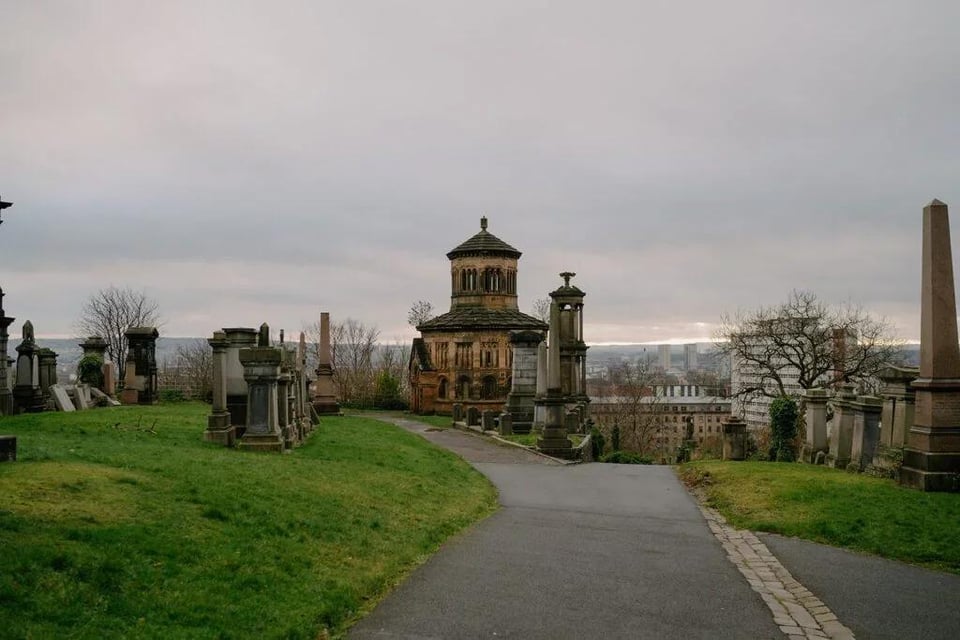
In September 1954, something broke the collective psyche of the children in the Gorbals district of Glasgow. It wasn't a movie, and it wasn't a shared dream. It was a full-scale, three-night-long armed mobilization in a Victorian cemetery that ended with police intervention and a change in British law.
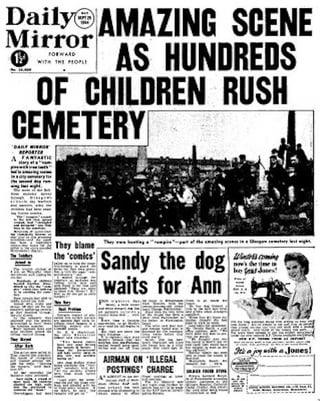
The hunt officially began on the evening of September 23, when PC Alex Deeprose was called to the Southern Necropolis. He expected vandals or a few loitering teens, but instead, he found an almost apocalyptic scene: hundreds of children, aged 4 to 14, swarming the gravestones. They weren't playing. They were armed with kitchen knives, sharpened wooden stakes, bricks, and even axes. Some had brought their dogs, and they were there with one clear purpose: to kill a monster.
The rumor had spread through the playgrounds like a virus, whispering of a seven-foot-tall vampire with "iron teeth" that had allegedly snatched and devoured two local boys. The setting itself was pure nightmare fuel; right behind the cemetery stood the "Dixon's Blazes" steelworks, turning the night sky a hellish orange. Thick, sulfurous smoke rolled over the crumbling Victorian tombs, and whenever the steelworks flared, strange shadows leaped across the graves. To a terrified 8-year-old in 1954, every shifting silhouette in that chemical fog was the Vampire incarnate.
Looking back as a researcher, I find the description of the "iron teeth" fascinating because it reveals a deeper layer of folklore than just a comic book story. While the press at the time blamed "corrupting" American horror comics like Tales from the Crypt, the reality was rooted in the industrial soul of Glasgow. The Gorbals was a place of grinding poverty and massive iron foundries, where the "Iron Man" was a local boogeyman used by parents for generations. Add to this the Biblical "fourth beast" from the Book of Daniel with its "great iron teeth," and the old nursery rhyme of "Jenny wi' the Airn Teeth," and you have the perfect recipe for a modern myth.
This hunt lasted for three nights and only stopped when the rain finally washed away the adrenaline. The resulting national scandal led directly to the Children and Young Persons (Harmful Publications) Act 1955, as the government literally banned "repulsive" comics, fearing they could trigger mass hysterical uprisings.
But the real question remains for this community: No children were actually missing, and no bodies were ever found. So, what did hundreds of kids actually see in that sulfurous fog? Was it just a "magical realist" moment of mass hysteria triggered by industrial pollution and old nursery rhymes, or did the collective fear of a neighborhood manifest something darker in that necropolis? Can mass hysteria "create" a temporary tulpa or an egregore in a high-stress environment like 1950s Glasgow?
I’ve explored these types of collective manifestations and energy forms in my own research, and I’d love to hear your thoughts on whether the "Gorbals Vampire" was a product of the mind—or something that stepped out of the fog for a few nights in 1954.
by bortakci34