
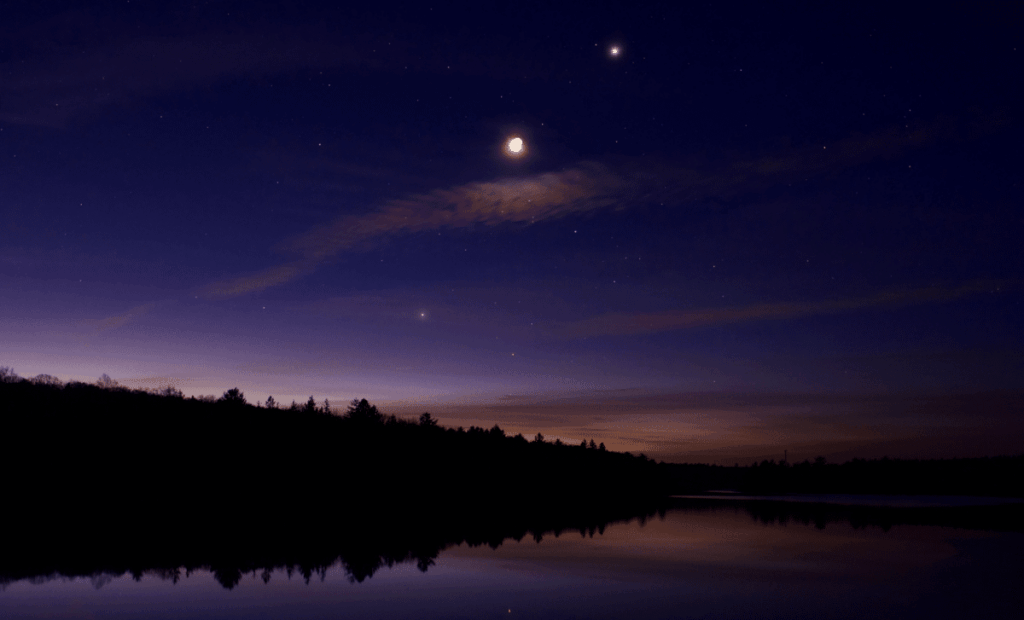
As April ushers in clearer skies, two dazzling celestial bodies, Venus and Jupiter, are taking center stage in the evening sky, offering stargazers an unforgettable view. These two planets will remain visible for several hours after sunset, making them easily observable from various locations across the globe. With Venus shining low in the west-northwest and Jupiter soaring high in the south-southwest, this month offers prime opportunities for both amateur and seasoned astronomers alike to witness a planetary show like no other.
Venus and Jupiter: April’s Star Performers
April presents one of the most spectacular opportunities for planetary observation, thanks to the striking positions of Venus and Jupiter in the evening sky. Venus, often referred to as the “sister planet” due to its similarities to Earth, continues to ascend higher each week throughout the month. According to Space.com, it will appear about 10 degrees above the horizon 45 minutes after sunset. Its position makes it one of the easiest planets to spot without specialized equipment, casting a brilliant light visible even in suburban skies. As Venus moves closer to the horizon over the coming months, its crescent shape will become more apparent through binoculars and telescopes.
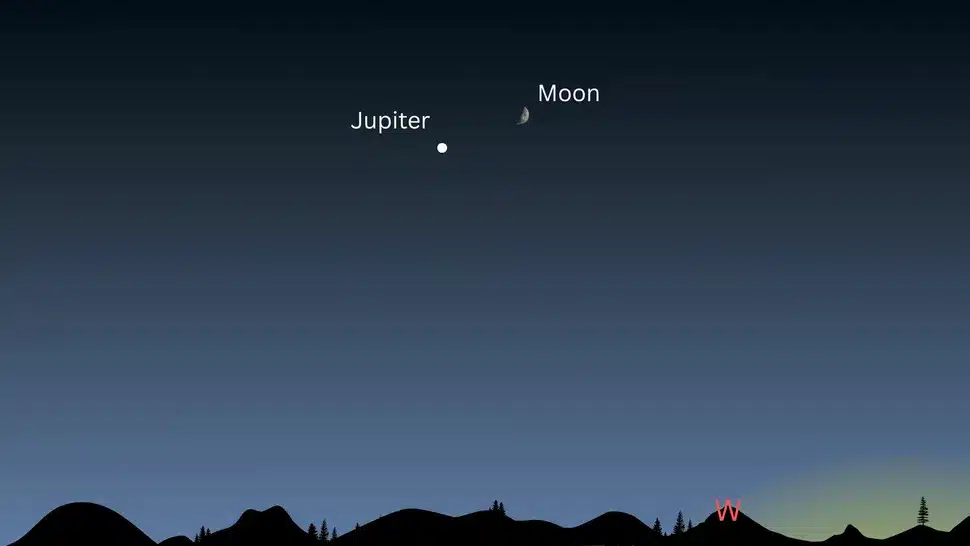 Approximate location of the moon and Jupiter on April 22.
Image credit: Joe Rao created in Canva Pro
Meanwhile, Jupiter, the largest planet in our solar system, will be the first star-like object to appear at dusk. High in the south-southwest, this gas giant will remain visible until well after midnight, making it a prominent feature in the evening sky. For observers with telescopes, Jupiter offers a stunning view of its cloud bands and four largest moons, Io, Europa, Ganymede, and Callisto, visible as bright dots orbiting the planet. On April 22, Jupiter will be accompanied by a crescent moon, creating a picturesque view that should not be missed.
Mercury and Mars: The Morning Planets
While Venus and Jupiter dominate the evening, other planets like Mercury and Mars will make their mark during the early morning hours. Mercury, currently at its greatest western elongation on April 3, is best seen just before sunrise. From mid-northern latitudes, it will be located about 10 degrees south of due east. However, only skywatchers in the Southern Hemisphere will be able to spot this elusive planet with the naked eye due to its low position on the horizon.
Mars, with a magnitude of +1.2, is more challenging to spot due to its location near the horizon during twilight. By mid-April, Mars will gradually become more visible to observers closer to the tropics. On April 16, a special event will occur when Mercury, Mars, Saturn, and a narrow crescent moon align before sunrise, an exciting opportunity for those with binoculars to catch a glimpse of these celestial bodies together.
A Spectacular Month for Stargazing
With so many planets visible at different times of the day, April offers an extraordinary window for stargazing enthusiasts to explore the cosmos. Whether you’re a beginner or an experienced astronomer, the opportunities to see Venus, Jupiter, Mercury, and Mars are not to be missed. These planets, each with their unique characteristics, give us a chance to connect with the vast universe beyond our world.
In addition to the planetary events, stargazers can also enjoy the sight of Venus passing near the Pleiades star cluster on April 23, creating a breathtaking spectacle visible through binoculars. This event provides an excellent opportunity for even casual observers to get an up-close look at two celestial objects that rarely align so closely.