
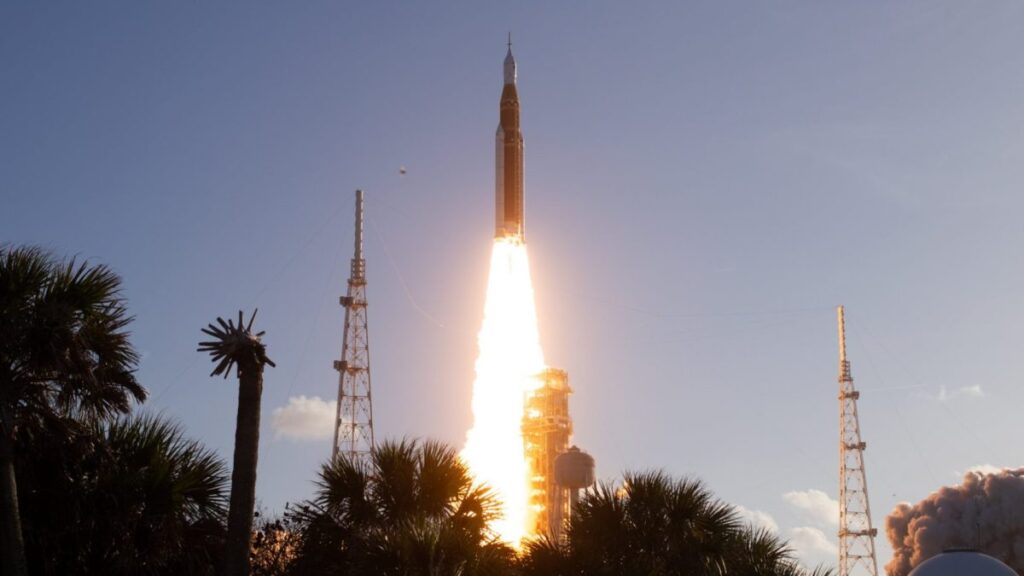
Four people will go further from Earth on Monday than anyone has been before – and they will be beyond contact or help.
For 40 nail-biting minutes the astronauts on Nasa’s Artemis II mission to fly round the far side of the Moon will be out of reach of any signal from or to Earth.
Radio signals cannot pass through the Moon so the astronauts will have no means of communication with Earth, but they hope to bring back invaluable information.
The crew of the Orion spacecraft – Nasa astronauts Reid Wiseman, Victor Glover, and Christina Koch, and Canadian Space Agency astronaut Jeremy Hansen – will also advance the longer-term goals of the Artemis programme, which include landing on the Moon and setting up a permanent base there.
The Moon always presents the same face to the Earth and it is this near side that all previous crewed lunar missions have explored. The far side is sometimes inaccurately called the dark side, although it gets the same amount of sun as the near side.
Orion‘s astronauts don’t go fully “behind” the Moon from Earth’s perspective until shortly before midnight on Monday but they are already seeing it from new angles.
They have shared a photograph they took of a large plain called the Orientale basin, which Nasa said was the first time the entire basin has been seen with human eyes. “Something about you senses that is not the Moon that I’m used to seeing,” Koch said.
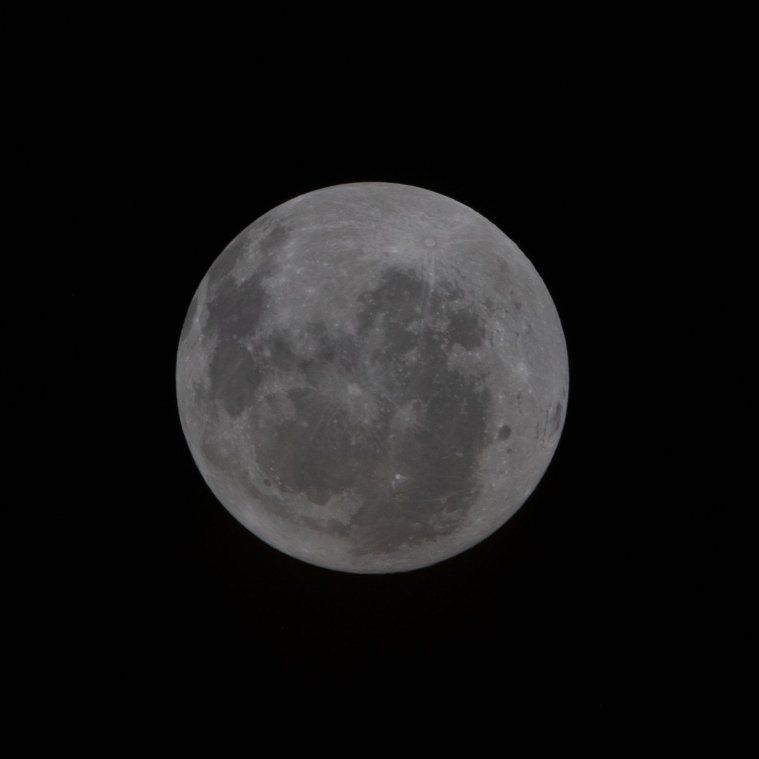 The Orientale basin is the small dark patch at the right of the disk (Photo: NASA)
The Moon always shows us the same face because, soon after it formed, gravitational forces between the Moon and the Earth slowed down the Moon’s spin until it was locked in synchrony with the Earth. The satellite takes about 27 days both to orbit the Earth and to spin on its own axis.
Such “tidal locking” has happened with all the large moons orbiting other planets in the solar system.
The far side of the Moon is different from the more familiar near face in several ways. It has a thicker crust, the interior is colder, and it seems to have been less volcanically active during the Moon’s early history.
That’s why the near side of the Moon has more dark patches – they were once seas of molten lava, when volcanic activity caused lava to erupt on to the surface and spread out to fill huge craters left by asteroids and comets smashing into the Moon when it was younger.
Dark patches were once called lunar seas because 17th century astronomers thought that is what they were.
There are several theories about why the Moon’s two sides are so different. The Moon formed when a planetary body about the size of Mars smashed into and merged with the nascent Earth about 4.5 billion years ago, ejecting a large mass that coalesced into the Moon.
At first the Moon was much closer to Earth, about a tenth of its current distance, and the Earth was still incredibly hot, at more than 2,500°C. This meant that the near side took longer to cool down than the far side, leading to a thicker crust on the far side, because of the way the elements condensed.
The near side may also have remained hotter for longer because of the tug of Earth’s gravity. And it may also have more radioactive elements, like uranium, which give off heat.
New FeatureIn ShortQuick Stories. Same trusted journalism.
Orion‘s flight is not the first journey to the Moon’s far side, though. Several of the Apollo missions that began in the 1960s also orbited the Moon and more recently, the Chinese have sent an uncrewed spacecraft that landed on the far side and returned rock samples to Earth.
Rocks from the far side of the Moon collected by China’s Chang’e 6 spacecraft have shed further light on the temperature differences between the two sides. They were found to have formed in the interior three billion years ago at a temperature of about 1,100°C – that’s 100°C cooler than similar rocks collected from the near side.
“These findings take us a step closer to understanding the two faces of the Moon,” said Xuelin Zhu, a PhD student at Peking University, who helped compare the samples. “They show us that the differences between the near and far side are not only at the surface but go deep into the interior.”