
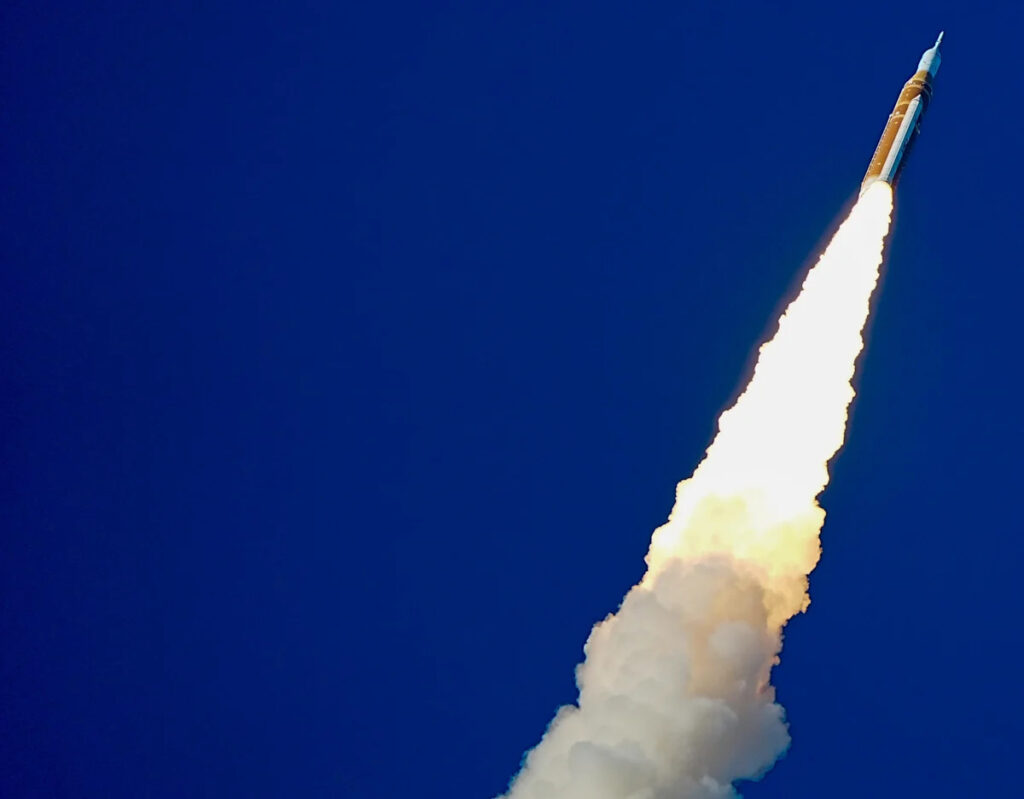
The world tuned in to the Artemis II launch in Florida, with NASA’s Space Launch System rocket sending four astronauts on a 10-day journey orbiting the moon.
The crew members – NASA astronauts Reid Wiseman, Christina Koch and Victor Glover, and the Canadian Space Agency’s Jeremy Hansen – are expected to venture farther in space than anyone in human history.
After launch on April 1, 2026, from Kennedy Space Center near Cape Canaveral, Florida, all eyes are still on the Artemis II crew. What is on the agenda for Day 4 of the 10-day mission? Where is Artemis II crew now? See below.
Primarily considered a test mission, Artemis II could represent a giant step toward NASA’s goal of returning astronauts to the lunar surface for the first time since the Apollo missions came to an end in 1972. The mission, expected to last about 10 days, is a critical demonstration that NASA’s Orion crew capsule can handle a lunar mission with humans aboard before a landing is attempted as early as 2028.
So, what happens now and until splashdown? Here’s a summary and schedule for the Artemis II crew’s 10-day journey around the moon in the Orion capsule.
What’s next for Artemis II? Mission milestones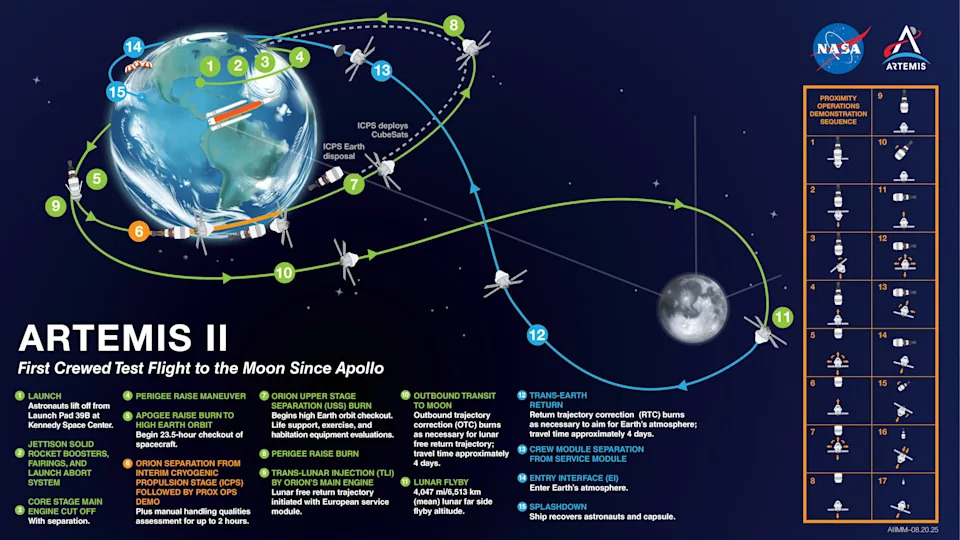
This NASA graphic illustrates the path of the Artemis II mission.
Here’s a look at the main mission milestones of Artemis II, beginning with launch, according to NASA.
Wednesday, April 1, 2026, launch: NASA makes history with its Artemis II launch from Kennedy Space Center in Cape Canaveral, Florida. Liftoff occurred at 6:35 p.m. ET Wednesday, April 1, with four NASA astronauts, including three Americans and one Canadian.
Thursday, April 2, 2026, perigee raise burn: Lingering in high-Earth orbit, the astronauts prepared Orion for a maneuver to raise the vehicle’s perigee – an astronomical term referring to the point at which an object is nearest to Earth in its continuous orbit. The move set the stage for a translunar injection burn by Orion’s main engine − an additional engine firing to get Orion into the correct orbital geometry.
Thursday, April 2, 2026, translunar injection: The translunar injection burn propelled Orion on a path beyond Earth’s orbit and toward the moon. The maneuver also doubled as Orion’s deorbit burn, setting the stage for it to be on the correct trajectory to reenter Earth’s atmosphere for a water landing in the Pacific Ocean.
Friday, April 3, to Saturday, April 4, 2026, outbound transit to the moon: NASA’s Artemis II crew was on a four-day journey to the moon, during which Orion will intermittently fire its engines to ensure it remains on the correct path. Simply stated, this is the time in space before they head to their destination.
Sunday, April 5, 2026, lunar sphere of influence: The Artemis II crew will enter the lunar sphere of influence, where the pull of the moon’s gravity will become stronger than the pull of the Earth’s gravity.
Monday, April 6, 2026, lunar flyby: If all goes according to schedule, Artemis II is due to reach the moon and make a historic lunar flyby. Flying up to 6,000 miles above the surface, the crew is expected to lose communication with the Earth for anywhere from 30-50 minutes. However, for about six hours, they will take photos and video of the moon’s far side and make observations to be shared with scientists on the ground after they regain communication.
Tuesday, April 7 to Thursday, April 9, 2026, trans-Earth return: The astronauts will then make a four-day journey back to Earth, using our planet’s gravity to naturally “slingshot,” or pull Orion back home, negating the need for propulsion or much fuel. As on the journey to the moon, Orion’s service module is expected to fire, or burn, its engine up to three times to refine the trajectory and ensure the crew is set up for a safe splashdown. During that time, a radiation shield test and a manual piloting demonstration is set to take place.
Thursday, April 9, 2026, trans-Earth return, entry interface: second of three return trajectory correction burns. The Artemis II crew module’s “reaction control system engines will steer the heatshield into the direction of travel to prepare for peak heating. While still 400,000 feet – almost 76 miles – above Earth, Orion will begin to feel the effects of the Earth’s atmosphere for the first time since launch. Within a matter of seconds, superheated plasma will begin to build up around the spacecraft as the friction of the surrounding atmosphere increases. Orion will experience temperatures around 3,000 degrees Fahrenheit, and communications with the crew will be temporarily blocked by the plasma.”
Friday, April 10, 2026, reentry and potential splashdown! The Orion capsule will reenter Earth’s atmosphere as its service module responsible for propelling and maneuvering the vehicle through space will separate and burn up. That maneuver exposes the crew module’s heat shield, protecting the astronauts from the 3,000-degree Fahrenheit conditions the vehicle will endure. Orion will then make a parachute-assisted water landing estimated for Friday, April 10, in the Pacific Ocean near California off the coast of San Diego. After the landing, the Artemis II crew would exit the vehicle on to a U.S. Navy recovery vessel.
Where is Artemis II now? Location tracker
Want to follow the astronauts along the Artemis II lunar journey? NASA has an Artemis II tracker available online and on its mobile app that allows users to see where Orion is, how fast it’s traveling and how far the spacecraft is from both the Earth and the moon.
The mobile version for smartphones even includes an augmented reality feature that allows users to move their phones to see where Orion is relative to Earth.
Who are the Artemis II astronauts?
The crew members of Artemis II includes NASA astronauts Reid Wiseman, Christina Koch and Victor Glover, and the Canadian Space Agency’s Jeremy Hansen.
The mission will make Glover the first Black man to venture within the vicinity of the moon, while Koch will become the first woman and Hansen the first Canadian to do so.
All three Americans are experienced astronauts who have been to space before on ventures to the International Space Station, while Hansen, a veteran aviator, is making his first spaceflight.
Eric Lagatta is the Space Connect reporter for the USA TODAY Network. Contact him at elagatta@usatodayco.com. Subscribe to the free Florida TODAY newsletter.
This article originally appeared on Florida Today: Artemis II schedule, tracker. When does NASA crew reach moon, head home?