
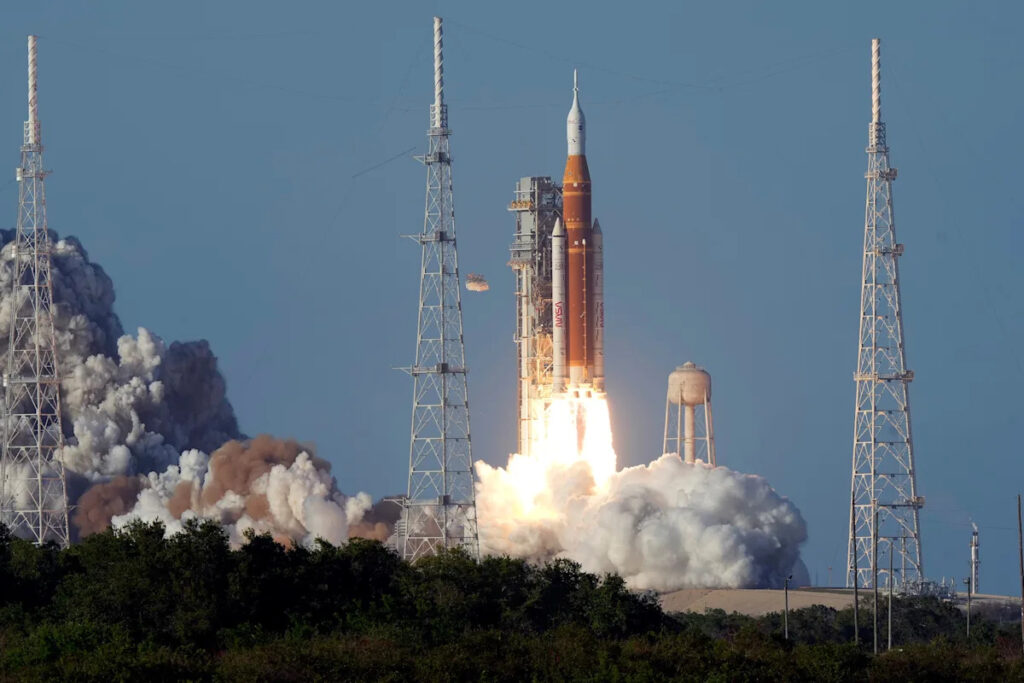
After weeks of delays, NASA launched the Artemis II into space on Wednesday, the start of a 10-day journey that will take its four-member crew around the moon and back.
The Artemis II lifted off from pad B at Kennedy Space Center in Cape Canaveral, Fla., at 6:35 p.m. ET. Twin solid rocket boosters, which provided 80% thrust, detached two minutes into the flight, and the shuttle entered Earth’s orbit nine minutes after takeoff.
The astronauts — NASA commander Reid Wiseman, pilot Victor Glover, mission specialist Christina Koch and Canadian space agency mission specialist Jeremy Hansen — were safe, secure and “in great spirits,” NASA Administrator Jared Isaacman said during a postlaunch press conference.
Wiseman told NASA controllers on the ground that the crew could see their destination.
“We have a beautiful moonrise, we’re headed right at it,” he said.
What is the goal of the Artemis II mission?
Artemis II crew members, from right, Reid Wiseman, Victor Glover, Christina Koch and Canadian Space Agency astronaut Jeremy Hansen.
(Aubrey Gemignani/NASA)
The Artemis II is the first U.S. human lunar spaceflight in over 50 years, marking a “key step toward long-term return to the moon and future missions to Mars,” according to NASA.
The four astronauts on Artemis II won’t be landing on the moon; instead, they’ll venture 600,000 miles around the moon and will return at 30 times the speed of sound, according to NASA. During their 10-day trip, the astronauts will collect critical information for those future missions, including conducting experiments as “both scientists and test subjects” to help scientists understand how long-distance space travel may affect the human body.
They will test life-support systems in the Orion capsule for future crewed missions to the moon’s surface. A moon landing would occur during Artemis III, which NASA is hoping to launch sometime in 2027.
“The information we learn from the Artemis II test flight will inform future missions and help NASA pave the way for the next era of exploration on the moon and Mars,” the agency said in a video posted to social media.
NASA’s long-term goal is to return humans to the moon to establish a continuous human presence and develop a lunar settlement on the south pole, a region where it’s believed water ice is abundant and could be used for drinking and breathing and as a source for rocket fuel.
Artemis’s long-term mission is to also lay the foundation for future crewed missions to Mars. The program is building on the legacy of the Apollo-era missions to the moon in the late 1960s and early ’70s. The Artemis program is named after the ancient Greek goddess of the moon, twin sister of Apollo.
Where is Artemis II now, and when will it reach the moon?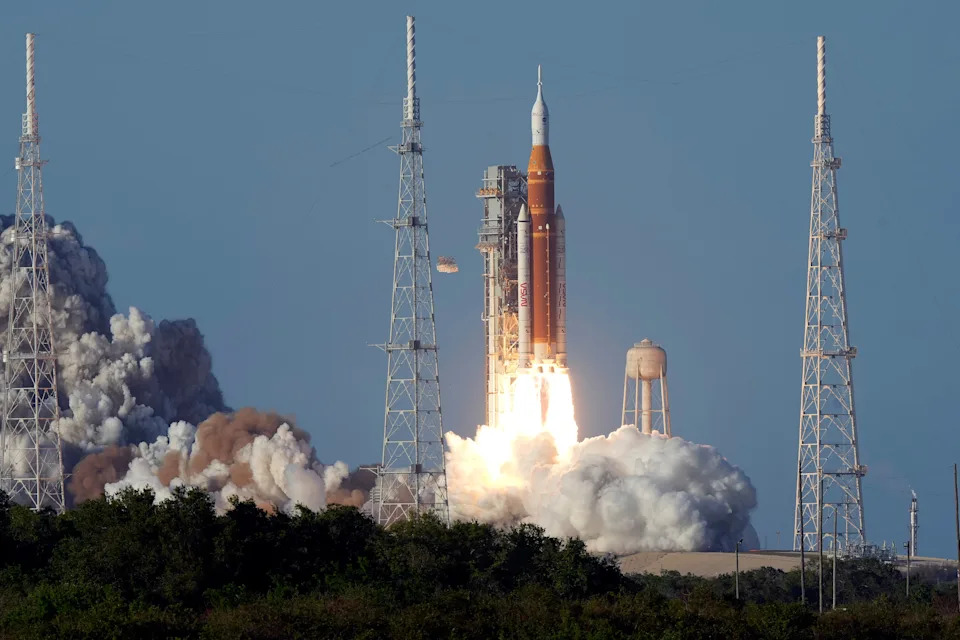
NASA’s Artemis II lifts off from the Kennedy Space Center in Cape Canaveral, Fla., on April 1.
(ASSOCIATED PRESS)
According to the latest flight update from NASA, the Orion fired its main engine for nearly six minutes to complete the “translunar injection (TLI) burn,” sending the crew out of Earth’s orbit and on a trajectory toward the moon.
If all goes well, the Orion will reach the moon on April 6, according to NASA.
During a six-hour flyby window, the crew members will observe the moon’s surface to “help scientists understand how the Moon and solar system formed,” per NASA.
And they’ll witness a solar eclipse, giving them “an opportunity for them to look for flashes of light from meteoroids striking the Moon’s surface, dust lofting above the edge of the Moon, and deep space targets, including planets,” NASA said.