
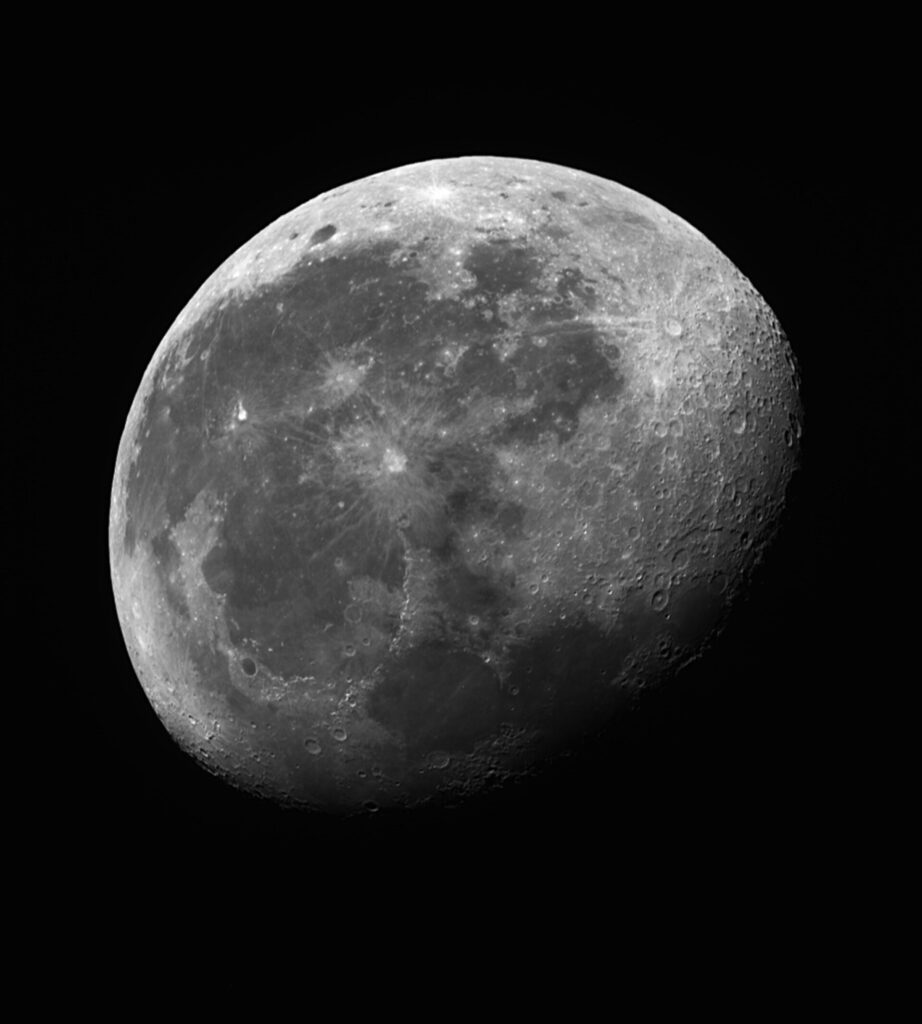
In an unusual perspective for an Earth-observing satellite, the Copernicus Sentinel-2 mission captures this image of Earth’s only natural satellite.
The Sentinel-2 mission acquired this lunar image by rolling one of its satellites sideways to view the Moon instead of Earth. This is part of a regular calibration process, whereby the stable intensity of the Moon’s light makes it possible to detect and correct even the smallest changes in the performance of Sentinel-2’s instrument. This ensures data accuracy throughout the mission, which is critical for its applications.
Of course, Sentinel-2 is not the only mission that is focusing on the Moon in these days. The Artemis II mission, launched yesterday from the Kennedy Space Center in Florida, US, is travelling around the Moon with four astronauts on board. The mission will bring them to within a few thousand km of the Moon, giving them a unique view of the lunar surface, including some areas that have never before been seen by human eyes.
With an impressive resolution of around 5 km, this image features some famous landmarks, including the Tycho, Copernicus and Kepler craters, and the seas of Rain, Serenity and Tranquillity. The Tycho Crater is the large, pale, impact crater at the top-right of the Moon in this image. The Sea of Tranquillity is where the Apollo 11 mission touched down in 1969, placing the first humans on the lunar surface. The last crewed mission, Apollo 17, landed in the Taurus-Littrow valley in between Serenity and Tranquillity.
With the launch of the Artemis II mission, the Moon is once again in the spotlight, and Europe’s contribution is essential. For 10 days, the Orion spacecraft and its crew will be powered by ESA’s European Service Module, which propels and sustains life on this historic journey, the first of its kind since Apollo 17 in 1972, over half a century ago.