
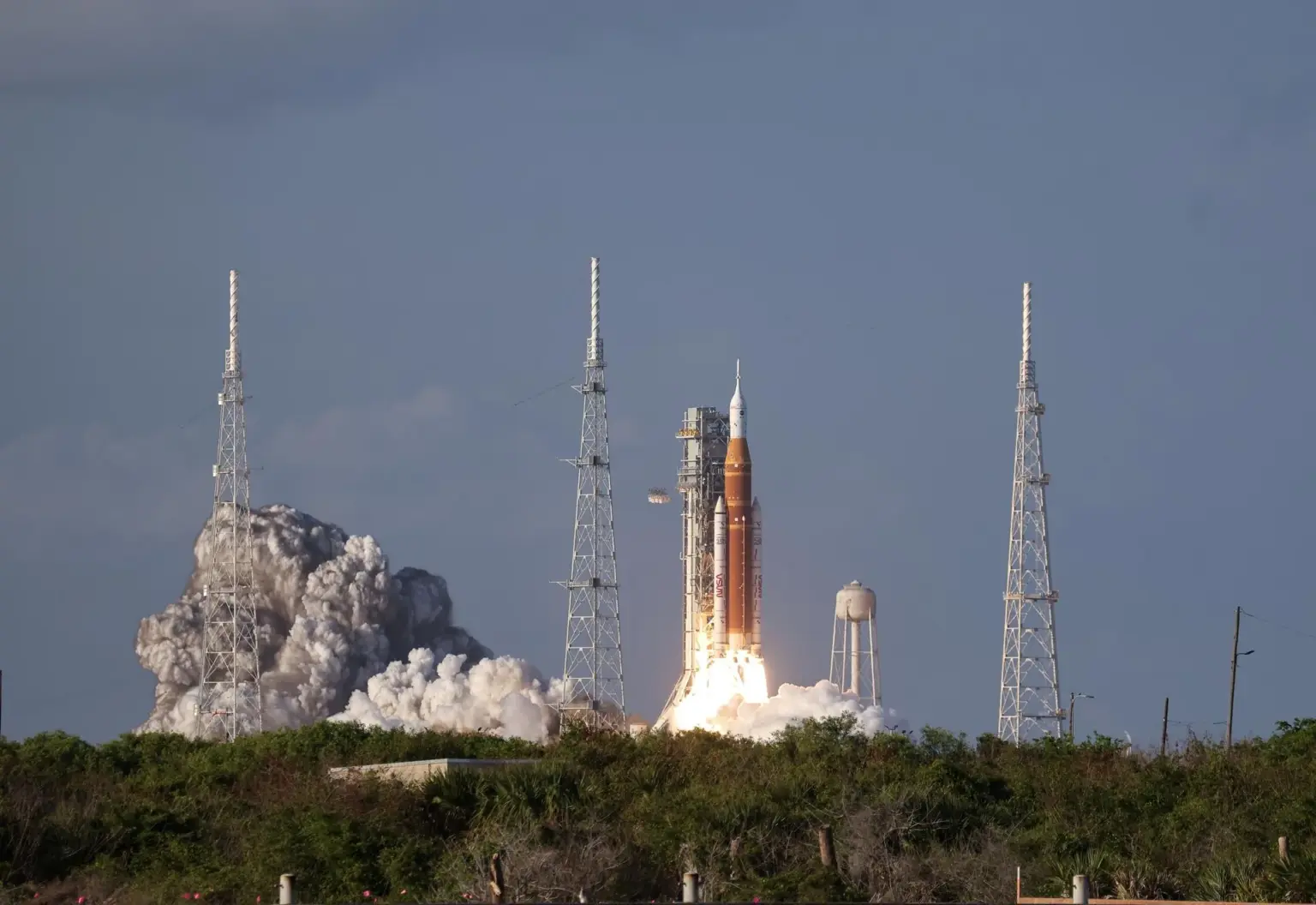
Miami, US (EFE).- The National Aeronautics and Space Administration (NASA) authorized on Thursday the initiation of the Artemis II Orion capsule’s journey to the Moon, scheduled for 25 hours after liftoff from Cape Canaveral (Florida, United States). This is the next critical step in the mission, which anticipates returning humans to lunar orbit for the first time in over half a century.
“NASA’s Artemis II mission management team polled ‘Go’ for the translunar injection burn to send the crew in the Orion spacecraft toward the Moon,” stated NASA in its live mission updates.
The maneuver is scheduled for 7:49 pm Eastern Time and will last five minutes and 49 seconds.
The space administration detailed that “Orion’s main engine provides up to 6,000 pounds of thrust, enough to accelerate a car from 0 to 60 mph in about 2.7 seconds.”
Earlier on Thursday, NASA Administrator Jared Isaacman reported that the four Artemis II astronauts were «doing great» while orbiting the Earth, a necessary step before they evaluated whether to continue their journey to the Moon or abort the mission.
«Artemis II astronauts are doing great. The Orion spacecraft is performing well in an impressive elliptical orbit, and the @NASA_Johnson Mission Control team (at the Johnson Space Center in Houston) is taking good care of the crew,» Isaacman posted on his X account.
First day in space
The crew spent their first day in space, following their launch, circling the Earth to verify the spacecraft is ready for the trans-lunar injection that would propel them out of Earth’s orbit toward the Moon, a trip that would take four days.
The ground team at NASA woke the crew with the song ‘Sleepyhead’ by the band Young & Sick at 7:06 am Eastern Time, after a brief rest period, nearly 12 hours after the launch, according to the space agency.
If successful, the crew will reach the far side of the Moon next Monday, April 6, and will then achieve the farthest point in deep space that any humans have ever traveled, more than 400,000 kilometers from Earth.
The NASA Administrator recalled that this mission represents another step for the Artemis program, which expects to perform another crewed launch into low Earth orbit in 2027 and two human missions that will land on the Moon in 2028.
«Back at @NASAKennedy (in Cape Canaveral), the teams are out at the pad getting ready for what comes next. We are going to get into a rhythm of launching Moon rockets around here,» concluded Isaacman.
The crew consists of Commander Reid Wiseman, Specialist Christina Koch, and Pilot Victor Glover, all three from NASA, as well as Jeremy Hansen, from the Canadian Space Agency (CSA).
Artemis seeks to initiate a permanent US presence on the natural satellite with a base, in addition to laying the groundwork for the exploration of Mars. EFE
ppc-hbc-ims/dmv