
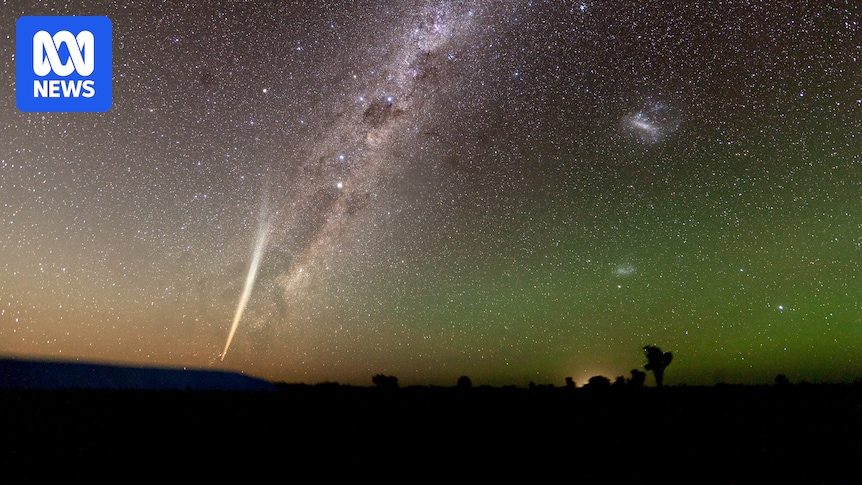
Australians could be treated to not one, but two, comets this month — but only if the icy objects don’t melt on their journey around the Sun.
The first comet is about to hurtle past the Sun this weekend. If it makes it to the other side, it could put on a spectacular show from April 7.
Even if this comet doesn’t survive, there will be another comet in the evening skies later in the month.
Amateur astronomer Michael Mattiazzo said there was a small chance both comets could be visible at the same time, which would be an “extremely rare event”.
How to see the April comets
If the first comet, known as C/2026 A1 MAPS, doesn’t disintegrate this weekend, it may be visible with the naked eye from April 7 for about a fortnight.
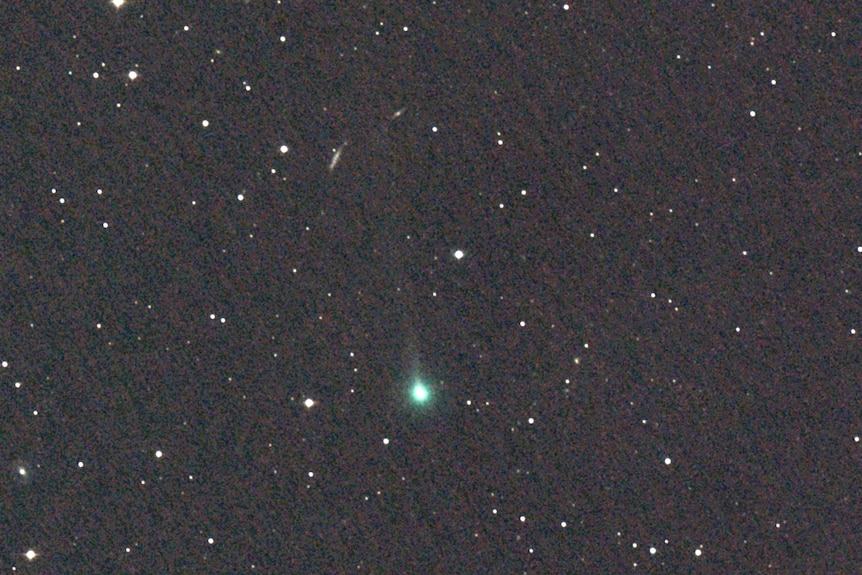
Before it got too close to the Sun in late March, Mr Mattiazzo was able to snap some photos of comet A1 MAPS through a telescope. (Supplied: Michael Mattiazzo)
The second comet, C/2025 R3 PanSTARRS, will be visible from April 30 onwards, and is much more likely to survive but will be dimmer.
Brad Tucker, an astrophysicist at the Australian National University, says it’s unlikely we’ll see both comets at once.
But, he says, the best time to catch a glimpse of each comet will be shortly after sunset, just above the western horizon.
“Look low to the horizon after the Sun’s set,” Dr Tucker advises.
“If you can see where the Sun sets, the comet’s not going to be too far from that.”
To get the best view, he advises trying to find somewhere away from large sources of artificial light and to bring binoculars.
You’ll also need to be patient, as it may take a few days for each comet to become visible.
What are the chances Comet A1 MAPS will survive?
The first comet, C/2026 A1 MAPS, is travelling extremely close to the Sun — and that makes its fate unpredictable.
At its closest point, called perihelion, the comet will be about 857,000 kilometres from the centre of the Sun, and 161,000km above its surface: less than half the distance between the Earth and the Moon.
This proximity could cause the comet to heat up and break apart, as the ice inside its body turns to gas and becomes unstable.
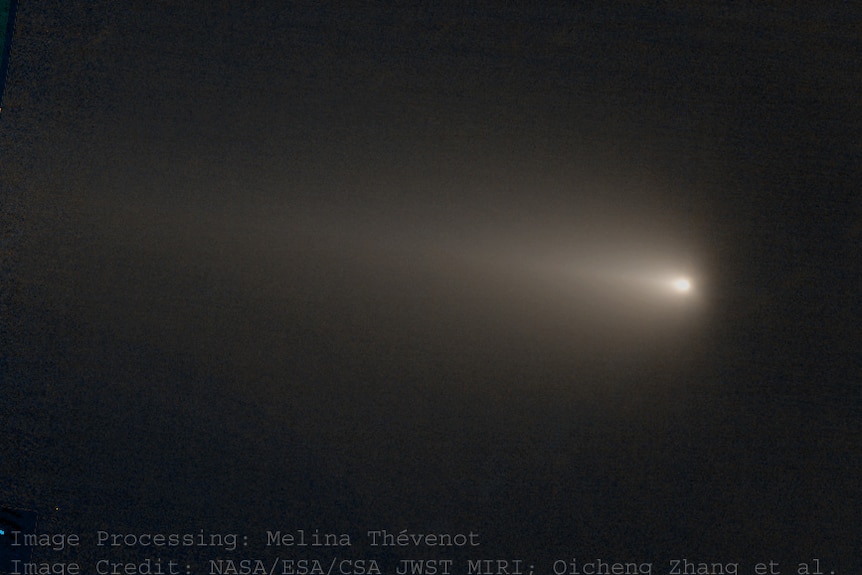
Researchers have examined comet A1 MAPS with the James Webb Space Telescope’s MIRI instrument, finding it was about 400m in diameter. (Supplied: NASA/ESA/CSA JWST MIRI, Qicheng Zhang et al., Melina Thevenot, CC BY-SA 4.0)
Mr Mattiazzo puts the comet’s chances of survival at “less than 50 per cent”.
But don’t write it off just yet; comets like this have made for good viewing before.
Comet Lovejoy (C/2011 W3 Lovejoy), for example, put on a stunning show in December 2011.
“We gave it no chance of surviving, but then it managed to survive just for a few days after its approach to the Sun and ended up showing a spectacular tail a week later,” says Mr Mattiazzo.
Comet A1 MAPS was first detected in January this year, and is thought to belong to a group known as “Kreutz sungrazers”.
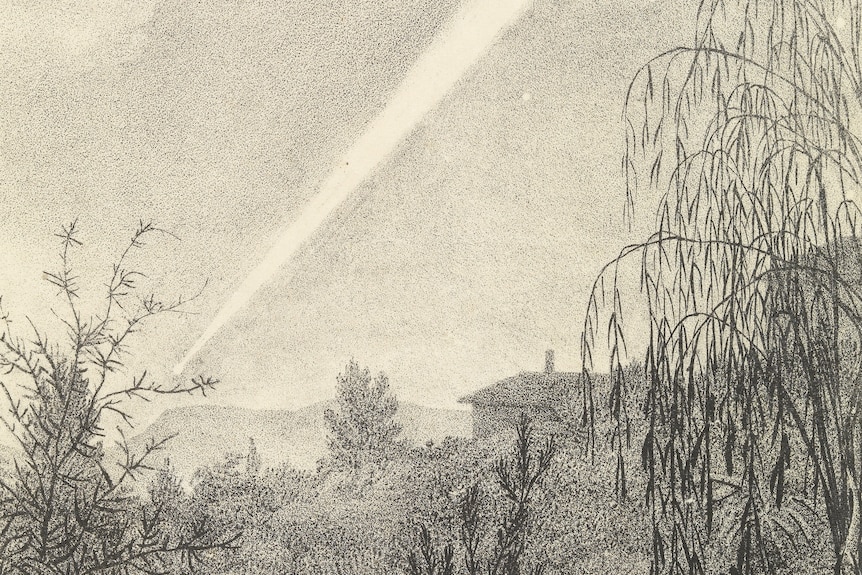
Kreutz sungrazers are particularly easy to see from the southern hemisphere because of their orbital paths, such as this one which was drawn from Tasmania in 1843. (Mary Morton Allport via Libraries Tasmania)
Kreutz sungrazers are named after a German astronomer who first detected a group of bright comets in the 1800s.
“Kreutz proposed that they were all related, suggesting that they were fragments of a single progenitor comet that was witnessed by the Greek philosopher Aristotle in 371 BC,” says Mr Mattiazzo who has discovered several comets.
These comets include some of the greatest comets of all time, and follow a similar orbit which sees them graze the Sun roughly every 800 years.
But there’s a price to pay for coming so close to the Sun.
As Dr Tucker says: “these comets are a high-risk, high-reward game”.
How bright could it get?
If the comet doesn’t break up, its proximity to the Sun will make it very bright.
At its brightest, it could have an apparent magnitude of nearly -3, with better visibility than the sky’s brightest stars.
But Jonti Horner, an astrophysicist at the University of Southern Queensland, says the comet’s light has faltered in recent weeks, with it failing to brighten to predicted levels.
“That all suggests something has gone wrong — either the comet has run out of volatile material, is falling apart, or otherwise dying,” Professor Horner says.
“We can’t be sure — there is always a chance it will improve again. But I think it unlikely now.”How to check what’s happening with the comet this weekend
You can check Comet A1 MAPS’ passage past the Sun this weekend by looking at real-time images from NASA and the European Space Agency’s Solar and Heliospheric Observatory (SOHO) spacecraft, which orbits and monitors the Sun.
The comet will pass through the satellite’s field of view from about 5am AEDT this Friday (April 3), through to 1pm AEST on Monday (April 6) — assuming it doesn’t break up before.
If it’s still clearly visible in SOHO’s imagery after its closest point to the Sun on Sunday morning, Mr Mattiazzo says it will be time to “pop the champagne bottles”.
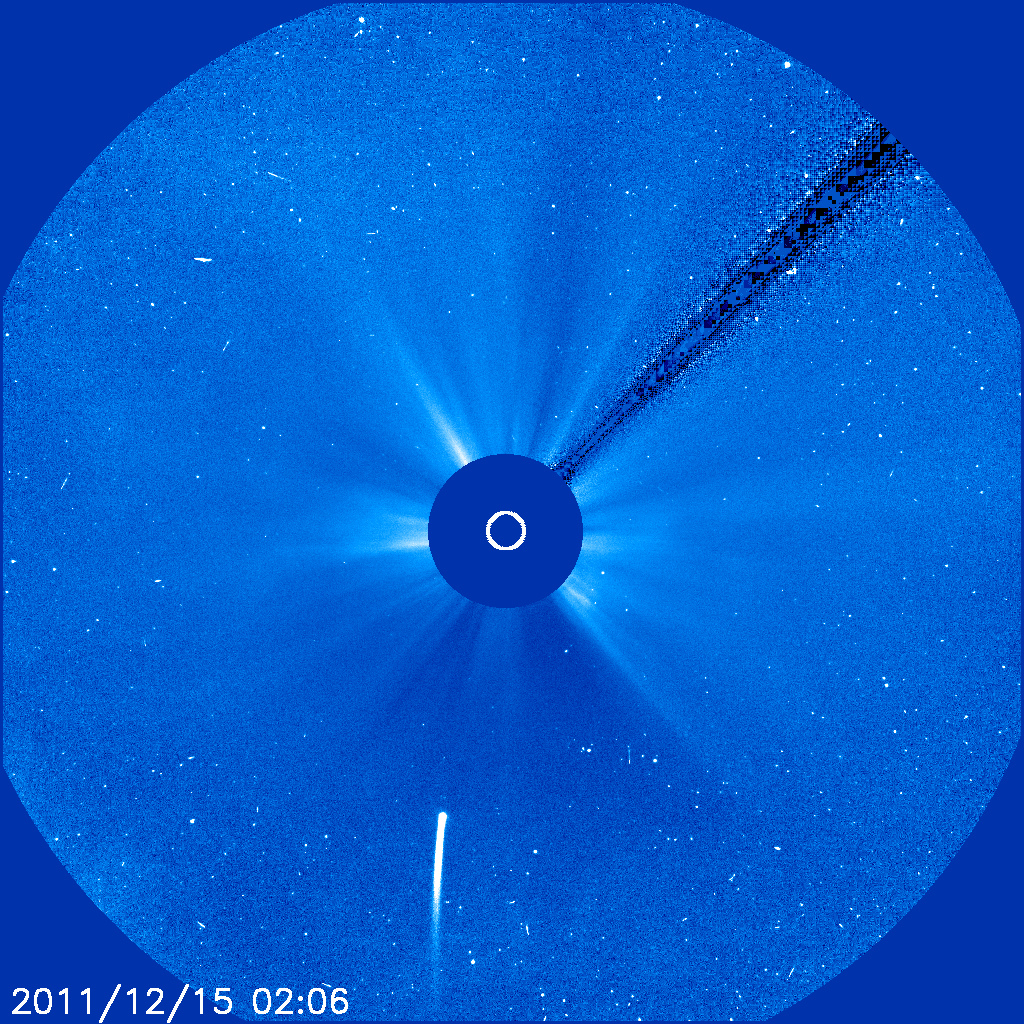
The SOHO satellite uploads real-time images from its instruments like this to the internet. This picture, taken in 2011, catches comet Lovejoy in frame. If it survives, comet A1 MAPS will look similar. (Supplied: ESA/NASA – SOHO/LASCO)
Late April comet headed for interstellar space
If Comet A1 MAPS doesn’t make it through the weekend, the second comet, C/2025 R3 PanSTARRS is hot on its heels.
Comet R3 PanSTARRS will be much further from the Sun at its perihelion on 19 April, and is much more likely to survive its brush than the first comet, but it won’t be as bright.
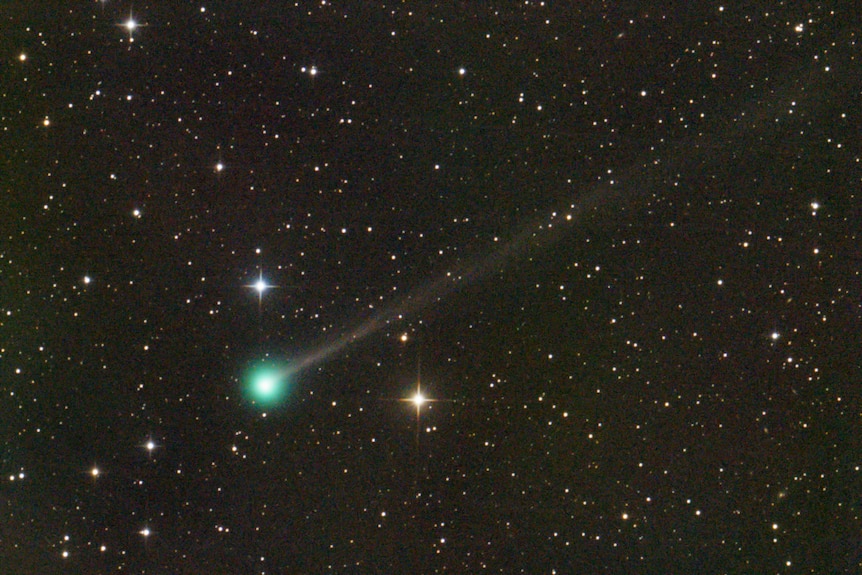
Comet C/2025 R3 (PanSTARRS) will be 74 million km from the Sun at its closest, which is about half the distance between the Sun and the Earth. (Flickr: Dimitrios Katevainis, CC BY-SA 4.0)
While it will probably peak at magnitude 5, which is visible to the naked eye, you’ll get a better view with binoculars.
“On its way out, it’s going to be perfectly located for southern hemisphere sky watchers,” Mr Mattiazzo says.
Comet R3 PanSTARRS, which was discovered last September by the Panoramic Survey Telescope and Rapid Response System (PanSTARRS) in Hawaii, probably last visited the Sun about 170,000 years ago.
But according to Professor Horner, while it’s expected to pass the Sun safely, this visit may be its last.
That’s because it is travelling so fast it may get flung out of the Solar System.
Third interstellar object detected in our Solar System
For just the third time, an interstellar object has entered our solar system
“That’s actually not uncommon — the Solar System is shedding comets to space like space dandruff and has been ever since it formed,” Professor Horner says.
But the gas and dust ejected by the comet could still change its speed and knock it off course, meaning it will continue to stay trapped in the Solar System.
“Never bet on a comet,” Mr Mattiazzo says.
“Just wait for them to surprise you.”