
Science & Exploration
02/04/2026
46 views
1 likes
‘Extreme but not exotic,’ – a glimpse at Comet 3I/ATLAS through the eyes of the European Space Agency’s Jupiter Icy Moons Explorer (Juice).
In November 2025, Juice was in the right place, at the right time, with the right equipment to observe interstellar comet 3I/ATLAS just after its closest approach to the Sun. Our mission operations teams switched on five of Juice’s science instruments to collect information about how the active comet was behaving at the time.
Following a three-month wait to receive the data on Earth, scientists working on each of these instruments have spent the last few weeks delving into the photos, spectra and numbers. Results are still preliminary, work is still ongoing, but here are five things we’ve already learned.
1. The comet was releasing 70 Olympic swimming pools of water vapour every day
On 2 November 2025, just four days after 3I/ATLAS had made its closest approach to the Sun, Juice’s Moons And Jupiter Imaging Spectrometer (MAJIS) detected that the comet was spewing out 2000 kg of water vapour every second – equivalent to 70 Olympic swimming pools per day.
Comets – true to their ‘dirty snowballs’ nickname – are mostly made of ice. As they approach the Sun, this ice turns to gas and escapes the comet. The amount of water vapour leaving 3I/ATLAS is not exceptional, but it is on the high side of what we would expect from a comet close to the Sun, based on what we have seen before in comets like 67P (300 kg per second) and Halley (20 000 kg per second).
These numbers depend a lot on the size of a comet and its distance from the Sun. MAJIS detected 3I/ATLAS again on 12 and 19 November, as it was moving away from the Sun. By 12 November, the amount of water vapour being released by the comet did not seem to have reduced significantly. The instrument team is planning to analyse the data from 19 November in the coming weeks.
Juice detected water vapour and carbon dioxide from Comet 3I/ATLAS
2. Most of this water vapour was being released in the direction of the Sun
Juice’s Submillimeter Wave Instrument (SWI) also detected water vapour from 3I/ATLAS, revealing that most of it was being released from the Sun-facing side of the comet. It also appears that a lot of this water vapour is not actually coming directly from the solid part of the comet (its nucleus), but from icy dust grains that have escaped into a surrounding halo of dust and gas (its coma).
The SWI team are continuing to look into the data to determine how much ‘light’ water (normal H2O) 3I/ATLAS is releasing. It is interesting to compare this to the amount of ‘semiheavy’ water (HDO) from the comet, which has been measured by the ALMA and Webb telescopes. This ratio is a really important number in our studies of the Universe, giving a kind of ‘fingerprint’ that describes how and where an object formed.
ALMA and Webb found this ratio to be unexpectedly and extremely high for 3I/ATLAS – possibly because the comet was born in a very cold and very ancient environment, where it was exposed to a lot of ultraviolet radiation from young stars. The SWI team is investigating whether the Juice data back up these findings.
3. Gas and dust stretch at least 5 million km from the comet’s nucleus
Juice’s Ultraviolet Imaging Spectrograph (UVS) captured light coming from oxygen, hydrogen and carbon atoms in the gas and dust surrounding and trailing behind the comet. Oxygen, hydrogen, carbon and dust emit photons of light at specific wavelengths, which UVS recorded as counts per second.
UVS saw these gas elements and dust stretching up to more than 5 million km from 3I/ATLAS’s nucleus. Gas and dust are common around active comets, with tails sometimes reaching up to 10 million km long.
Juice sees gas and dust a long way from the nucleus of 3I/ATLAS
4. This interstellar comet looks… just like a normal comet!
Juice’s high-resolution science camera, JANUS (short for ‘Jovis Amorum ac Natorum Undique Scrutator’ – or ‘Scrutiniser of Jupiter, and all his loves and descendants’) also saw 3I/ATLAS spewing gas and dust.
Comet 3I/ATLAS in different colours
Despite being over 60 million km from 3I/ATLAS, JANUS clearly reveals the coma in which the nucleus is hiding, as well as two tails. One tail stretches away from the Sun, and the other follows the path taken by the comet through the Solar System. We can also see fainter shapes within the coma and tails that indicate various processes and interactions with the radiation, particles and magnetic field from the Sun. The JANUS team is currently investigating these shapes in more detail.
Overall, JANUS shows that, despite its interstellar origin, Comet 3I/ATLAS was behaving like a typical comet from the Solar System during a close approach to the Sun.
Comet 3I/ATLAS at 180 million km
5. 3I/ATLAS is supporting our planetary defence efforts – perhaps not in the way you might think
Juice’s Navigation Camera (NavCam) is specially designed to help Juice navigate around Jupiter’s icy moons following arrival in 2031. The encounter with 3I/ATLAS allowed us to do something totally unexpected with it.
We have already used telescopes on and around Earth to estimate the location and path of Comet 3I/ATLAS through the Solar System. It seems to come from the direction of the Milky Way’s disc, and was therefore likely created more than 10 billion years ago.
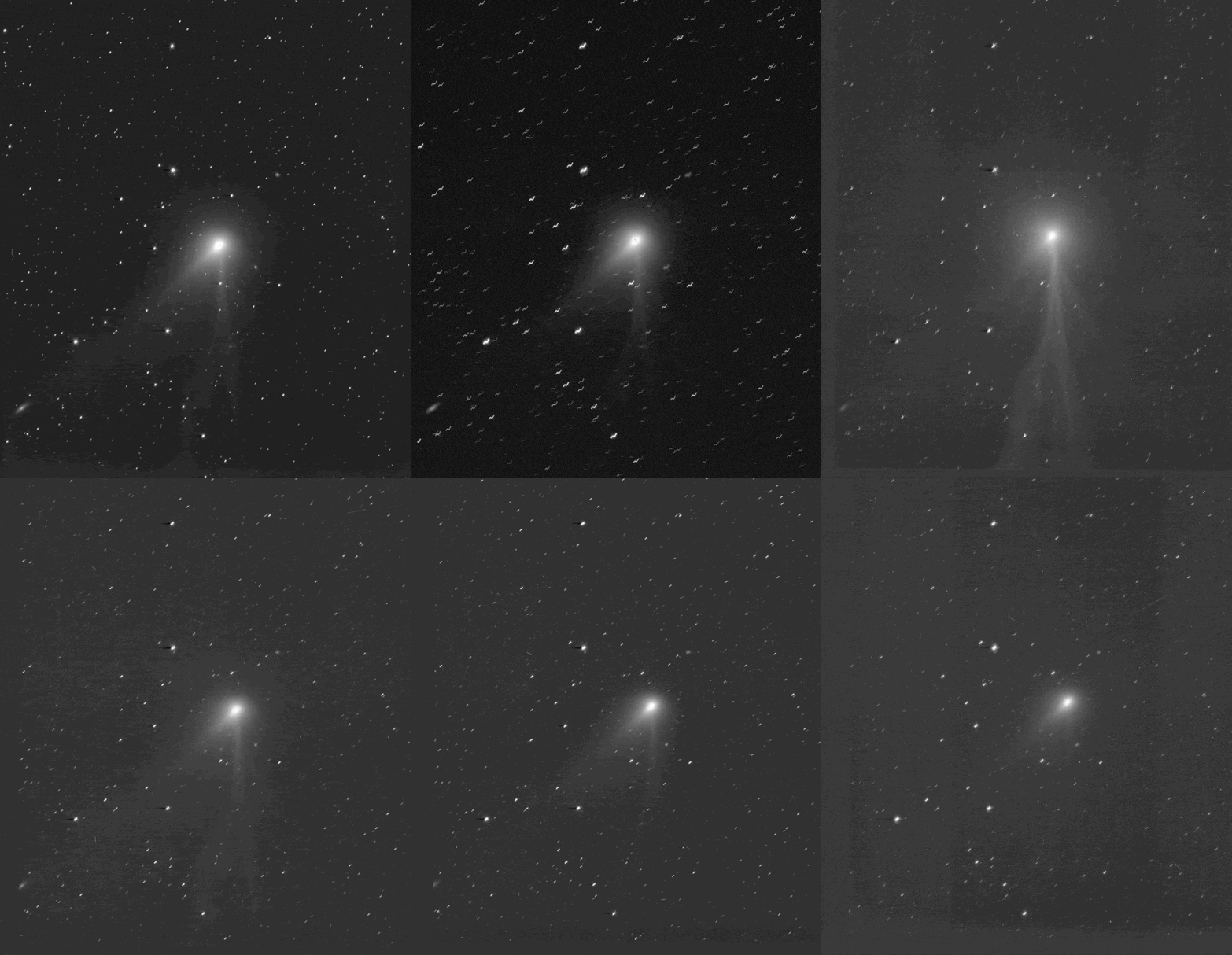
NavCam had a much closer view of 3I/ATLAS, from a different angle to Earth-based telescopes, and when the comet was not visible from Earth. This meant that ESA’s Planetary Defence team could line up NavCam images from throughout November to get a better idea of the comet’s changing position and trajectory.
In this way, the team – which usually tracks potentially hazardous asteroids – showed how powerful observations from deep-space missions can be to precisely calculate the orbits of comets or asteroids that cannot immediately be seen from Earth.
What’s more, because a comet’s trajectory is affected slightly by the release of dust and gas, the team is starting to use the trajectory measurements based on NavCam images to understand what materials – and how much of them – the comet is leaving in its wake.
NavCam images of Comet 3I/ATLAS
Instrument teams will continue to study the data, with many teams planning to publish papers on their results in the coming months.
“3I/ATLAS is a rare and unexpected visitor, its arrival came as a complete surprise,” says Olivier Witasse, ESA Juice Project Scientist. “But when we realised that Juice would be close to the comet around its closest approach to the Sun, we realised what a unique opportunity this was to collect a once-in-a-lifetime dataset.”
He continues: “Observing the comet was challenging, with no guarantee of success, but in the end, it turned into a great bonus for Juice during its journey to Jupiter.”
The closest Juice came to 3I/ATLAS was about 60 million km, whereas it will see Jupiter’s moons from just a few hundred kilometres away. Even so, being designed and equipped to study icy moons, Juice’s instruments were a great match for the icy interstellar comet.
We still have five years to wait before Juice arrives at Jupiter in 2031, but all its instruments will be switched on once again in September 2026 when Juice returns to Earth for another gravity assist.
“The data we are already seeing from Juice’s instruments is really promising,” says co-Project Scientist Claire Vallat. “We are getting more excited about how well they work and how much we will reveal about Jupiter and its icy moons in the 2030s.”
Like