
In this context, Italy, also thanks to the role of its institutions and ASI, is among the leading industrial partners involved in the development of strategic assets for the new phase of space exploration.
At Thales Alenia Space’s Turin site, the first lunar habitation module for astronauts (Multi-Purpose Habitat – MPH) is being developed for NASA and ASI, ensuring a safe and comfortable environment for astronauts and enabling scientific experiments and interoperability with external assets. The European lunar lander Argonaut, developed for ESA, will transport and deliver cargo to the lunar surface.
In Nerviano, Leonardo is developing robotic systems such as drills capable of excavating the subsurface, extracting and processing mineral resources, and robotic arms able to autonomously handle heavy materials. One example is the drill equipped with the integrated analytical laboratory PROSPECT (Platform for Resource Observation and in-Situ Prospecting for Exploration, Commercial exploitation and Transportation), designed to search for ice and other natural resources beneath the lunar surface and currently under development for NASA’s CLPS (Commercial Lunar Payload Services) program.
Telespazio is leading Moonlight, ESA’s program for lunar telecommunications and navigation, interoperable with NASA’s one. It will consist of a constellation of five satellites capable of supporting communications and navigation on the Moon and between the Moon and Earth. With over 400 lunar missions planned by space agencies and private companies over the next twenty years, the program represents a significant step towards sustainable lunar exploration and the development of a lunar economy.
Among Leonardo’s contributions to lunar exploration is ESA’s LUMIO project, developed by a European consortium led by the Politecnico di Milano and supported by ASI. The LUMIO cubesat, with the Lumio-Cam optical instrument built at the Campi Bisenzio site, will observe meteoroid impacts on the far side of the Moon, contributing to knowledge of the cislunar environment and the safety of future missions.
The Group’s expertise in digital technologies also extends to Space Cloud: space-based data centers, cloud computing, supercomputers and artificial intelligence will play an increasingly strategic role in managing and enhancing the large volumes of data generated by these infrastructures, including on the Moon.
These technologies contribute to the development of the so-called Lunar Economy, which is expected to grow to over €140 billion by 2040 (“Lunar market assessment: market trends a nd challenges in the development of a lunar economy” PwC, 2021), creating new industrial and commercial opportunities across the entire space value chain.
In this context, space represents one of the pillars of Leonardo’s strategy, where industrial capabilities, digital expertise and data management converge to enable new services and operational models. From infrastructure to geoinformation services, and from cloud solutions to space-based data centers, the Group is building an integrated ecosystem to support future missions.
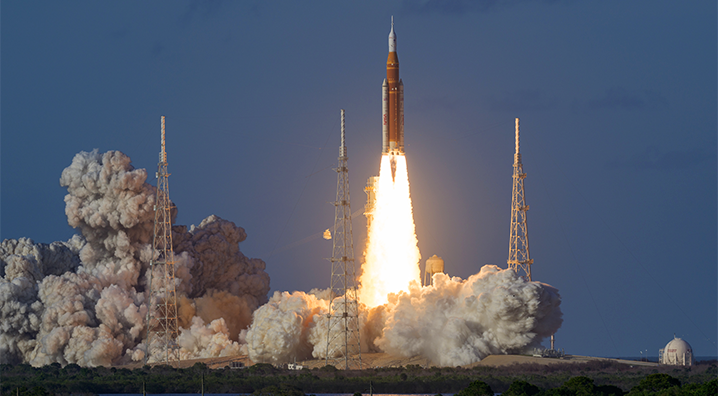
With Artemis and NASA’s Ignition plan, the Moon is once again at the center of international space exploration strategies. Leonardo and its ecosystem are at the forefront of developing the technologies that will shape this new phase: another “small step” opening the way to a new frontier for humanity in space.