
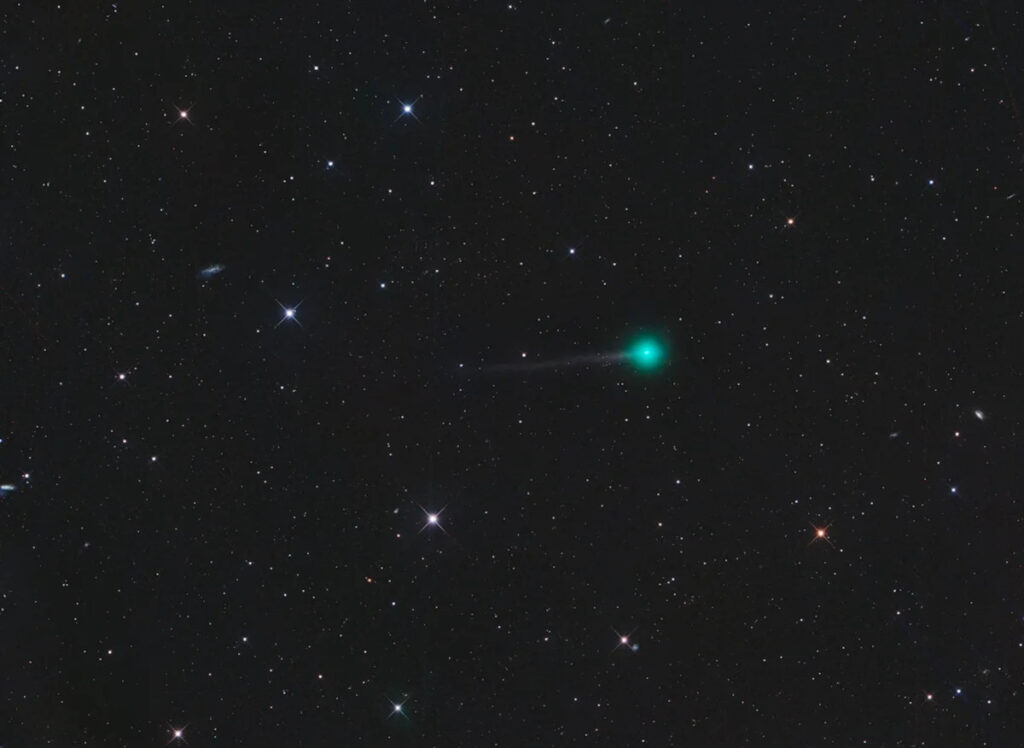
A newly discovered comet is giving astronomers a rare early look at a high-risk journey toward the sun. First detected on January 13 by French researchers at the AMACS1 observatory in San Pedro de Atacama, Chile, C/2026 A1 (MAPS) is a Kreutz sungrazer—a type of comet that plunges extremely close to the sun.
“In the case of C/2026 A1, it’ll come within 100,000 miles of the Sun’s surface, which is extremely close,” says Chris Mihos, a professor of astronomy at Case Western Reserve University. At such a close distance, the comet may break apart completely.
But there’s also a chance that C/2026 A1 will survive and instead burn brightly, putting on a show for amateur and professional astronomers alike here on Earth. For example, the Great Comet of 1882, one of the brightest comets ever observed, was visible during broad daylight and followed a similar path. Here’s what to know about when and how to spot C/2026 A1 (MAPS) if it makes it through.
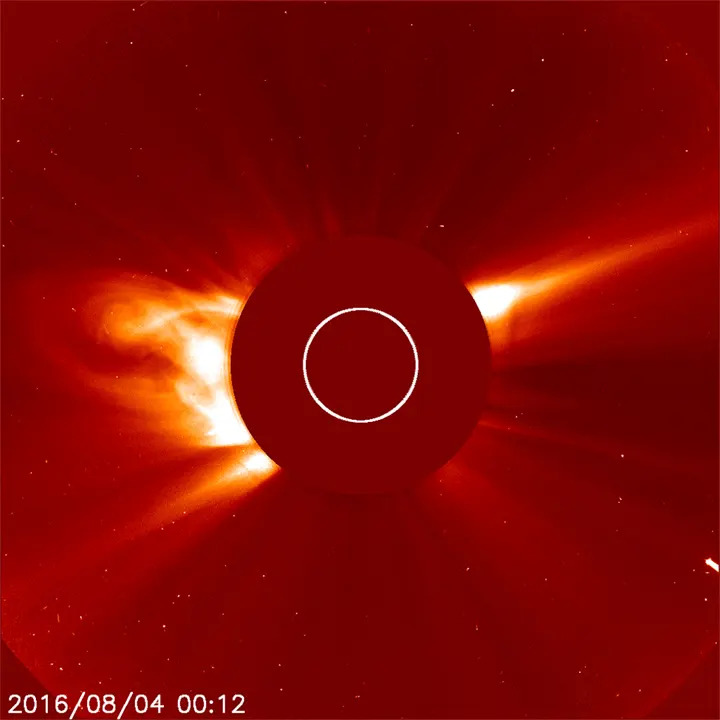
European Space Agency and NASA’s Solar and Heliospheric Observatory observed a bright comet plunging toward the sun at nearly 1.3 million miles per hour on August 3–4, 2016. Like most sungrazers, it was torn apart and vaporized by the intense heat and forces near the sun. ESA/NASA/SOHO/Joy Ng
What is a sungrazer comet?
Comets are balls of ice and dust that orbit the sun. “When they come into the inner solar system, the sun heats them and starts to vaporize them,” says Mihos. “The tail of the comet is the ice on the comet’s surface being vaporized and leaving behind a trail of gas and dust.”
(Asteroids vs. comets: How do they differ, and do they pose a threat to Earth?)
Kreutz sungrazers are a particular class of comet—ones thought to have originated from a larger comet that broke up centuries ago—characterized by very elongated orbits. While they spend most of their time far away from the sun, they eventually plunge through the sun’s outer atmosphere, called the corona, at very high speeds. Here, temperatures often reach 2 million degrees Fahrenheit— conditions that can quickly tear apart an object made largely of ice.
Why are comets so unpredictable?
Comets are inherently unstable objects thanks to their loosely bound composition. As they approach the sun and begin to vaporize, their structure shifts—altering how they spin, shed material, and move through space. That constant change makes their behavior difficult to predict.
“Comet C/2026 A1 is a little bit special in the sense that of all the Kreutz-class comets that have been identified, it was discovered farthest from the Sun,” says Mihos. “In other words, we can watch it coming in and see how it behaves as it gets nearer and nearer to the Sun.”
(Interstellar comet 31/ATLAS is a weirdo, but it’s definitely not aliens.)
That extended lead time gives astronomers a rare opportunity to observe a sungrazer’s structural evolution in real time. By tracking how Comet C/2026 A1 (MAPS) responds to extreme solar heating, scientists can better understand how these fragile bodies are built.
“Its behavior—whether its orbit changes, whether or not it survives the close passage with the Sun, how it forms its tail—gives us information about how tightly held together it is,” says Mihos. “Will it break up easily? Will it survive? Will it lose a lot of ice? All that helps astronomers work out things about its structure.”
Will the comet survive—and can you see it from Earth?
Whether comet C/2026 A1 (MAPS) survives its close solar encounter remains uncertain. If it does emerge intact, there may be a brief opportunity to see it with the naked eye. “If we see anything of it, it won’t be until after it passes the sun on April 4th,” says Mihos. “In the week after that, we might be able to see the comet and its tail, presuming it survives, very low in the western sky immediately after sunset.”
(Here are eight night sky events to see in April, from a planet parade to a full pink moon.)
In any case, comet C/2026 A1 (MAPS) flares into view or vanishes into the sun, its journey offers a fleeting glimpse into the fragile nature of objects formed at the outer edges of the solar system—and what happens when they venture too close to the star that binds them. “We never quite know what will happen, and so it’s interesting to watch and see,” says Mihos.