
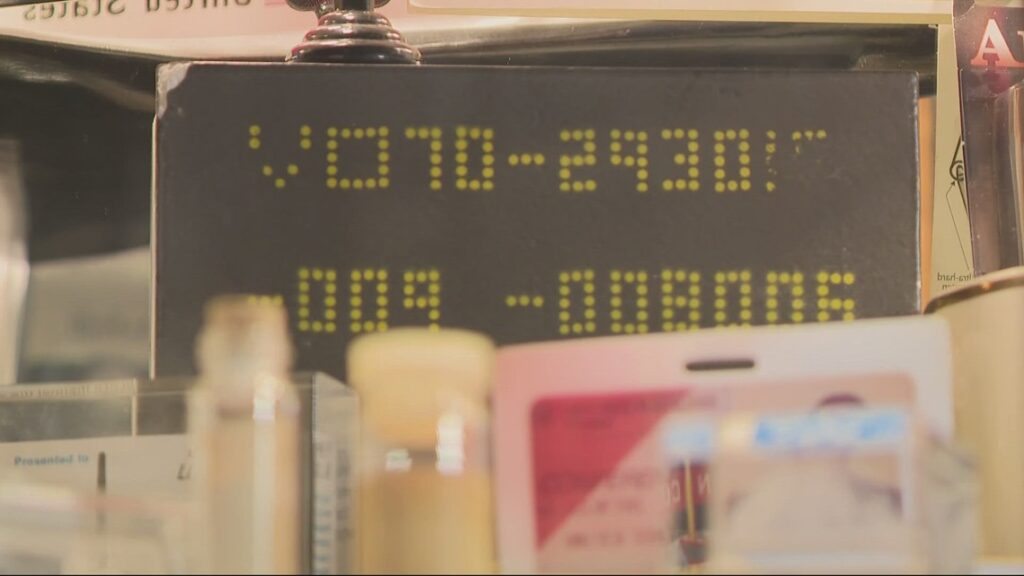
Artifacts tucked inside a bed-and-breakfast offer a close-up look at space history as astronauts head back toward the moon for the second time in 50 years.
PORTLAND, Ore. — Tucked inside a trio of cabinets at the Gardner House Cafe Bed and Breakfast, a small museum is quietly preserving a piece of American space history.
The JPL Museum in Stayton may be modest in size, but its connection to NASA runs deep. As the Artemis II mission launched Wednesday, sending four astronauts on a mission to orbit the moon, the moment carried special meaning inside those cabinets.
For James Loftus, the museum’s director, space exploration isn’t just history. It’s personal.
“This is my father here, Joe Loftus Jr.” James said, pointing at a photo on the wall in the cafe.
James Loftus grew up with a front-row seat to NASA through his father, Joseph Loftus Jr., who spent more than four decades with the agency. His work put him alongside some of the most recognizable names in space exploration.
James said his dad played a key role in shaping early spaceflight, including how astronauts lived and worked inside spacecraft.
“In the early stages, he was responsible for the crew accommodations for basically where the switches lay out for the astronauts as they’re going through their flights,” James said.
His contributions also helped extend early lunar missions, allowing astronauts to spend more time on the moon without redesigning the spacecraft itself.
“When you remember the first time we went to the moon, we were only there for a few hours. When we went back, we were able to extend that stay to 72 hours, and that’s because his team had redesigned, without redesigning the spacecraft had redesigned the fuel tank and oxygen tank.” James said.
RELATED: Why isn’t Artemis II landing on the moon? A look back at Apollo 17
Joseph passed away in 2005. The museum was founded in 2015 and named in his honor. JPL stands for Joseph P. Loftus.
Inside the small display, history is packed tightly together. There are artifacts that span decades of space exploration, many with direct ties to NASA missions.
“This here is a shuttle tile,” James said, holding up a piece of a heat shield.
Some items are even more extraordinary.
“This went to the moon and back,” James said of a small portion of a heat shield that shows burn marks from reentry. “This is one of the few pieces of the spacecraft that came back.”
James says the collection isn’t just about preserving the past — it’s about inspiring the future.
His father’s influence reached far beyond the workplace, even helping set standards for astronauts themselves.
“He selected the height criteria at 5’11. He was 6’1, so the moment that decision was made, that took him out of the ability to go,” James said when asked if his dad ever went into space.
Today, James sees the museum as a way to share that legacy with students and visitors, sparking curiosity about space in a new generation.
And with Artemis II marking NASA’s return toward the moon more than 50 years after the Apollo 11 mission, the timing feels especially meaningful.
“It’s been a long time coming. I’m glad that we’re going. I’m holding my breath ’cause I know that we’ve had some issues with the fuel tanks,” he said.
He says his father would have been watching closely.
“He would’ve been a big proponent for it from the very beginning,” James said.
Back inside the Gardner House, the artifacts remain carefully preserved, each one a tangible link between past and present missions.
“All of this is technically the government’s property, so I am just simply a caretaker,” James said.