
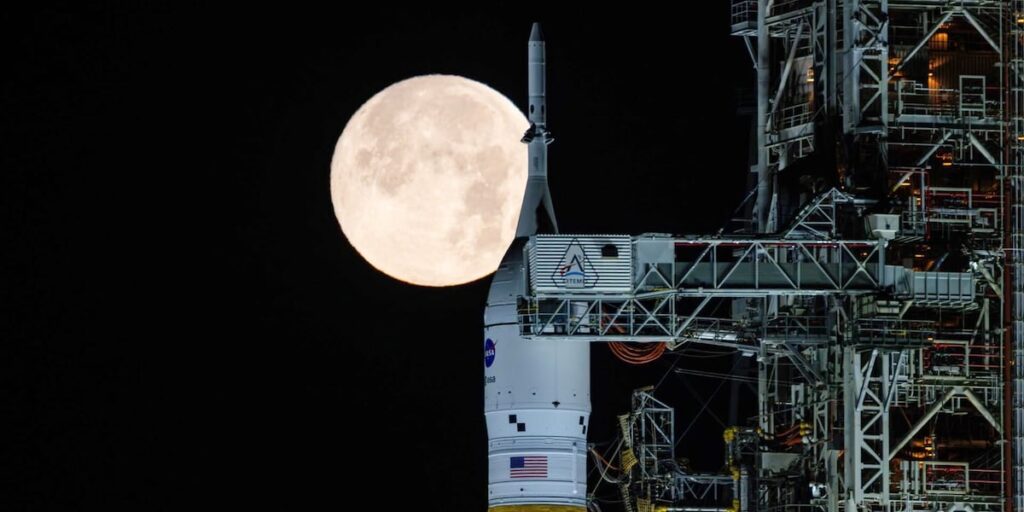
NEW ORLEANS (WVUE) – As NASA’s Artemis II launch window opens, the mission is drawing attention not only because it will send astronauts around the moon for the first time since Apollo, but because it moves the space agency closer to a more ambitious goal: landing humans near the moon’s south pole.
Artemis II is designed as a 10-day mission carrying four astronauts around the moon and back to Earth. The crew will not land on the lunar surface. But NASA says the flight is a major step toward later Artemis missions that are expected to target the south pole.
 FILE – This file photo provided by NASA shows, from left, NASA Astronauts Christina Koch, Victor Glover, Reid Wiseman, and Canadian Space Agency Astronaut Jeremy Hansen at the Johnson Space Center in Houston, March 29, 2023. (Josh Valcarcel/NASA via AP)(Josh Valcarcel | AP)
NASA scientists say the region is unlike the areas visited during Apollo. Instead of relatively flatter sites near the moon’s equator, the south pole has mountain ridges that can stay in sunlight for long periods and deep craters that have remained in darkness for billions of years. Those permanently shadowed craters are so cold they may trap water ice for long periods.
That ice is one of the biggest reasons NASA wants to go.
Scientists say future explorers could use lunar ice for drinking water. It could also be broken into hydrogen and oxygen, which could be used for breathable air and rocket fuel. That makes the South Pole important not just for science, but for the long-term goal of sustained human exploration.
NASA also wants to study the ice itself.
Researchers still do not know exactly how much ice is there, how deep it is buried or what form it takes. Some believe it may help answer broader questions about how water reached the moon and even Earth.
RELATED STORIES
NASA is set to send humans to the moon for the first time since 1972The road to the moon runs through New OrleansIn a throwback to Apollo, NASA’s Artemis II mission will send four astronauts on a lunar fly-around.(Source: ASSOCIATED PRESS, NASA)
The south pole also could reveal more about the moon’s history.
Apollo astronauts collected rocks mostly from younger volcanic areas near the equator. NASA scientists believe the south pole contains older material that could provide new clues about how the moon formed, how impacts shaped its surface and how its soil evolved over time.
Getting there will not be easy.
NASA says the south pole is rugged, shadowed and difficult to navigate. The lighting is extreme, temperatures can plunge lower than those on Pluto in some areas, and the terrain includes steep craters, boulders and deep shadowed regions. That is why robotic missions are being used to scout the area and test drilling, communications and landing technology before astronauts arrive.
For Louisiana, the Artemis program also carries local significance.
At NASA’s Michoud Assembly Facility in New Orleans East, Boeing quality engineer Evan Sibley said workers helped build the Artemis core stage, the bottom three-quarters of the rocket.
“We are going back to the moon,” Sibley said.
As Artemis II begins, the mission stands as a fly-around of the moon. But NASA’s bigger target is already clear: the lunar south pole, where the agency hopes science, resources and exploration can meet.
See a spelling or grammar error in our story? Click Here to report it. Please include the headline.
Subscribe to the Fox 8 YouTube channel.
Copyright 2026 WVUE. All rights reserved.