
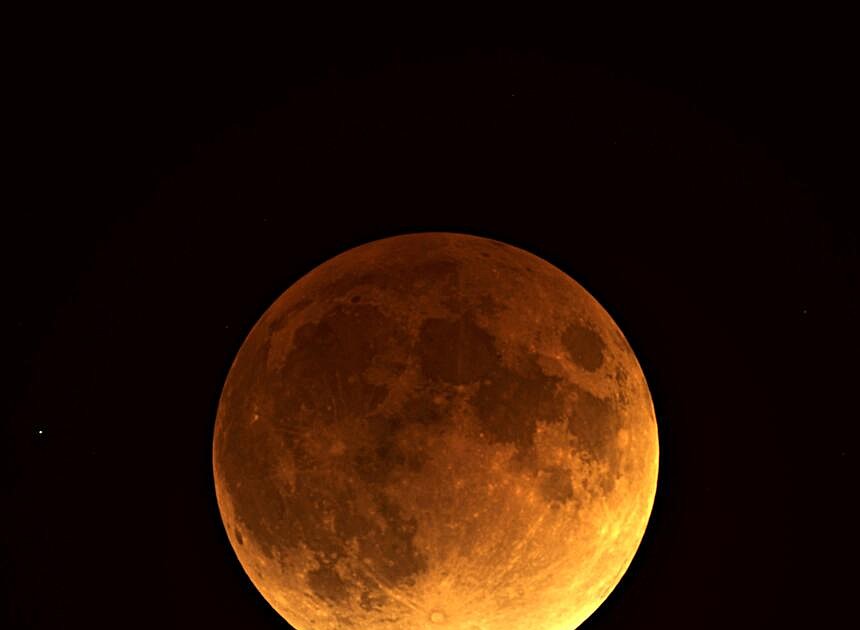
As days lengthen and nights warm, April promises an exciting display of celestial events for astronomy enthusiasts. This month will give us an engaging list of planetary and lunar alignments, a meteor shower, a potentially bright comet, and our standard moon phases, to include the “Pink” Full Moon.
But first, a short recap showing last month’s, March 3rd total lunar eclipse. We were lucky enough to have clear skies all night long to observe this eclipse whose maximum eclipse occurred at 3:33 am. Here is what the moon looked like locally from the Rimrock Observatory.
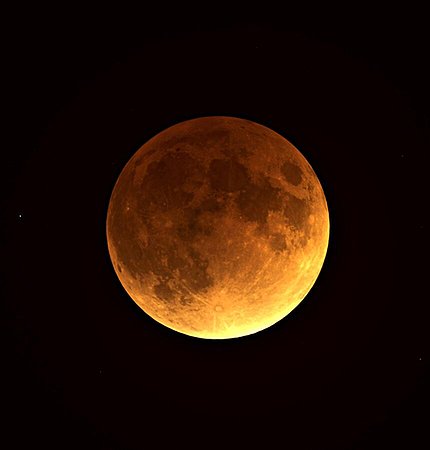
Image courtesy of John Taylor and the Rimrock Observatory
April 1 – Full Moon, the Pink Moon
The moon will be located on the opposite side of the Earth as the sun and its face will be fully illuminated. This phase occurs at 7:12 p.m. PDT. The April full moon was known by early Native American tribes as the “Pink Moon” because it marked the appearance of the moss pink, or wild ground phlox, which is one of the first spring flowers. This moon has also been known as the Sprouting Grass Moon, the Growing Moon, and the Egg Moon. Many coastal tribes called it the Fish Moon because this was the time that the shad swam upstream to spawn.
April 2 – The Moon and the bright star Spica, a Conjunction
At 10 p.m. on this evening the moon will be a mere 3½ degrees (3 fingers width at arm’s length) from the brightest star in the constellation of Virgo, Spica. Look low in the southeast to see this interesting conjunction.
April 5 – Easter Sunday
If it seems like the annual date of Easter Sunday is a random occurrence, it isn’t. The date on which Easter Sunday occurs is based on ecclesiastical rules that approximate astronomical events. So, how do you calculate the date of Easter Sunday? Easter Sunday is the first Sunday after the first full moon after the first day of spring (the vernal equinox). So, for this year, the first day of spring is March 20, the first full moon after that date is April 3 and the next Sunday is Easter, April 5. Using these rules, Easter Sunday can only fall anywhere between the dates of March 22 and April 25.
April 8 to 16 – Potentially Bright Comet C/2025 R3 (PANSTARRS)
Comet C/2025 R3 (PANSTARRS) will make its closest approach to the Earth on April 26. On this date in North Idaho, it will not be readily observable since it will be very close to the Sun. After this date it is not observable because it stays to near the Sun’s glare. So, we have to move our observing window to the second week of April. The predicted brightness could be as bright as the stars that make up the Great Square of Pegasus, around 3rd magnitude. This brightness level makes this comet a naked eye object. Look low in the East to find the Great Square of Pegasus at 4:45 am. Using binoculars would really enhance the view.
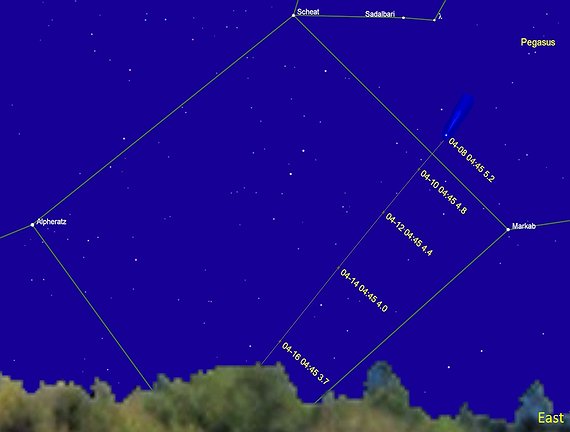 This trajectory simulation shows the track of comet C/2025 R3. Starting on the right side of the track it shows the date of April 8, the time of 4:45 a.m, and the brightness level of magnitude 5.2. Notice as the dates advance the brightness numbers get smaller meaning the comet is getting brighter. This is happening because it is moving closer to the Sun. Image courtesy of John Taylor and Cartes du Ciel.
April 9 – Last Quarter Moon
The Last Quarter Moon is the third and final quarter phase of the Moon during its monthly cycle. This occurs at 9:52 p.m. PDT. The Moon once again appears half-illuminated, with the left half visible. This moon is viewable after midnight and throughout the morning.
April 17 – New Moon.
The Moon will be located on the same side of the Earth as the Sun and thus will not be visible in the night sky. This phase occurs at 4:52am PDT. This is the best time of the month to observe faint objects. You should be able to see some of the dimmer galaxies and star clusters because there is no moonlight to interfere.
April 18 – Moon, Venus conjunction
On this evening look low in the West at 8pm PDT to see Venus and the crescent Moon just 5 degrees away from one another. Because the crescent moon will be so thin, you will need your binoculars to see this very thin crescent moon. Your cell phone has the capabilities to take an amazing image of this occurrence. Don’t forget to use a tripod with your cell phone.
April 21-22 – Lyrids Meteor Shower.
The Lyrids is an average meteor shower, producing as many as 20 meteors per hour at its peak. It is produced by dust particles left behind by comet C/1861 G1 Thatcher, which was discovered in 1861. The shower runs annually from April 16-25. It peaks this year is on the night of the 21st and morning of the 22nd. The peak occurrence is around 4 a.m. on the 22nd.
These meteors can sometimes produce bright dust trails that last for several seconds. The light from the thin crescent moon will not be much of a problem, so this should be a relatively good show. Best viewing will be from a dark location after midnight. Meteors will radiate from the constellation Lyra but can appear anywhere in the sky.
April 22 – Moon and Jupiter Conjunction
Look high in the Southwest sky at 8:30pm to see the nearly first quarter moon less than 4 degrees from the bright planet Jupiter.
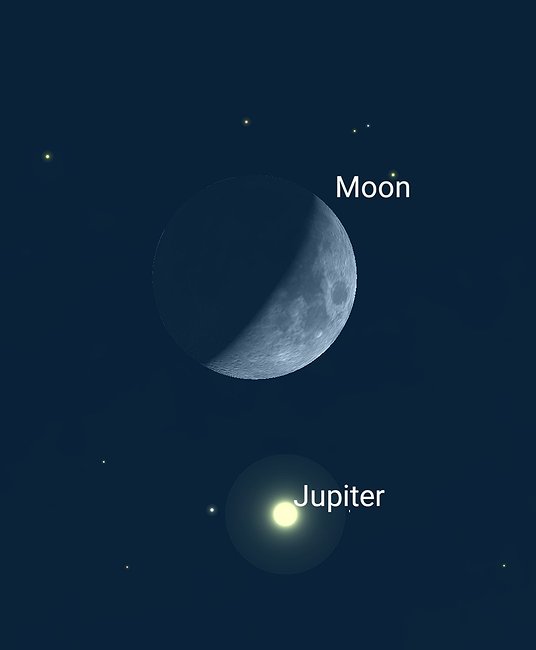 Image courtesy of John Taylor and Sky Safari Pro 6
April 23 – First Quarter Moon
The First Quarter Moon marks the halfway point between the New Moon and the Full Moon. It appears as a half-illuminated disk, which occurs at 7:32 p.m. PDT, and only the right half is visible. It is viewable in the afternoon and evening sky.
April 23 – Venus, Uranus, and the Pleiades (M45)
This evening at 8:30pm look low in the western sky to see the brightest planet Venus only 3½ degrees from the star cluster the Pleiades, and less than a degree from our seventh planet Uranus. This will most likely be a binocular event to see Uranus and deal with the remaining twilight.
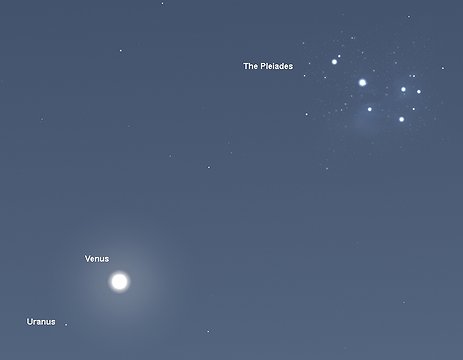
Image courtesy of John Taylor and Stellarium
And finally, if you’re choosing your first telescope, setting up gear, tracking down night sky objects, or diving into astrophotography, you can go here to ask your questions.
ncmrrimrockobservatory.space/contact