
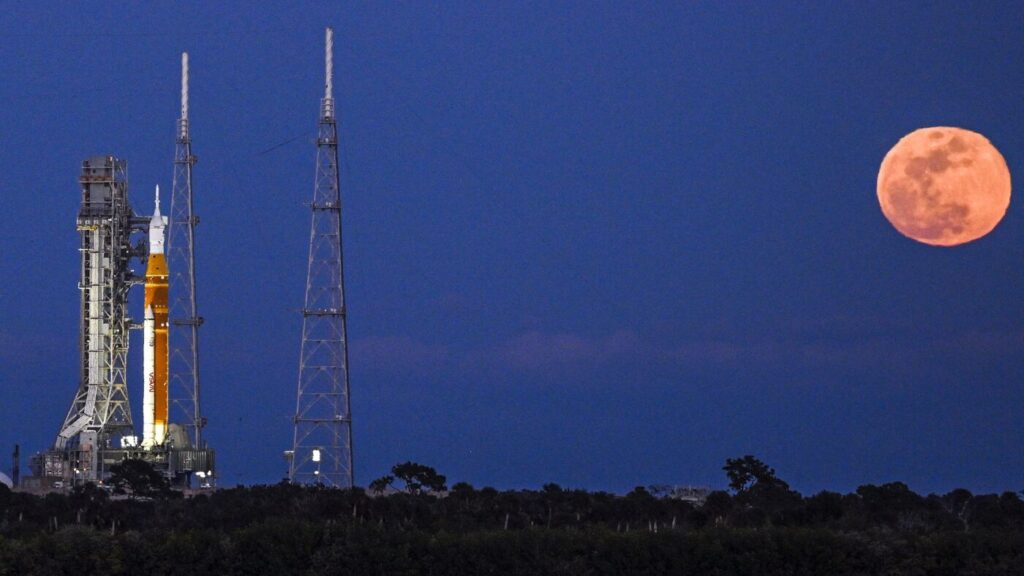

Wednesday, humans could get closer to the moon than they have in over half a century following the launch of the Artemis II mission.
Miguel J. Rodriguez Carrillo
hide caption
toggle caption
Miguel J. Rodriguez Carrillo
NASA’s Artemis II mission is set to launch this week, which could bring humanity close to the moon for the first time since 1972. It’s a mission that’s over twenty years in the making – and even though it’s not the first venture out to the moon, it still involves a lot of firsts. If all goes to plan, the mission will bring the first woman, person of color and non-American close to the moon. But why are we embarking on a sequel space mission to begin with? And while they’re up in space, what could scientists learn about the possibility of life in space for those of us still on Earth?
Interested in more science behind current events? Email us your question at shortwave@npr.org.
Listen to every episode of Short Wave sponsor-free and support our work at NPR by signing up for Short Wave+ at plus.npr.org/shortwave.
Listen to Short Wave on Spotify and Apple Podcasts.
This episode was produced by Arundathi Nair with help from Rachel Carlson. It was edited by Amina Khan and our showrunner Rebecca Ramirez. Tyler Jones checked the facts. Kwesi Lee was the audio engineer. Special thanks to Carl Craft and Russell Lewis.