
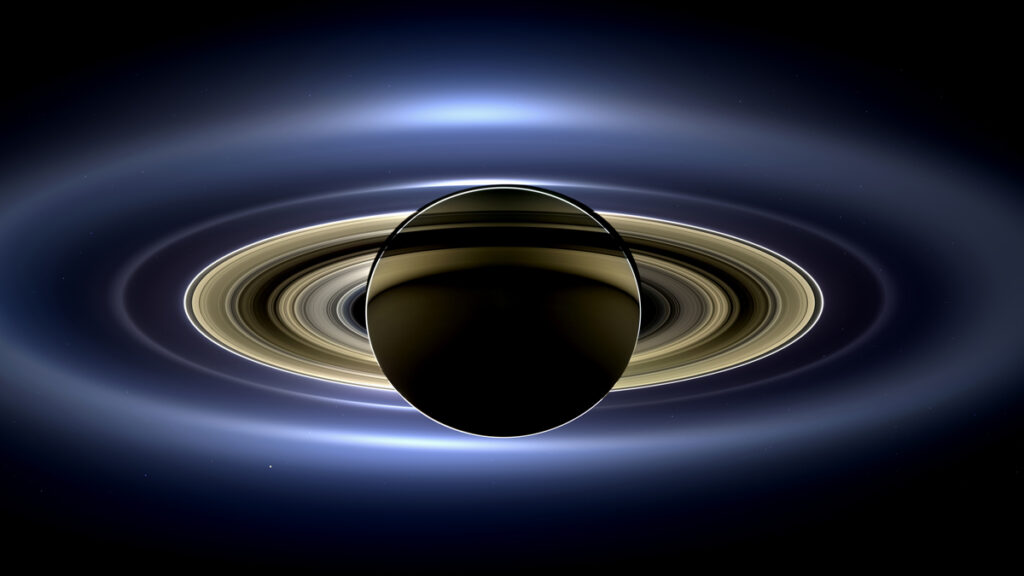
What’s happening in the skies over North Texas this month? April holds some spectacular sights in the night sky. Check out the list below.
Where are the planets?
Overview of where to view the planets:
All month of April: Venus dominates the early evening western sky.
All month of April: Jupiter is very high in the west in the early evening.
All month of April: Mars is low in the pre-dawn east.
Early April: Mercury is visible above the eastern horizon before dawn. On April 3rd, the planet will be at its greatest elongation, or its furthest distance from the sun as seen from Earth, making it easier to see.
Late April: Saturn is very low in the pre-dawn eastern horizon.
The distance of the planets
Mercury averages a distance from the Earth of 48 million miles and from the sun of 36 million miles.
Venus’s distance from the Earth varies from 24 million miles to 162 million miles.
Mars averages 140 million miles from Earth. The closest recorded distance between Earth and Mars was 34.8 million miles in August 2003. According to NASA, the two will not be that close again until the year 2237.
Jupiter’s distance from the Earth varies from 336 million miles to 600 million miles.
Saturn’s distance from the Earth varies. When the two are closest, they lie approximately 746 million miles apart, or eight times the distance between the Earth and the sun. At their most distant, when they lie on opposite sides of the sun from one another, they are just over a billion miles apart, or 11 times the distance between the Earth and the sun.
The distance between Earth and Uranus constantly changes because both planets orbit the sun, ranging from about 1.6 to 2 billion miles. Sunlight takes roughly 2.5 hours to travel from the Earth to Uranus at average distances, varying from about 2.4 to 2.9 hours depending on their orbital positions.
The distance between the Earth and Neptune is constantly shifting because both bodies are moving through space. When Neptune and Earth line up on the same side of the sun, at their closest, they are only 2.7 billion miles apart. But when the planets are on opposite sides of the sun, they can put as many as 2.9 billion miles between them.
A planetary alignment
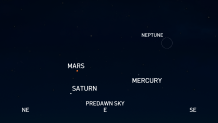
On April 18th, a rare “planet parade” will unfold as Mercury, Mars, Saturn and Neptune gather just before sunrise in a tight, diagonal grouping. Finding Neptune will require binoculars and an unobstructed view of the horizon.
You’ll have a 30-minute window to view the planets before the sun rises.
Follow the Zodiacal Light
You can hunt for the Zodiacal Light following April’s new moon. It will appear as a faint, ghostly pyramid of light stretching upward from the western horizon after twilight. This is caused by sunlight reflecting off interplanetary dust in our solar system. This light shines with a similar or a bit fainter brilliance than the Milky Way.

APAP
This month offers one of your best chances to witness this glow in the evening sky. When it returns in the fall, it will only be visible as a “false dawn” in the hours before sunrise. Any glow from Dallas-Fort Worth’s urban lights will limit the view.
Comet fly-bys
Two comets could become visible in the night sky this month. Comet C/2026 A1 (MAPS) and C/2025 R3 (PanSTARRS) are both approaching the inner solar system, offering skywatchers a rare double opportunity.
Comet C/2026 A1 (MAPS)
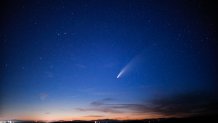
This comet will pass extraordinarily close to the sun — just 487,000 miles from its surface. This will happen between April 4th and 5th. Its proximity to the sun could make it spectacularly bright. However, it also means the comet may not survive. If it breaks apart, however, it may vanish entirely before becoming visible.
The best chance will come 30 to 45 minutes after sunset, looking very low in the western sky. We may see a bright tail around April 9th.
C/2025 R3 (PanSTARRS)
Comet C/2025 R3 (PanSTARRS) will offer a better viewing opportunity later in the month. This comet will reach perihelion (its closest point to the sun) on April 20th. It will make its closest approach to Earth on April 27th at 44 million miles.
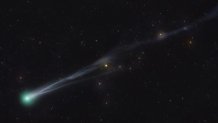
Julien De Winter & Victor SabetJulien De Winter & Victor Sabet
It could benefit from scattering, where sunlight reflecting off its tail enhances its brightness as seen from Earth. PanSTARRS will be best seen in the eastern predawn sky.
Full Pink Moon
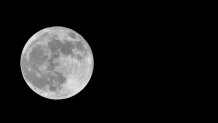
The month will start with a full moon taking place on April 1st. The April full moon, known as the Pink Moon, will reach full illumination at 9:11 p.m. CDT.
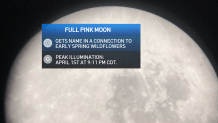
The name Pink Moon comes from a type of pink flower, Phlox subulata, also called pink or moss phlox, which blooms in spring.
Moon phases
The eight moon phases of a lunar month are divided into four primary and four intermediate (waxing and waning) moon phases.
New moon: The new moon is when the sun and moon are aligned, with the sun and Earth on opposite sides of the moon.
There are two reasons why we can’t see the new moon:
The new moon is up in the daytime sky. It rises and sets around the same time as the sun. Thus, bringing it too close to the sun’s glare to be seen.
Waxing crescent moon: This intermediate moon phase occurs after the new moon and lasts until the first quarter moon.
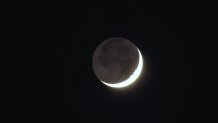
FIRST QUARTER: The first quarter moon occurs when half of the moon’s face is lit up. Whether the lit-up half appears on the left or right depends on where you are on Earth.
WAXING GIBBOUS MOON: This intermediate moon phase occurs after the first quarter moon and lasts until the full moon.
FULL MOON: A full moon is when the entire face of the moon is lit up. The moon is in constant motion around the Earth, so a full moon only lasts for an instant of time.
WANING GIBBOUS MOON: This intermediate moon phase occurs after the full moon and lasts until the third quarter moon.
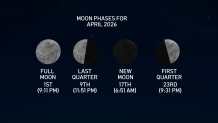
THIRD QUARTER: The third quarter moon is when the opposite half of the moon is illuminated compared to the first quarter. Whether the lit-up half appears on the left or right depends on where you are on Earth.
WANING CRESCENT MOON: This intermediate moon phase occurs after the third quarter moon and lasts until the new moon.
ELLIPTICAL ORBIT
The moon’s orbit around the Earth is elliptical, with one side closer to and the other farther from the Earth. On April 7th at 3:30 a.m. CDT, the moon will be at apogee, its farthest from Earth in this orbit, at 251,637 miles. On April 19th at 1:54 a.m. CDT, the moon will be at perigee, its closest to the Earth for this orbit at 224,708 miles.
MONTHLY METEOR SHOW: THE LYRIDS
The April Lyrids are expected to be active between April 14th and April 30th, peaking on April 21st-22nd. At the peak, about 18 meteors per hour will be visible.
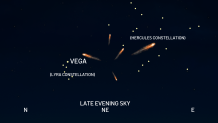
The expected rate and brightness of these meteors are low enough that Dallas-Fort Worth Metroplex watchers will have little chance of seeing them. You are more likely to see them if you have an unobstructed view and clear skies in a very dark place, far from any urban light sources.
The Lyrids will appear to radiate from near the Lyra constellation, which contains the bright star Vega. Look above the northeastern horizon after about 10:30 p.m. CDT.
The Lyrids are caused by comet C/1861 G1 (Thatcher) debris entering the Earth’s atmosphere at 110,000 miles per hour. The comet is expected to be visible from Earth again in 2276.
HOW FAR WILL THE EARTH TRAVEL AROUND THE SUN THIS MONTH?

First, the Earth’s spin is constant, but the speed depends on the latitude at which you are located. For example, at the equator, the speed is about 1,037 mph.
Earth’s spin, of course, is not the only motion we have in space. Our orbital speed around the Sun is about 67,000 mph. That’s the equivalent of traveling from London to New York in about three minutes.
In our orbital voyage around the Sun, we’ve traveled 194.64 million miles by the end of April. Only 389.36 million miles to go!
ASTRONOMY 101: THE SOLAR SYSTEM’S BIGGEST STORM
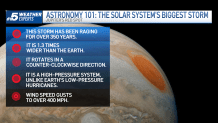
The solar system’s biggest storm can only be found in one place – the biggest planet, Jupiter.
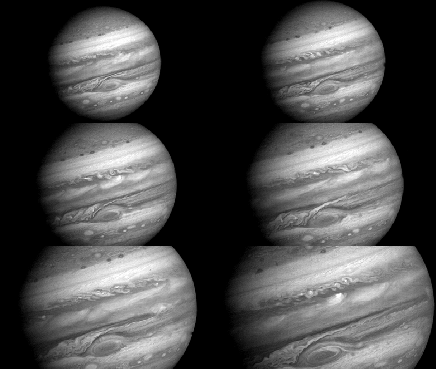
Jupiter’s Great Red Spot (GRS) is a massive high-pressure anticyclone in the planet’s southern hemisphere. This storm has been raging for over 300 years. Surface winds can reach up to 425 mph. While surface winds are intense, the storm extends over 200 miles deep into the atmosphere.
Its distinct brick-red color is caused by chemical reactions involving ammonia and acetylene in the upper atmosphere.
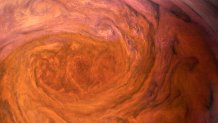
NASA/JPL-Caltech/SwRI/MSSS/Roman TkachenkoNASA/JPL-Caltech/SwRI/MSSS/Roman Tkachenko
Once large enough to fit many Earths, the Great Red Spot has shrunk to about 10,250 miles across, making it the smallest it has ever been. It is now shrinking by roughly 580 miles per year.
Please enjoy these events in the night sky this month. Until then, Texans, keep looking up!