
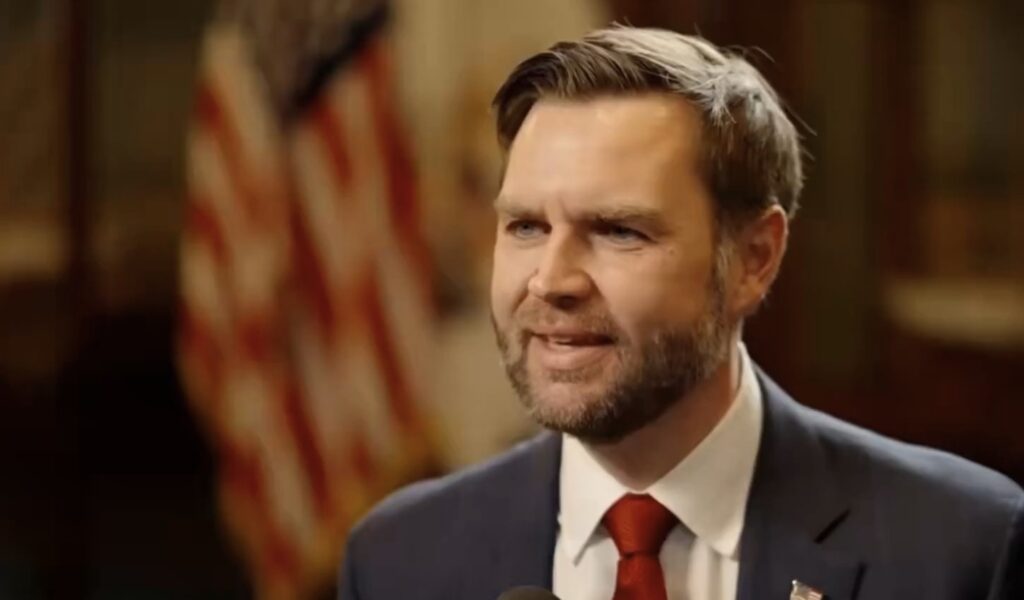
This week, Vice President JD Vance appeared on the conservative podcast, The Benny Show, and professed that he believed aliens were demons.
There are two easy reads here. The first is that Vance was just being glib. The second is that he was dodging the topic of the war in Iran. While both may be true, they sell the moment short.
The idea that UFOs are better understood as spiritual rather than extraterrestrial did not originate with Vance. The idea was popularized by Jacques Vallée, a French-born astronomer, venture capitalist, and computer scientist who spent decades studying UFOs. In his best-known book, Passport to Magonia, Vallée traced parallels between modern UFO encounters and centuries of folklore about fairies, angels, and demons, arguing that these phenomena have persisted across human history in different forms.
Vallée may have popularized this interpretive frame, but he is far from alone in advancing it. Conservative evangelicals, in particular, have long drawn on similar ideas to argue that UFOs are demonic manifestations. Some, like the late Michael Heiser, author of The Unseen Realm, have even claimed there is a rich scriptural tradition to support this view — provided the Bible is read with an open mind.
Vance’s intentions aside, it is another indication that the Overton window around acceptable metaphysical belief has shifted — sharply. Over the past year, and often to widespread mockery, conservative media figures like Tucker Carlson and Megyn Kelly have openly entertained beliefs in demons and witchcraft, respectively. In Kelly’s case, she reacted with genuine alarm to a Jezebel journalist joking about using Etsy-bought witchcraft to hex Charlie Kirk, treating it as something closer to a credible threat than a provocation.
The pattern extends beyond media rhetoric. The mooted nomination of Dr Casey Means for Surgeon General underscored how porous these boundaries have become. Means, a physician who left her surgical residency to become a wellness influencer, has also dabbled in alternative spiritual traditions, including kabbalah. Not long ago, openly embracing such New Age beliefs might have been disqualifying — a marker of unseriousness, even instability. There were always edge cases, like the Reagans’ reported consultations with an astrologer, but those were framed as curiosities: discreet, anecdotal, perhaps even apocryphal. To build a public identity around such beliefs is something else entirely.
Astrology, too, may be the clearest example of the mainstreaming of magical beliefs. Take Mercury in retrograde — a period many believe is unlucky for major decisions or serious communications. Not long ago, this was treated as a punchline or, at most, a private belief shared among astrologers. Today, it is widely acknowledged in social and even professional circles as a phenomenon worth noting, even if it still draws the occasional skeptical eye. Millions of Americans take astrology seriously, and its influence is visible in everyday conversation.
Similarly, more diffuse beliefs in “energy” have gained legitimacy. Practices like Reiki and energy healing are now offered through integrative medicine programs at major hospitals. (I personally had Reiki covered by my health insurance when I was pregnant with my first child — yes, really.) These examples show that beliefs once relegated to the fringe are increasingly woven into mainstream life.
Shifting gears, this re-enchantment is also showing up in our relationship with technology. Increasingly, people — including those who aren’t casual observers or AI evangelists — are willing to entertain the idea that AI might be conscious, or something close to it. This is a clear marker of the trend: attributing a kind of soul to systems we once assumed were purely mechanistic. The impulse to see the mind where there may only be math is ancient; in other contexts, we’d call it animism.
Why are beliefs changing this way? There’s no single answer. Technology is accelerating, and even AI’s creators often struggle to explain how it works. Trust in institutions — medicine, science, universities — has been eroding for decades, a process accelerated by Covid as more people questioned experts’ honesty or competence. Religious attendance has declined steadily over the last century, even as spiritual hunger persists. Commercialization adds another layer: healing crystals now line grocery-store shelves, and the Internet has made once esoteric knowledge widely accessible. In a world where traditional authorities are questioned and knowledge is fragmented, it’s little wonder people are gravitating toward alternative frameworks for understanding reality.
Vance may well have been distracting the audience from Iran. He probably was. But the fact that demonology was available to him as a plausible subject change, that he could say it on a major podcast, tells us something real about where the culture is. Magical thinking is no longer fringe. In the Nineties, it was mainstreamed as a sideshow attraction — something you saw as a novelty item on programs like Unsolved Mysteries or in fiction, like The X-Files. Today, it’s the water we swim in, and that water is rising.