
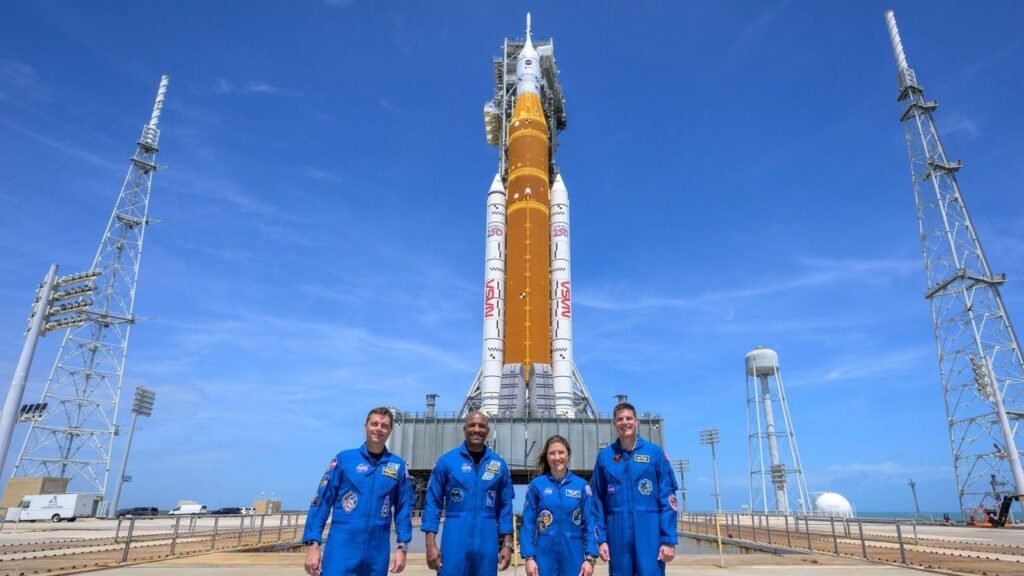
CAPE CANAVERAL, Fla. (TNND) — NASA officials are set to outline final preparations for the Artemis II mission during a pre-launch news conference at Kennedy Space Center in Florida on Tuesday afternoon.
They will discuss the progress they’ve made on what will be the first crewed flight of the agency’s return-to-the-moon program in more than 50 years.
Mission managers and engineers said testing of the Space Launch System rocket and Orion spacecraft is complete, with teams focused on final safety checks and integration work ahead of the launch.
The 32-story Space Launch System rocket is poised to blast off Wednesday evening with four astronauts, including the following:
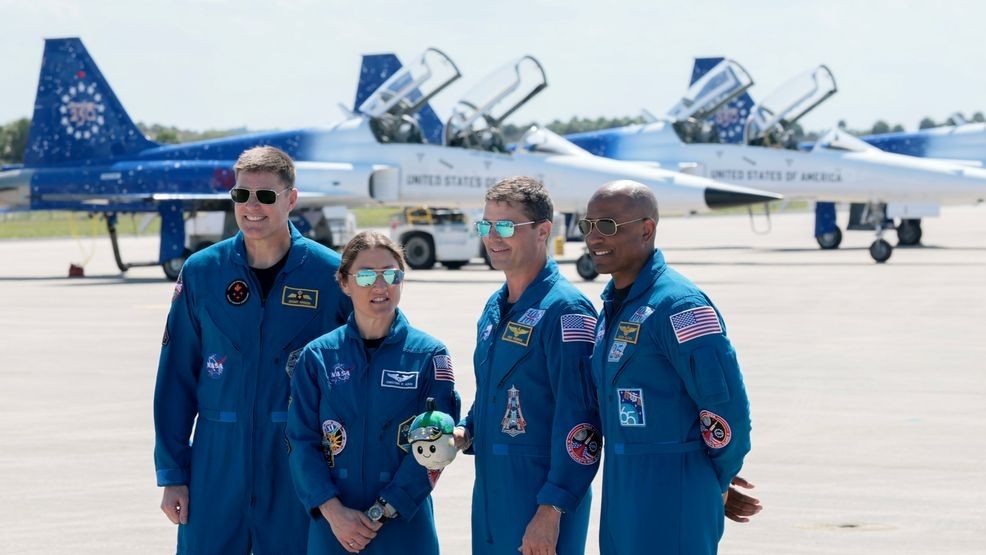
The Artemis II crew – (L-R) mission specialist Jeremy Hansen of CSA (Canadian Space Agency), mission specialist Christina Koch, commander Reid Wiseman and pilot Victor Glover – stand together after arriving at the Kennedy Space Center on March 27, 2026 in Cape Canaveral, Florida. The astronauts arrived to begin preparations for an April 1, 2026 launch for a 10-day mission, which will take them around the Moon and back to Earth. (Photo by Joe Raedle/Getty Images)
Managers said the rocket is doing well following the latest round of repairs. Forecasters said the weather should cooperate.
After a day in orbit around Earth, their Orion capsule will propel them to the moon and back. There are no stops — just a quick U-turn around the moon.
The nearly 10-day flight will end with a splashdown in the Pacific.
“Our team has worked extremely hard to get us to this moment,” said launch director Charlie Blackwell-Thompson. “Certainly all indications are right now we are in excellent, excellent shape.”
The lunar flyby mission will mark NASA’s first crewed journey beyond low-Earth orbit since the Apollo era. The flight is designed to test the spacecraft’s life support systems, navigation and performance in deep space before future missions attempt a lunar landing.
Officials said the crew has been training extensively for the mission, including simulations of launch, deep-space operations and emergency scenarios.
NASA emphasized that Artemis II is a critical step in its broader goal of establishing a sustained human presence on and around the moon, as well as preparing for eventual missions to Mars.
The mission is expected to build on the success of Artemis I, an uncrewed test flight that orbited the moon and returned safely to Earth in 2022.
______________
Comment with Bubbles
BE THE FIRST TO COMMENT
EDITOR’S NOTE: The Associated Press is contributing to this report.