
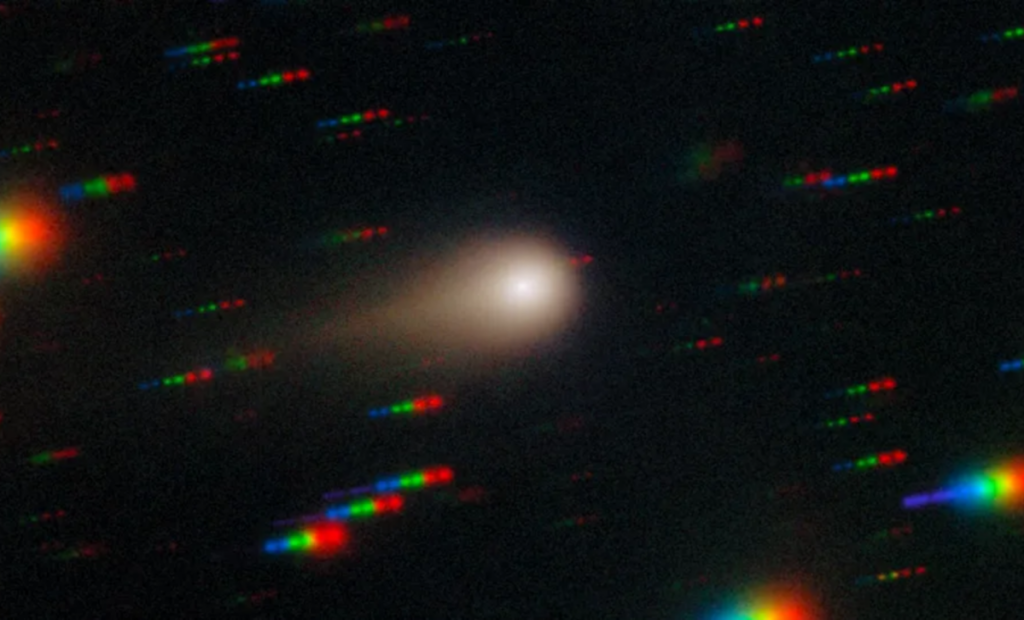
In the vast expanse of the cosmos, where time stretches across unimaginable scales, some objects stand out as cosmic time capsules. One such object is the interstellar comet 3I/ATLAS, a mysterious traveler that has ventured into our solar system from beyond the stars. Recently, scientists made a startling discovery: this comet might be up to 12 billion years old, potentially making it one of the oldest objects to ever pass through our cosmic neighborhood.
The Ancient Traveler: How Old Is 3I/ATLAS?
3I/ATLAS made headlines when it entered our solar system, becoming one of only three known interstellar objects to visit from beyond our cosmic neighborhood. What makes this comet especially intriguing is its age. Recent analysis of its isotopic composition, including data from the James Webb Space Telescope’s Near-Infrared Spectrometer (NIRSpec), suggests the comet may be between 10 and 12 billion years old.
This age estimation comes from detailed studies of the comet’s carbon and deuterium ratios. Carbon-12, an isotope of carbon, dominates the comet’s molecular structure, with far fewer carbon-13 isotopes than what is typically found in comets from our solar system. This significant difference hints that 3I/ATLAS formed long before carbon-13 became prevalent in the galaxy, a period dating back to the early days of the Milky Way, around the time the galaxy itself was taking shape.
By comparing the isotopic ratios to galactic evolution models, the team behind the study concluded that 3I/ATLAS’s formation likely occurred during the first few billion years after the Milky Way’s formation. Such early formation implies that this comet originated from a much older part of the galaxy, potentially even before the solar system existed.
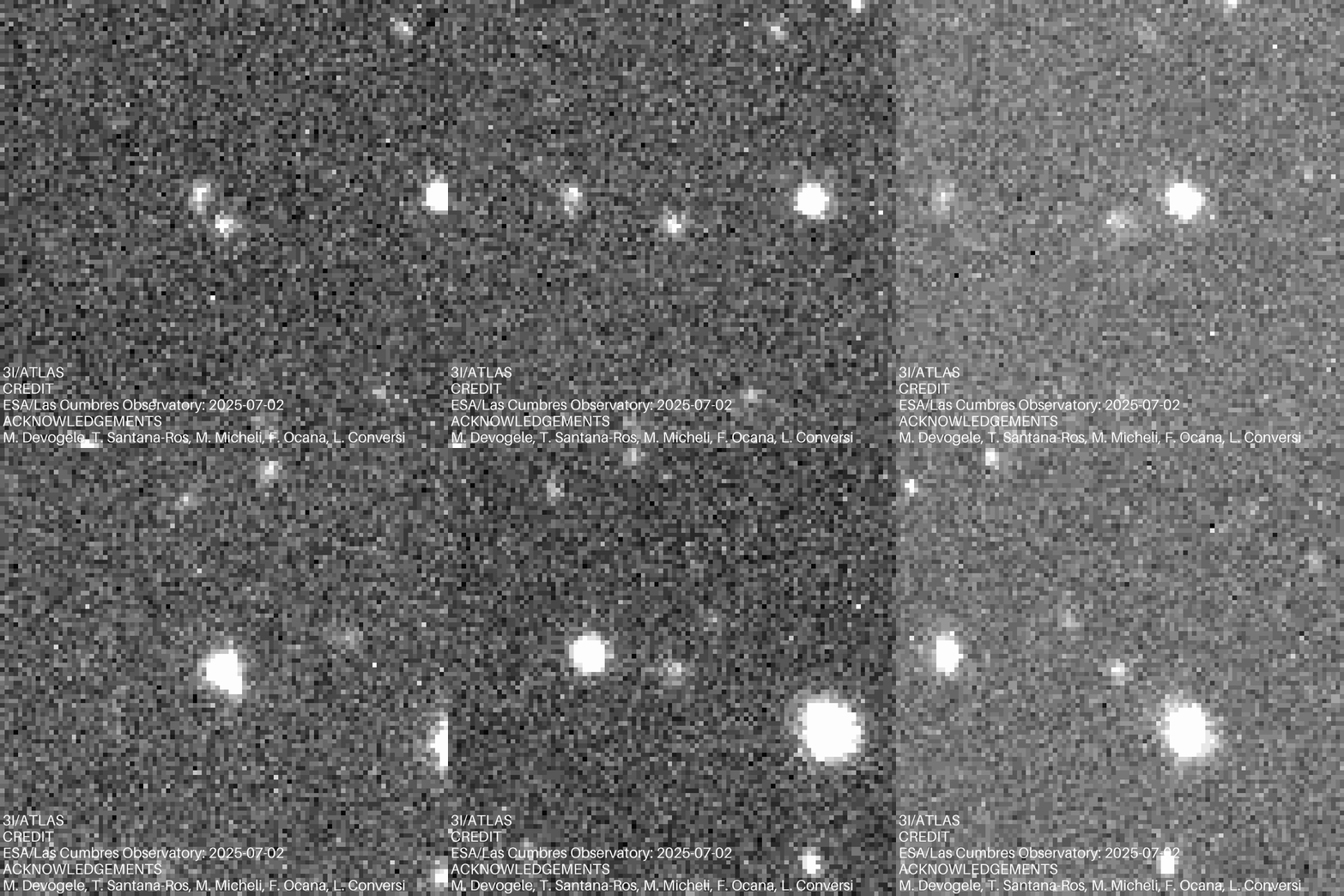 3I/ATLAS traveling through a background of stars. (Image credit: ESA)
A Relic of a Lost Star System
The study, led by Martin Cordiner from NASA Goddard, raises profound questions about the origin of 3I/ATLAS. The comet’s chemical makeup reveals that it formed in an environment rich in carbon but relatively poor in carbon-13. This suggests that it predates the carbon-13 buildup that resulted from nova explosions and other stellar processes within the Milky Way. At the time when 3I/ATLAS was born, the galaxy had yet to experience the full cycle of star formation that would later enrich it with heavier elements.
Cordiner’s team, after analyzing the comet’s chemical composition, identified it as a relic of a much earlier planetary system, possibly one that no longer exists. In their study, published on arXiv, Cordiner explains, “That seems more probable the older 3I/ATLAS is.” This statement underscores the likelihood that the star system which produced 3I/ATLAS has since been lost to the ravages of time.
Despite this, the comet offers researchers invaluable insights into the formation of early planetary systems. Unlike comets in our solar system, which formed under the warmer conditions of our Sun, 3I/ATLAS likely originated from a cooler, more distant region of its original star system. The presence of significant deuterium enrichment in its water molecules further supports this theory. Water-ice can become enriched with deuterium under the frigid conditions typical of interstellar clouds, where temperatures drop to near absolute zero.
 3I/ATLAS, imaged by the Hubble Space Telescope. (Image credit: NASA, ESA, STScI, D. Jewitt (UCLA). Image Processing: J. DePasquale (STScI))
The Chemistry of Early Planets
What makes 3I/ATLAS even more fascinating is its complex chemical composition. The comet contains significant amounts of carbon-based molecules, including methanol, formaldehyde, and methane, compounds that are fundamental to life as we know it. This rich mix of organic molecules suggests that the building blocks of life may have been widespread across the early galaxy, long before our solar system formed.
“We believe that cometary materials in general are representative of the building blocks of planets outside the water snow-line in the protoplanetary disk,” Cordiner told Space.com.
This means that 3I/ATLAS could provide essential clues about how planets and even life might have emerged in other star systems. Its chemical inventory reflects the conditions of planetary systems far from our own, expanding our understanding of how diverse and ancient the processes of planet formation can be.
For astronomers and astrobiologists, the implications of this discovery are profound. The presence of complex organic molecules and water-rich chemistry in 3I/ATLAS suggests that early planets may have been significantly different from those we observe in our solar system, shaped by conditions that no longer exist today.
Tracing the Comet’s Origins: A Cosmic Mystery
Despite its extraordinary age, the exact origin of 3I/ATLAS remains a mystery. Tracing its path through the stars is no easy task, especially given the gravitational interactions that have altered its trajectory over billions of years. However, the study of its chemical composition offers a vital clue: the comet is likely a relic of the Milky Way’s thick disk, a region of the galaxy that began forming stars as early as 13 billion years ago.
“We believe that the older 3I/ATLAS is, the more probable it is that it came from the thick disk of the Milky Way,” Cordiner explained. Observations of other stars in this part of the galaxy suggest that it could be the source of many ancient cosmic objects, making it a plausible origin for 3I/ATLAS.
In the end, the mystery of 3I/ATLAS’s origin may never be fully solved. But by studying this ancient interstellar traveler, scientists are not only learning about the early history of our galaxy but also gaining critical insights into the conditions that shaped the formation of planets and the potential for life in other star systems.