
NASA’s Transiting Exoplanet Survey Satellite (TESS) has unveiled TOI-4616 b, an Earth-sized planet orbiting a nearby M-dwarf star. Published in a March study on the preprint server arXiv, the findings reveal a rocky world situated just 91.8 light years from Earth, offering a rare opportunity to study a terrestrial planet in a nearby star system. This discovery marks a significant step in identifying planets with Earth-like conditions around stars that are not only common but also prime candidates for future atmospheric research.
A New World Revealed: TOI-4616 B’s Key Features
The exoplanet TOI-4616 b is no ordinary find. Orbiting the mid-M dwarf star TOI-4616, it is an Earth-sized planet with a radius of 1.22 Earth radii, and an estimated mass between 1.5 and 3.0 Earth masses. Its orbital period is remarkably short, just 1.5 days, completing a full orbit in under two Earth days. With an equilibrium temperature of about 525 K (around 252°C or 485°F), TOI-4616 b exists in a zone where the radiation levels are extreme, a characteristic that offers a unique perspective on the environmental conditions of exoplanets near their stars.
“The combination of precise stellar parameters, consistent multiband transit measurements, and the host star’s brightness makes TOI-4616 a particularly valuable system for future atmospheric and dynamical studies,” the researchers explain.
This makes TOI-4616 b not just a discovery but a vital test case for models of atmospheric escape, volatile retention, and interior composition of planets exposed to intense stellar irradiation.
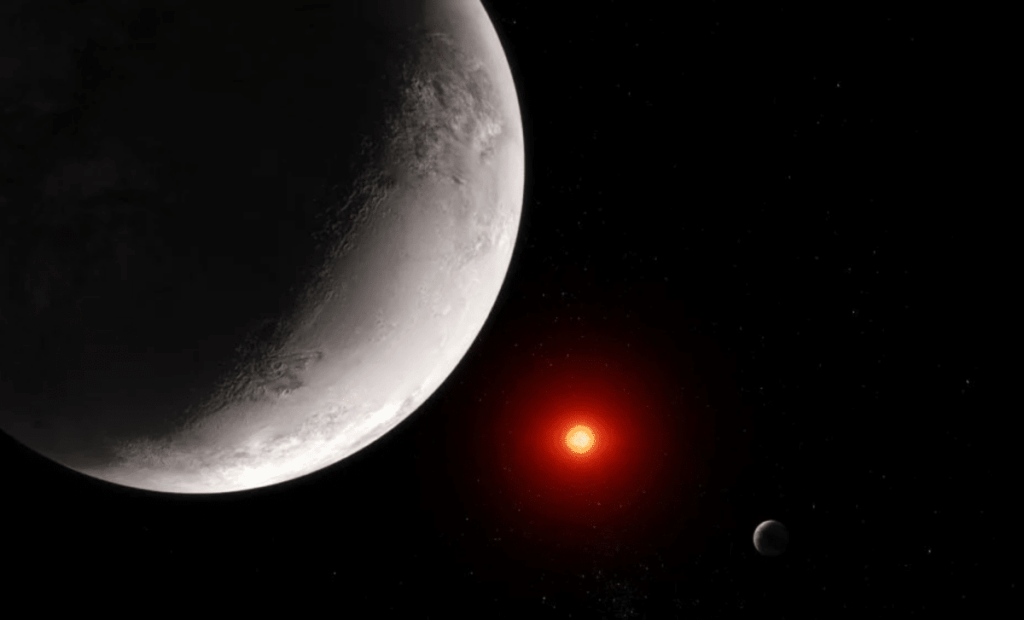
 This artist’s illustration shows the TRAPPIST-1 system. It’s a red dwarf that host seven rocky exoplanets, and four of them are likely in the habitable zone. The star’s powerful flaring is represented in the image. The JWST hasn’t found any evidence of atmospheres around any of these worlds yet.
Image Credit: NASA, ESA, CSA, STScI, Joseph Olmsted (STScI)
Why M-Dwarf Stars Matter in the Search for Exoplanets
M-dwarf stars like TOI-4616, smaller and cooler than our Sun, are among the most abundant types of stars in the galaxy. They are of particular interest to astronomers because their low luminosity and small size create ideal conditions for detecting Earth-sized planets. As noted in the study available on arXiv,
“Rocky exoplanets are particularly abundant around M-type stars. Their small radii and low luminosities provide favorable conditions for detecting transiting terrestrial planets and probing their atmospheric properties.”
These stars, which make up around 70% of the stars in our galaxy, present an exciting frontier for discovering new planets. Planets orbiting these stars are often subjected to strong radiation, making them valuable for understanding how atmospheres evolve and how planets respond to intense stellar activity.
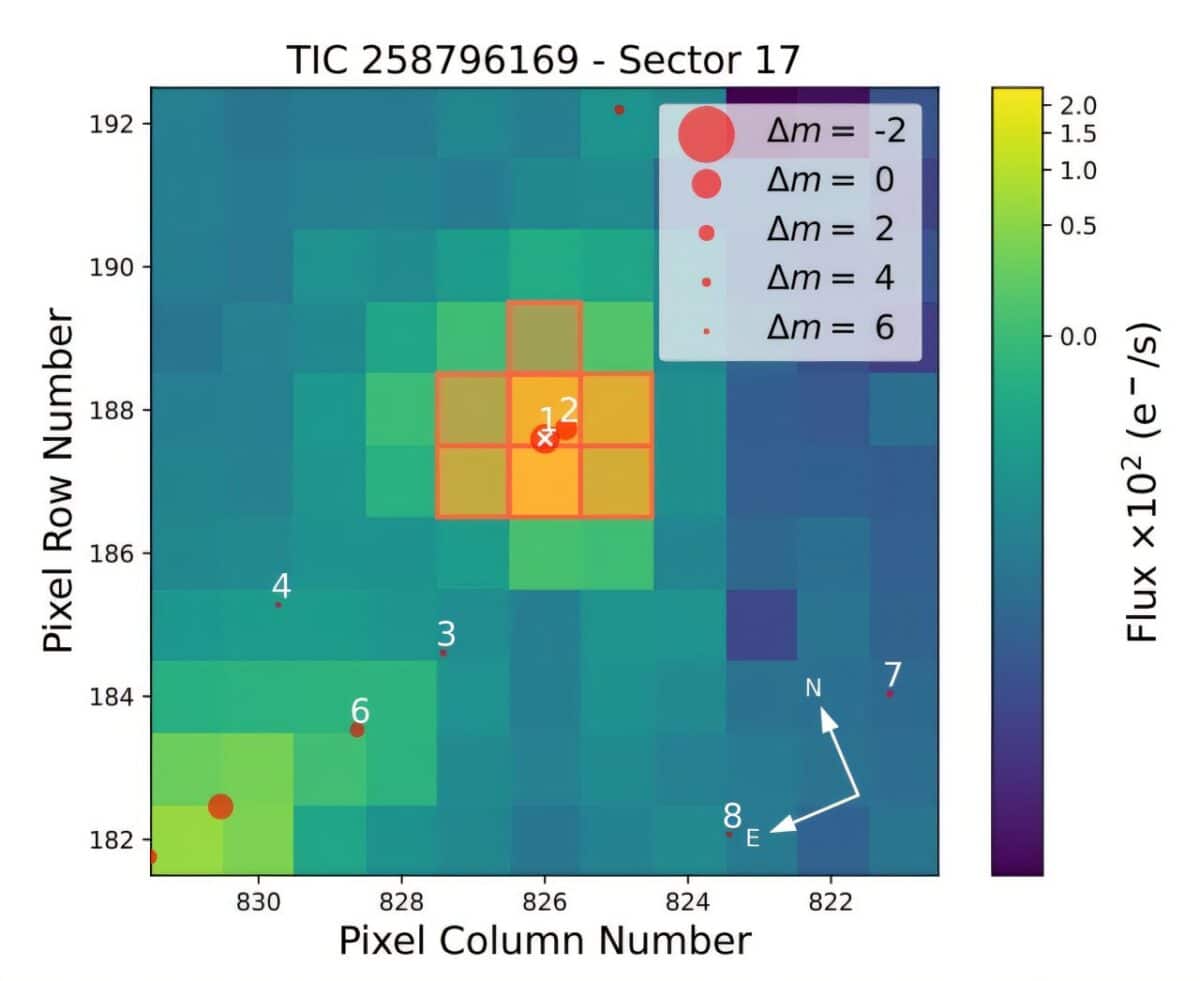 Target Pixel File (TPF) of TOI-4616 from TESS Sector 17. Credit: arXiv (2026). DOI: 10.48550/arxiv.2603.10905
TOI-4616 B: A Benchmark for Future Studies
The proximity of TOI-4616 b to Earth and the star’s well-constrained characteristics offer a golden opportunity for comparative planetary studies. With the planet’s unique attributes, researchers see it as an ideal benchmark for understanding how planets in similar conditions evolve, especially those exposed to extreme radiation.
“We report the discovery and statistical validation of TOI-4616 b, an Earth-sized planet transiting a nearby mid-M dwarf observed by the Transiting Exoplanet Survey Satellite (TESS),” the authors write.
The planet’s location places it in a regime that is intermediate between Earth-sized planets orbiting early M dwarfs and those orbiting ultra-cool stars, offering a rare vantage point for scientists.
The study suggests that TOI-4616 b could serve as a key benchmark for investigating planetary structure and evolution in the strongly irradiated regime, especially as we seek to understand the potential for life or habitability on such worlds. With continued observation, it is hoped that James Webb Space Telescope (JWST) will help detect atmospheric features, potentially revealing crucial details about its composition and climate.
The Significance of This Discovery for Atmospheric Science
The study of TOI-4616 b is not just about the planet itself, it also contributes significantly to our understanding of how planetary atmospheres behave under extreme conditions. Given that the planet likely has a secondary atmosphere, one that could have survived after the original hydrogen/helium envelope was stripped, future research could help scientists probe the processes of atmospheric escape and volatile retention.
“TOI-4616 b resides in an extreme irradiation environment for an Earth-sized planet orbiting a mid-M dwarf,” the researchers explain. This makes the planet a particularly informative test case for various atmospheric models. With its unique combination of precise stellar parameters, well-observed multiband transit data, and the star’s brightness, it stands as a model system for future atmospheric and dynamical studies.