
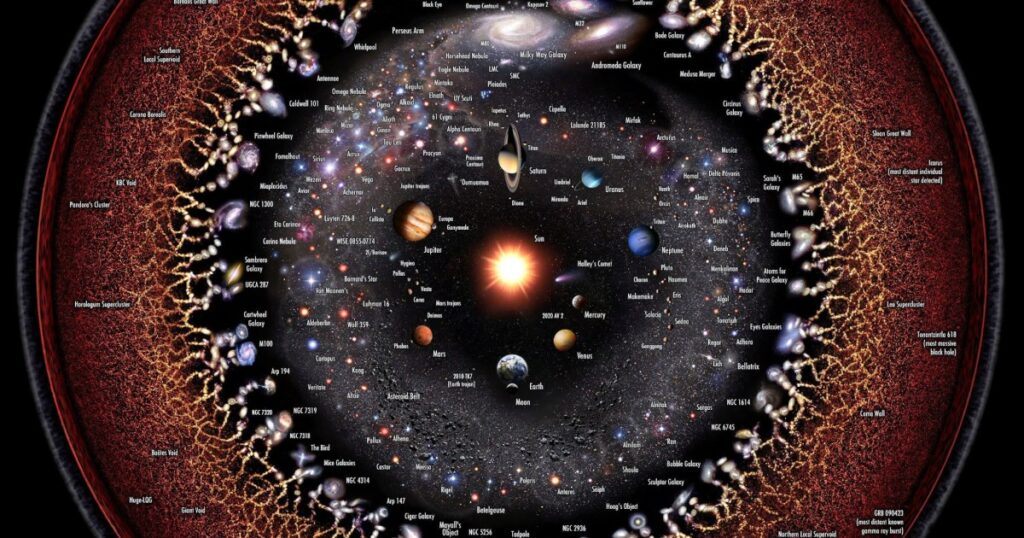
For most of us, the Universe doesn’t appear to change all that much on the scale of even a human lifetime. Sure, the stars move relative to one another, our Sun burns through a little more of its fuel, and the Moon slowly spirals away from the Earth as our rotation rate gradually slows down. Meanwhile, on grander scales, older stars across the Universe run out of fuel and die, new episodes of star-formation are triggered, and the Universe continues to expand, driving individual galaxies, groups of galaxies, and clusters of galaxies mutually apart, faster and faster, as time goes on.
But all of these events take time: enormous amounts of time. Stars occasionally pass through our Oort Cloud, but that only happens a couple of times every million years. The Sun will continue burning for 5-7 billion more years before it evolves to the next stage of its life. The Moon spirals away from the Earth so slowly that we’ll continue to have total solar eclipses for hundreds of millions of years. And star-formation will continue for trillions of years, providing new lights in the sky and new chances for cataclysms like supernovae, kilonovae, and tidal disruption events.
Still, when you read, “the Universe has changed by the time you finish this sentence,” just over three seconds have likely elapsed. And in those three seconds, the Universe changes in some profound ways that truly add up over time. Here are some of the most important and relevant ones.
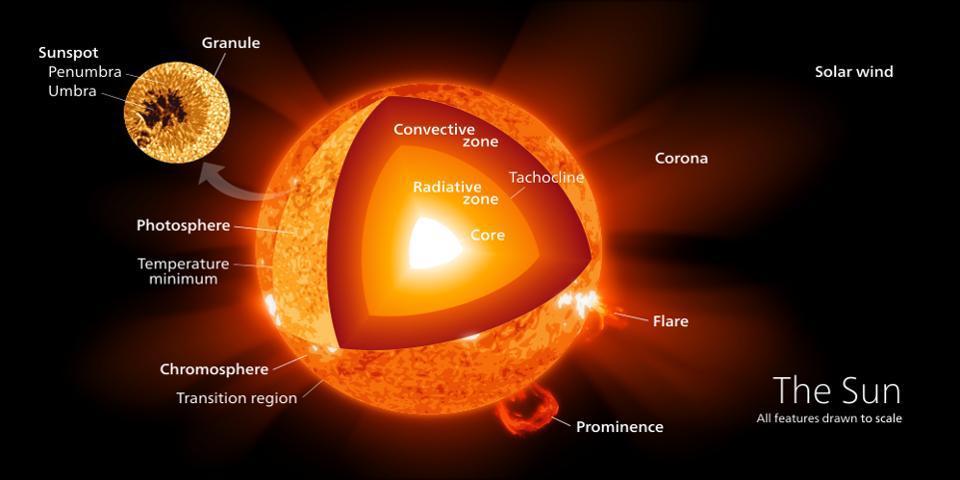
This cutaway showcases the various regions of the surface and interior of the Sun, including the core, which is the only location where nuclear fusion occurs. As time goes on and hydrogen is consumed, the helium-containing region in the core expands and the maximum temperature increases, causing the Sun to “cross the main sequence” as its energy output increases. The balance between the inward-pulling gravity and the outward-pushing gas pressure, only slightly augmented by radiation pressure (and mostly in higher-mass stars), determines the size and stability of a star, while the core’s temperature and element abundance determines the rate and species of fusion inside.
Credit: Wikimedia Commons/KelvinSong
Let’s start with the brightest thing in our skies: the Sun. The Sun shines with a relatively constant power output — also known as its luminosity — of a humongous 3.8 × 10²⁶ Watts. The ultimate source of that power, and the reason the Sun doesn’t slowly contract, cool, and/or dim over time, is because there is a nuclear furnace burning in the Sun’s core: one that converts bare protons into helium-4 nuclei. This process, relying on several nuclear fusion chain reactions but dominated by the proton-proton chain, converts a small amount of the net initial mass of those protons, about 0.7%, into pure energy via Einstein’s most famous equation: E = mc².
This leads to a few profound changes, even over the incredibly small timescale of just three seconds or so.
First, the Sun loses mass: the equivalent of about 12 million tonnes (or 12 billion kg) over the span of reading a single sentence.
Second, the Sun very, very slowly heats up: becoming slightly more luminous (increasing its overall energy output) by a tiny factor of ~5 × 10–¹⁶.
And third, the tiny loss of mass causes the Earth to very slowly spiral outward in its orbit around the Sun: increasing our orbital radius by approximately 5 nanometers during the time it took you to read the title sentence of this article.
Just by having a Sun with the mass and energy output that it exhibits, these changes are inevitable.
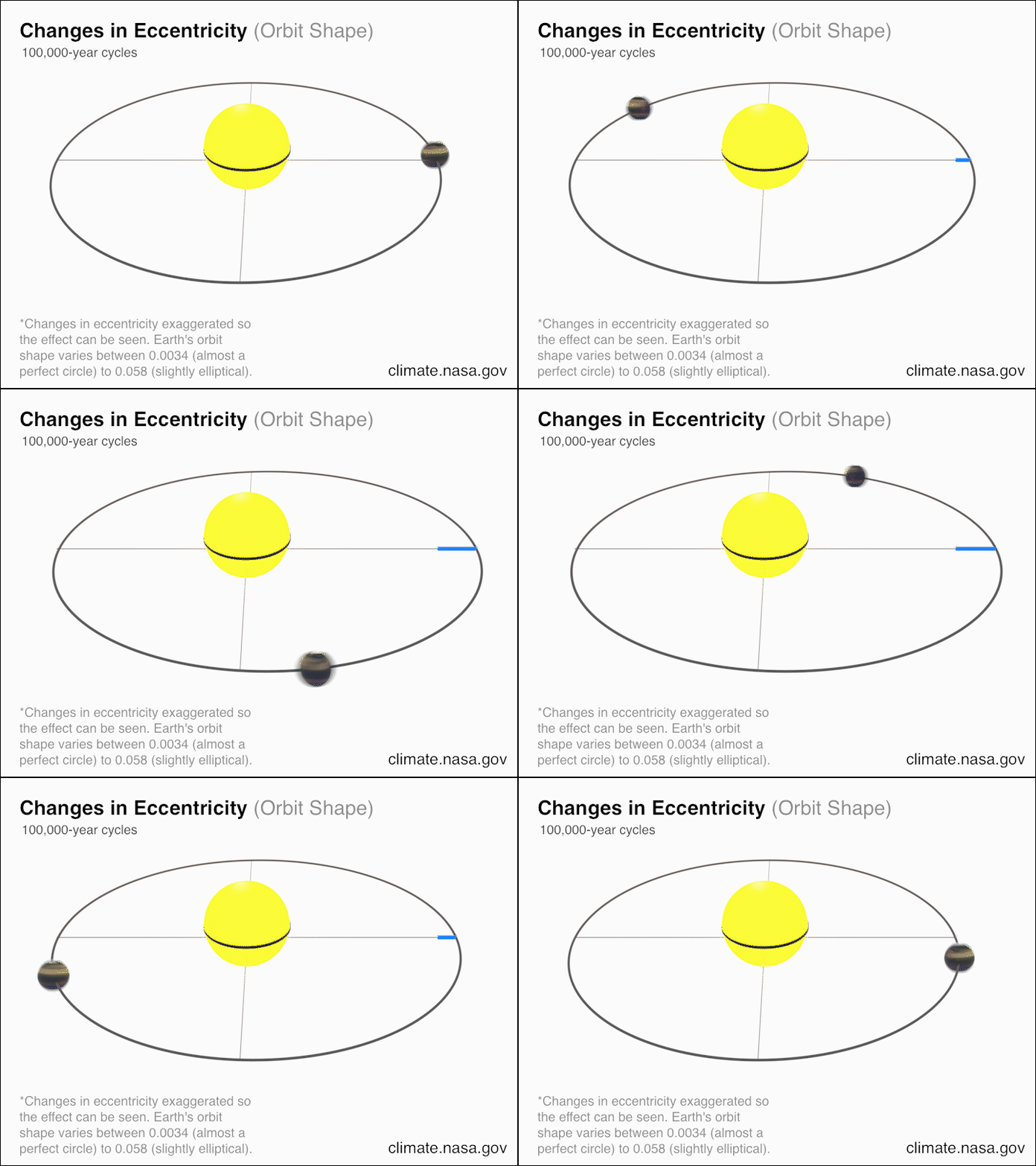
The Earth orbits the Sun not in a perfect circle, but rather in an ellipse. The eccentricity, or the difference between the “long axis” and the “short axis” of our orbit, changes over time, while the Earth-Sun orbital period, which defines our year, changes slowly over the lifetime of our Solar System. If we neglect the other planets and the mass loss of the Sun due to the solar wind and nuclear fusion, we’d find that the total angular momentum of the Earth-Sun(-and-moon, if you like) system remains conserved.
Credit: NASA/JPL-Caltech
Then, we have to reckon with the fact that it isn’t just the Earth that orbits the Sun, but the Earth-Moon system. Compared to the Earth, the Moon is relatively large and massive: 27% of the Earth’s diameter and about 1.2% as massive as Earth. Those are the largest ratios of a moon-to-planet in the entire Solar System, with one needing to move down to the Pluto-Charon dwarf planet system to find a more significant ratio. The Moon is exceptionally large compared with Earth for a natural satellite, and at only 30 Earth-diameters away from the Earth, its gravity is significant enough to be the dominant factor in determining the oceanic tides that our planet experiences.
But the gravitational interactions between the spinning Earth, the Moon, and the Sun all lead to an additional set of important effects: they cause the transfer of angular momentum from the spinning Earth to the orbit of the Moon around the Earth. This means that:
the Earth’s rotation slows ever so slightly, lengthening the day by around 4 picoseconds over the three seconds it takes you to read the title sentence,
and the Moon spirals out from Earth a little bit as well, migrating outwards by a net of just over 10 nanometers during those same three seconds.
While these changes might sound tiny, remember that they are cumulative: happening every three seconds atop the changes of the prior three seconds, and so on. Over very long timescales, they lead to a substantial evolution.

Tidal rhythmites, such as the Touchet formation shown here, can allow us to determine what the rate of Earth’s rotation was in the past. During the emergence of the dinosaurs, our day was closer to 23 hours long, not 24. Back billions of years ago, shortly after the formation of the Moon, a day was closer to a mere 6-to-8 hours, rather than the 24 we possess today: a consequence of the Earth’s rotation slowing as angular momentum is transferred to the Moon, leading to our natural satellite spiraling outwards and the progressive lengthening of Earth’s day.
Credit: Williamborg/Wikimedia Commons
Overall, across the Universe, a process continues that has been happening for all but the earliest few million years in cosmic history: the formation of stars. Thus far, 13.8 billion years into our cosmic story, a whopping 2 × 10²¹ stars have already formed: a truly cosmic, mind-bogglingly large number. And yet, the star-formation rate is just a trickle of what it was at its peak some 11 billion years ago: just 3% of that maximum rate. It’s steadily fallen ever since that maximum, known as “cosmic noon,” was reached all those billions of years ago, and is steadily decreasing even now, ensuring that most of the stars that will ever form in the Universe have already been born.
But even with those diminished numbers, it means that in the span it took you to read the title of this article — just around three seconds — more than 4000 solar masses worth of new stars were formed throughout the Universe. Given that the average estimated mass of a newborn star is right around 40% of the Sun’s mass, that equates to approximately 10,000 new stars formed every three seconds within our observable Universe. Very rarely is one of those stars within our Milky Way, which only forms an estimated 5 new stars per year, but overall, the Universe keeps on forming them, leading to the total number of stars growing ever larger over time.
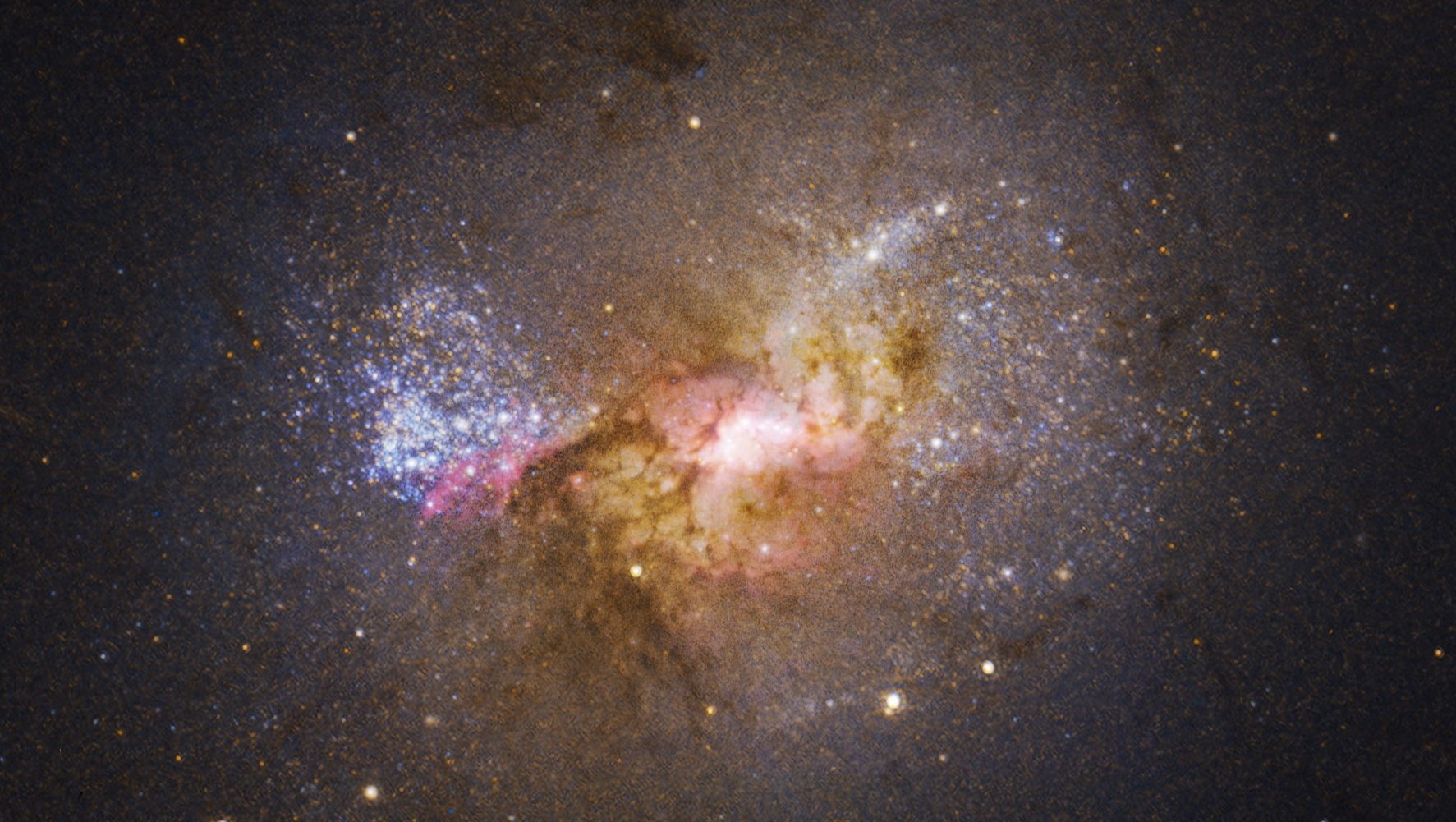
When major mergers of similarly-sized galaxies occur in the Universe, they form new stars out of the hydrogen and helium gas present within them. This can result in severely increased rates of star-formation, similar to what we observe inside the nearby galaxy Henize 2-10, located 30 million light years away. This galaxy will likely evolve, post-merger, into another disk galaxy if copious amounts of gas remains within it, or into an elliptical if all or nearly all of the gas is expelled by the current starburst. Starburst events like this were much more common earlier in cosmic history than they are today, and may be the primary method for forming the majority of stars within our Universe.
Credit: NASA, ESA, Zachary Schutte (XGI), Amy Reines (XGI); Processing: Alyssa Pagan (STScI)
Of course, the stars that we form don’t live forever; eventually they will all burn through the entirety of the fuel in their cores and then die: either gently for lower-mass stars, or violently and cataclysmically for other (mostly higher-mass) stars. The most massive stars will die in a core-collapse supernova, often within merely a few million years after their birth. Less massive stars can also experience violent cataclysms, either from tidal disruption events (where the star is torn apart by the gravitational influence of a black hole, for example) or when a stellar remnant, like a white dwarf, collides with another white dwarf, producing a “second chance” (or type Ia) supernova.
All told, supernovae are common events throughout the Universe, and even during the sentence-reading span of just over three seconds, an estimated 16 new supernovae occur somewhere within the observable Universe. About 80% of those supernovae, or around 12-13 of them, are likely of the core-collapse variety, with the remainder being type Ia, or emerging from the collision of two white dwarfs. Occasionally, one of those 12-13 supernovae may indeed be a peculiar type, coming from a star with a stripped gas envelope from its interactions in a binary system. For those brief moments where the supernova goes off and its energy output peaks, it can rival or even exceed the brightness of the entire host galaxy where it occurred.
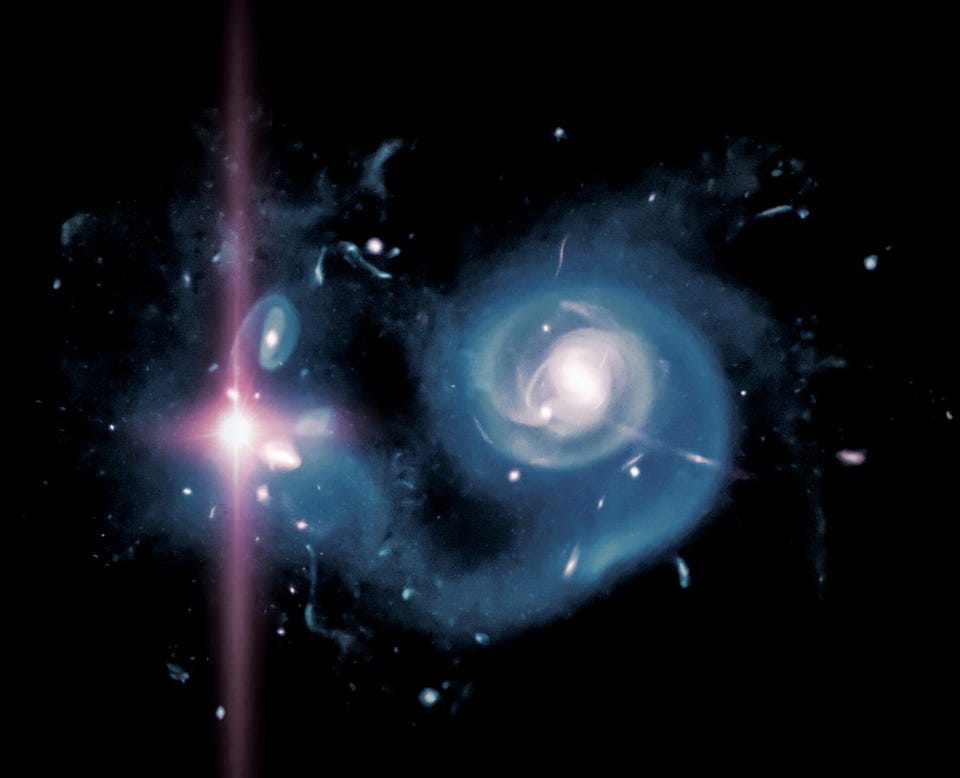
This illustration of superluminous supernova SN 1000+0216, the most distant supernova ever observed at a redshift of z=3.90, from when the Universe was just 1.6 billion years old, was up until recently the current record-holder for individual supernovae in terms of distance, a record that the JWST VENUS collaboration has likely broken in early 2026. In terms of brightness, it easily outshines an entire galaxy; in terms of power, it can rival most of the stars in the Universe, all combined together, for brief intervals.
Credit: Adrian Malec and Marie Martig (Swinburne University)
But the most subtle changes are sometimes the most profound of all, and these happen not just within the observable Universe, but on the cosmic scales that push the limits of what we can see, measure, reach, or ever hope to interact with. The earliest signal that we can directly see from the Universe at all is the cosmic microwave background (CMB), also known as the leftover glow from the Big Bang. Back when the Universe was young, there were no neutral atoms: just an ionized sea of protons, atomic nuclei, and electrons, amidst a bath of neutrinos and photons. Early on, for about 380,000 years, those photons were numerous enough and hot enough that any time a neutral atom formed, a photon smashed into that electron and kicked it off of that short-lived atom, ionizing it once again.
But as the Universe expands, it cools: stretching the wavelength of each photon traveling through it. After a few hundred thousand years, neutral atoms can stably form, and by the present day, the temperature of the CMB has fallen to a chilly 2.7255 K, or less than three degrees above absolute zero. This cooling process continues even today, where in the span of just three meager seconds, the CMB is now around 60 attokelvin (or about 6 × 10–¹⁷ K) cooler than it was three seconds prior. Again, it’s not much on such a short timescale, but all of these changes are cumulative, and in time, we’ll be able to measure the cooling of this omnipresent background glow.
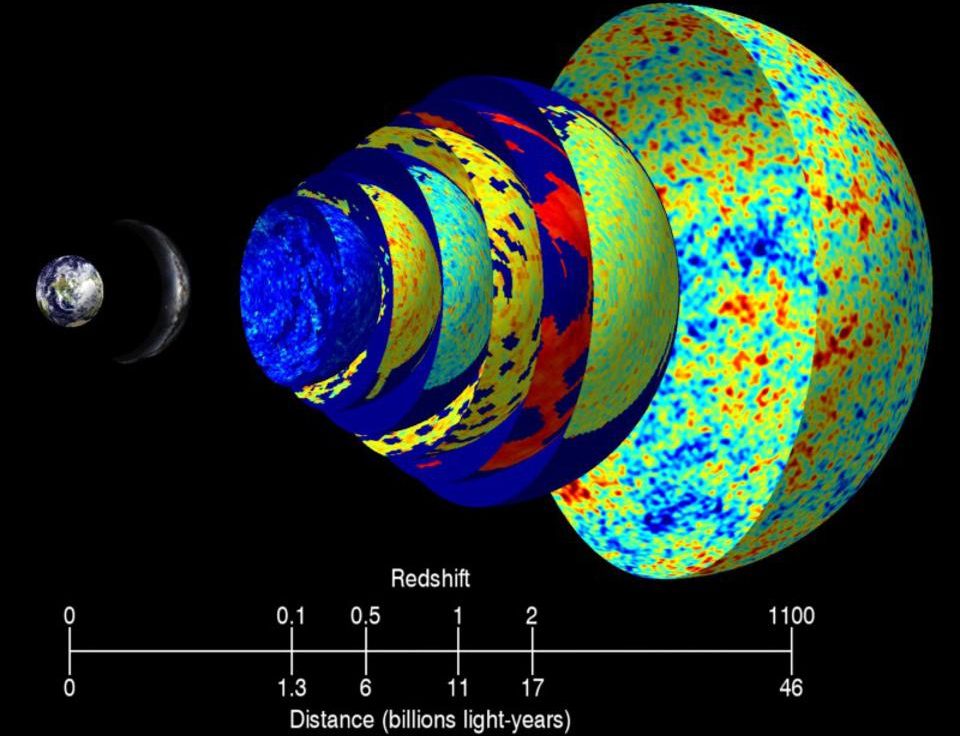
At any epoch in our cosmic history, any observer will experience a uniform “bath” of omnidirectional radiation that originated back at the Big Bang. Note that the CMB isn’t just a surface that comes from one point, but rather is a bath of radiation that exists everywhere at once. As each new year passes, the CMB cools down further by about 0.2 nanokelvin, and in several billion years, will become so redshifted that it will possess radio, rather than microwave, frequencies.
Credit: Earth: NASA/BlueEarth; Milky Way: ESO/S. Brunier; CMB: NASA/WMAP
Meanwhile, the scale of the observable Universe continues to grow. Because of cosmic expansion — and the fact that space itself expands, in addition to signals traveling at up to the speed of light through it — our 13.8 billion year-old Universe allows us to detect signals that are up to 46.1 billion light-years away. This cosmic expansion doesn’t actually consist of anything exceeding the speed of light, as the limits of special relativity (which limit speeds to a limit of the speed of light) are confined to two objects passing each other at the same location in space. Special relativity says nothing about the rate of expansion itself, enabling our dark energy-dominated Universe to grow much faster than one would expect using special relativity alone.
Even in the span of just over three seconds, our cosmic horizon grows tremendously: by approximately 6 million kilometers. This is much, much greater than the distance that light travels in just over three seconds, which is just over 900,000 km! The expansion of the Universe, particularly at the limits of what can be observed, are impressive, important, and profoundly different from how light behaves as it moves in our local vicinity: where the Universe, at least locally, doesn’t expand.
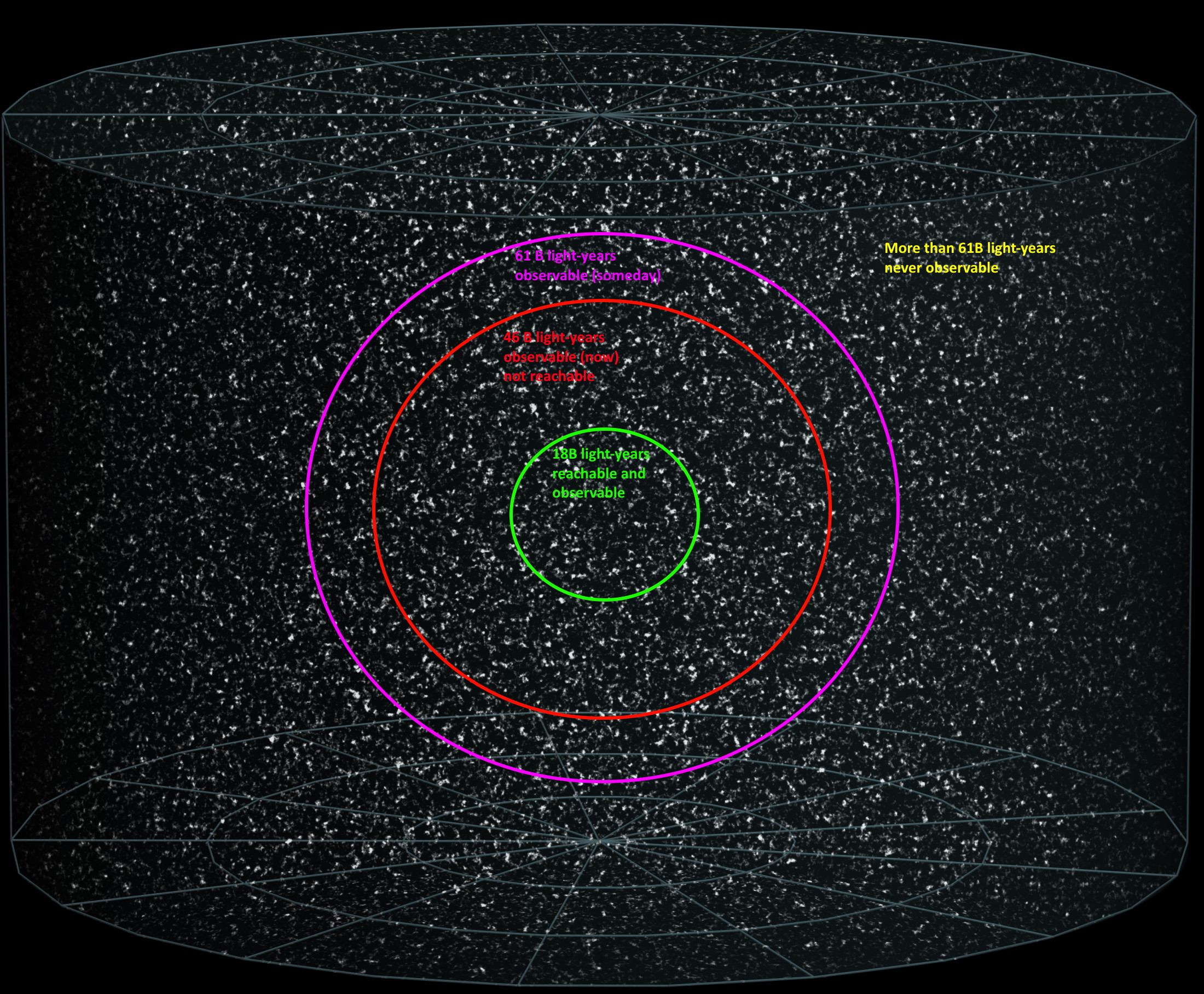
The size of our visible Universe (yellow), along with the amount we can reach (magenta) if we left, today, on a journey at the speed of light. The limit of the visible Universe is 46.1 billion light-years, as that’s the limit of how far away an object that emitted light that would just be reaching us today would be after expanding away from us for 13.8 billion years. Anything that occurs, right now, within a radius of 18 billion light-years of us, will eventually reach and affect us; anything beyond that point will not. Each year, another ~20 million stars cross the threshold from being reachable to being unreachable.
Credit: Andrew Z. Colvin/Wikimedia Commons; annotations: E. Siegel
As time marches onwards, there are two other profound changes that occur, in addition to the already-profound change of the most distant signal we can perceive being progressively farther away.
The first is that the number of objects that we can see continues to increase over time. Right now, we can see for about 46.1 billion light-years in all directions, but there are more distant objects (and locations) that have already emitted light, long ago, that’s been on its way towards us for most of cosmic history. Because of the two factors of:
the expansion of space in our expanding Universe,
and the finite speed of light, where light always travels through the vacuum of space at 299,792,458 m/s,
the light from objects within 61 billion light-years of us will eventually reach our eyes, with more of that already-on-the-way light arriving as time marches on.
In the span of reading just one sentence, over a timescale of just over three seconds, that implies that about a thousandth of a galaxy becomes newly visible. That may not sound like much in terms of galaxies, but when you remember that an “average” galaxy has about a billion stars within it, that’s a million new stars that become visible over the span of those three-or-so seconds.
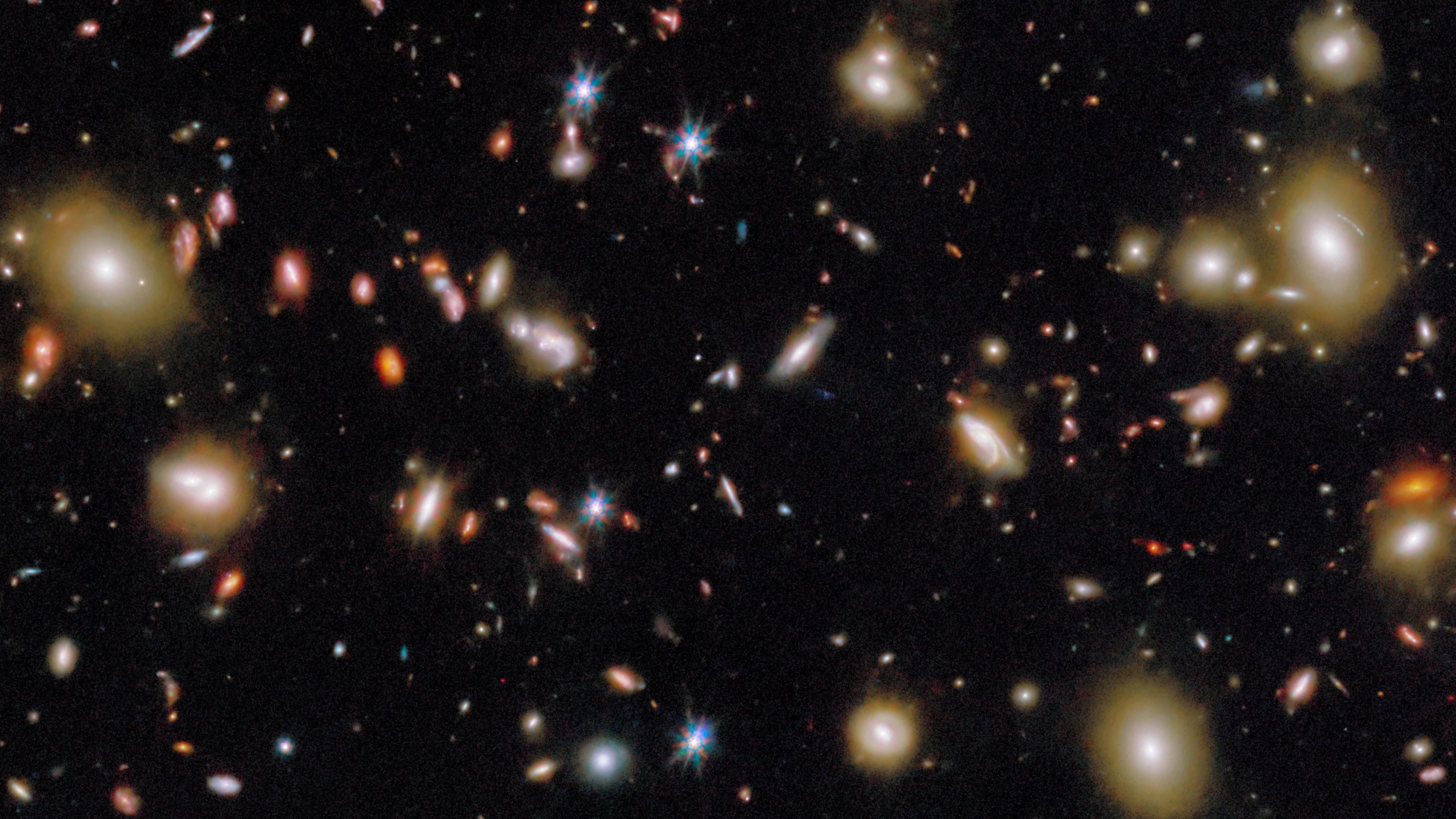
This deep-field view of the Universe showcases a portion of the COSMOS-Web field acquired with JWST. In this field are a wide variety of galaxies, where the reddest, most dot-like galaxies represent some of the most distant, earliest galaxies ever seen. Even beyond the limits of JWST, the light from galaxies still farther and more ancient than our current cosmic limits speeds towards us, where in the far future, it will someday become observable to an observer on Earth.
Credit: ESA/Webb, NASA & CSA, G. Gozaliasl, A. Koekemoer, M. Franco, and the COSMOS-Web team
But just as more and more objects become visible over time, fewer and fewer objects become reachable over time. That’s because the Universe is dominated by dark energy, as opposed to being dominated by matter or radiation: a transition that occurred about six billion years ago. For the first 7.8 billion years of cosmic history, if you were to look at a galaxy that was receding from us within the expanding Universe, you’d find that its recession speed appeared to slow over time. The expansion rate was dropping, and so was the apparent speed that a galaxy moved away from you.
Since dark energy rose to domination, however, the opposite is true. A distant object that recedes from you in the expanding Universe recedes at faster and faster speeds, progressively: a consequence of the expansion accelerating due to dark energy. At a distance that’s somewhere between 15 and 18 billion light-years away, a galaxy transitions from being “reachable,” which means that if you left today at the speed of light, you could eventually reach it, to “unreachable.”
As a consequence of cosmic expansion, in the span of just three seconds, two additional stars transition from reachable to unreachable: a dramatic illustration of how consequential dark energy is even on extremely human timescales.
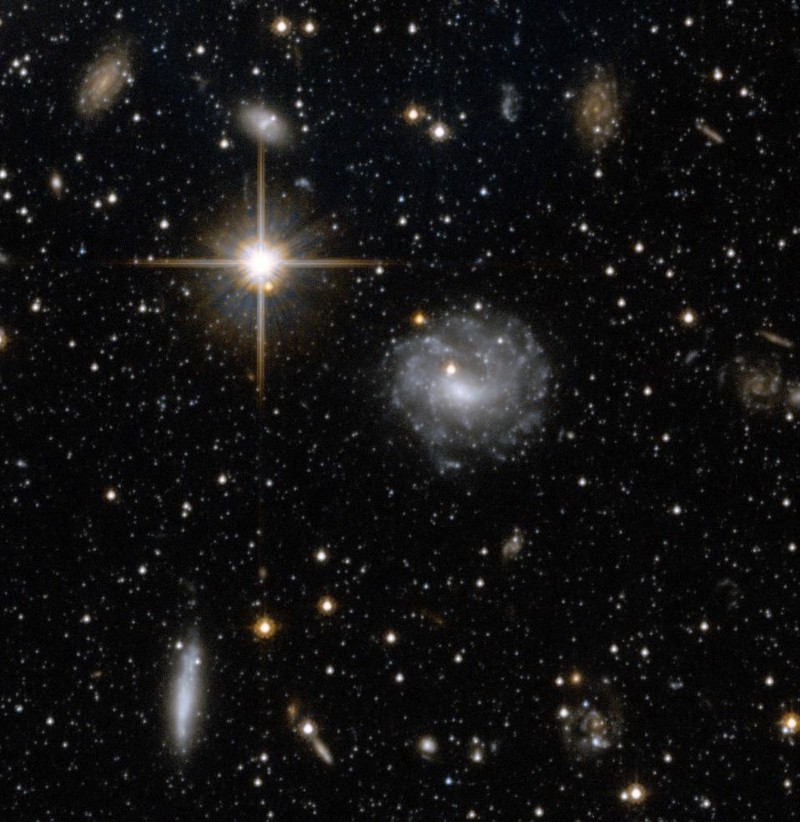
This image, perhaps surprisingly, showcases stars in the Andromeda Galaxy’s halo. The bright star with diffraction spikes is from within our Milky Way, while the individual points of light seen are mostly stars in our neighboring galaxy: Andromeda. Beyond that, however, a wide variety of faint smudges, galaxies in their own right, lie beyond. Individual stars can be resolved in galaxies up to tens of millions of light-years away by Hubble and up to around 200 million light-years away by JWST, but galaxies must be 15-to-18 billion light-years away to cross the threshold where they appear to speed away from us at faster than the speed of light.
Credit: NASA, ESA, and T.M. Brown (STScI)
With every sentence you read, or with every just-over-three-seconds that elapse, these changes happen again and again. They compound atop one another. If you spend ten minutes reading this article, or approximately 600 seconds, then you should multiply everything you learned by reading this by a factor of 200: that’s how much the Universe has changed over this amount of time. With each year that passes, since a year contains roughly 31.56 million seconds, multiply the numbers you’ve read so far by 10,000,000; those are the Universe’s annual changes. And if you multiply those numbers by a billion, you’ll get the changes in the Universe with each century, many of which add up quite significantly.
In reality, everything in the Universe changes with time. Wait a few hundred-thousand years, and another star will drift into our Oort cloud, perturbing it and potentially triggering new comets arriving in our inner Solar System. Wait a few million years, and the number of days in a year will change, removing the need for leap years altogether. Wait a few hundred million years, and total solar eclipses will be no more. Wait a few billion years, and the number of reachable galaxies will have halved from what it is today, while our Sun reaches the end of its life and dies. These are slow changes from just one limited perspective, but they’re happening all across the Universe. If you’re willing to wait for long enough, just about anything you can fathom will someday disappear. Even though it hasn’t happened yet, the sciences of physics and astrophysics allow us to predict when and exactly by how much: a tremendous achievement of human investigation into the very nature of nature itself.