
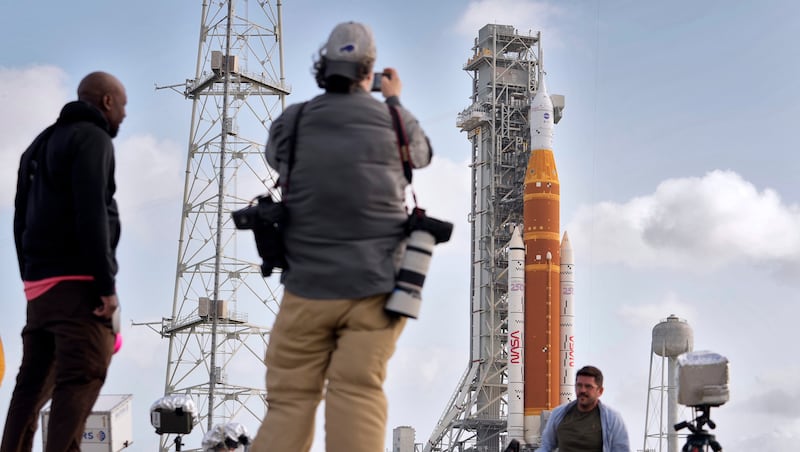
Following weeks of delays, NASA’s Artemis II mission looks set to launch Wednesday on a 10-day journey that will take its four-person crew to the moon and beyond, traveling further from Earth than any previous manned space mission.
If successful, it will also mark the first time a crewed space flight has traveled to the moon since the final Apollo mission in 1972.
While the ultimate goal includes traveling some 252,000 miles into space on an arc that takes the Orion space capsule and its crew about 5,000 miles beyond the moon before returning to Earth, mission commander Reid Wiseman told reporters last week that he and his fellow astronauts have trained for a variety of contingencies.
“This is a test mission,” Wiseman said. “When we get off the planet, we might come right back home. We might spend three or four days around Earth. We might go to the moon. That’s where we want to go, but it is a test mission, and we are ready for every scenario as we ride this amazing Space Launch System in the Orion spacecraft, 250,000 miles away. It’s going to be amazing.”
The Artemis II gets set to blast off just weeks after new NASA administrator Jared Isaacman announced accelerated plans, fueled by a $20 billion budget over the next seven years, to build a lunar base near the moon’s south pole. The revised strategy aims to launch two moon missions a year to accelerate the moon base construction and set the table for a future manned mission to Mars.
“This revised, step-by-step approach to learn, to build muscle memory, to bring down risk and gain confidence is exactly how NASA achieved the near impossible in the 1960s,” he said in a late March announcement, referring to the agency’s Apollo program. “But this time, the goal is not flags and footprints. This time, the goal is to stay.”
Before a crew heads to the moon for a surface landing attempt, however, a mission planned for next year aims to test out the process of docking the Orion capsule with lunar landers currently being developed in separate competitive tracks by SpaceX and Blue Origin.
When will Artemis II blast off?
Four astronauts, including Wiseman, pilot Victor Glover and mission specialists Christina Koch and Jeremy Hansen from the Canadian Space Agency, are currently in pre-flight quarantine and lined up to fly the Artemis II mission, scheduled to launch from Kennedy Space Center on Wednesday at 4:24 p.m. MDT in the Orion crew capsule atop a Space Launch System rocket. NASA reports weather forecasters are predicting an 80% chance of acceptable weather for launch.
An initial launch date in February was delayed by a string of issues including hydrogen leaks and problems with the rocket booster’s pressurization systems. During a Sunday press conference, NASA acting associate administrator Lori Glaze said all systems were go for a launch this week.
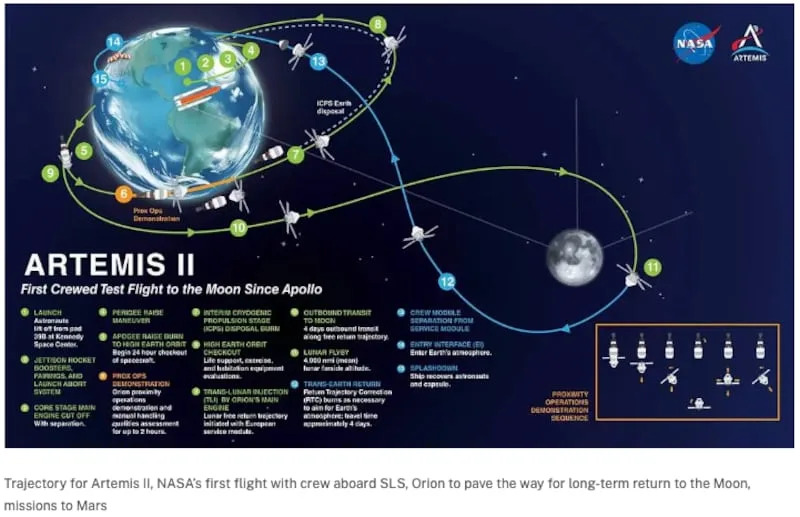
Wednesday’s planned launch follows 2022’s Artemis I mission, a $4.1 billion effort which saw a successful 25-day unmanned flight that tested out the SLS rocket/Orion capsule package. That mission took the Orion spacecraft, carrying three dummies outfitted in spacesuits and monitoring gear, within 81 miles of the lunar surface before eventually traveling some 40,000 miles past the moon before returning to Earth.
If the Artemis II mission goes to plan, NASA intends to launch the SLS/Orion package on a mission in 2028 that will include a landing on the moon’s surface.
A Utah connection to booster rockets
NASA says its SLS launch system stands at 322 feet high — taller than the Statue of Liberty — and weighs 5.75 million pounds when loaded with fuel.
During launch and ascent, the SLS produces 8.8 million pounds of maximum thrust, 15% more thrust than the Saturn V rockets that propelled Apollo astronauts to the moon.
Utah-based aerospace companies and experts have long played a role in NASA space missions, and the Artemis program is no exception. The massive solid fuel booster rockets that provide some 75% of the SLS initial thrust were developed and tested in Utah by Northrop Grumman in partnership with NASA.