
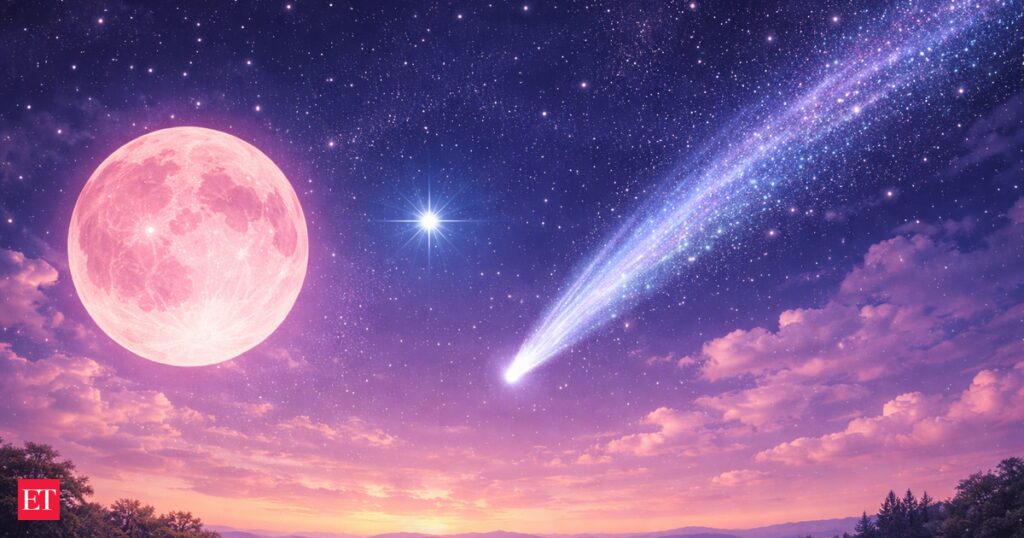
The first week of April promises a series of eye-catching celestial events, led by the rise of the Pink Moon, a bright appearance of Venus and the potential sighting of a glowing comet tail in the evening sky. Astronomy enthusiasts across North America are expected to witness a dynamic sequence of events beginning April 1, with each night offering a unique visual spectacle, as per a report by Forbes. Full Pink Moon Lights Up the SkyThe highlight of the week is the Pink Moon, April’s full moon, which reaches its peak brightness late on April 1. Despite its name, the moon does not appear pink; instead, it derives its name from seasonal spring blooms in North America.
The best time to view the Pink Moon is during moonrise, shortly after sunset, when it appears larger and glows in shades of orange or copper due to atmospheric scattering.
Adding to the excitement, the moonrise coincides with a major space milestone, as NASA’s Artemis II mission, a crewed lunar mission, may launch within a similar time window, creating a rare overlap of natural and human-made celestial events.
Moon And Spica Create a Striking PairOn April 2, the focus shifts to the elegant pairing of the Moon and Spica, one of the brightest stars in the night sky. Live Events
The moon, now in its waning gibbous phase but still appearing nearly full, will sit close to Spica in the southeastern sky after sunset. The proximity, just a few degrees apart, makes it an easy and rewarding sight for observers.
Spica, located about 250 light-years away, is actually a binary star system emitting a combined brightness far exceeding that of the Sun, making this conjunction particularly striking, as per a report by Forbes.At the same time, the planet Venus will be visible low on the western horizon, shining brightly just after sunset before dipping below view.
Comet Tail May Appear in TwilightTowards the end of the week, attention turns to the possibility of spotting a comet tail from Comet MAPS (C/2026 A1), a sungrazing comet that will pass extremely close to the Sun.
The comet reaches its closest approach on April 4, travelling within less than a million kilometres of the solar surface. Such proximity makes its behaviour unpredictable, it could brighten dramatically or disintegrate entirely.
If it survives, observers may catch a glimpse of the comet tail low in the western sky just after sunset. Clear skies, a flat horizon and patience will be essential for viewing.
Astronomers note that even if the comet breaks apart, its fragments could still produce a visible tail in the days following.
Constellation Spotlight: Draco the DragonFor those looking to explore deeper into the night sky, the constellation Draco offers a rewarding target. Winding between the Big and Little Dippers, Draco is visible throughout the year in the northern hemisphere.
One of its notable stars, Thuban, once served as Earth’s North Star thousands of years ago. Though its stars are relatively faint, the constellation’s serpentine shape becomes clearer under dark skies.
A Week of Rare Celestial AlignmentsThe combination of the Pink Moon, the Moon and Spica alignment, and the possible appearance of a comet tail makes this week particularly significant for skywatchers.
Such alignments not only provide stunning visuals but also offer insight into the dynamic nature of the cosmos, from lunar cycles to stellar systems and transient cometary visitors.
With favourable weather conditions, observers can expect a memorable start to April under the night sky.
FAQsWhat is the Pink Moon? The Pink Moon is April’s full moon, named after spring flowers, not its actual colour.
What is special about the Moon and Spica event? It is a close alignment where the bright star Spica appears near the moon, making it easy to spot.