
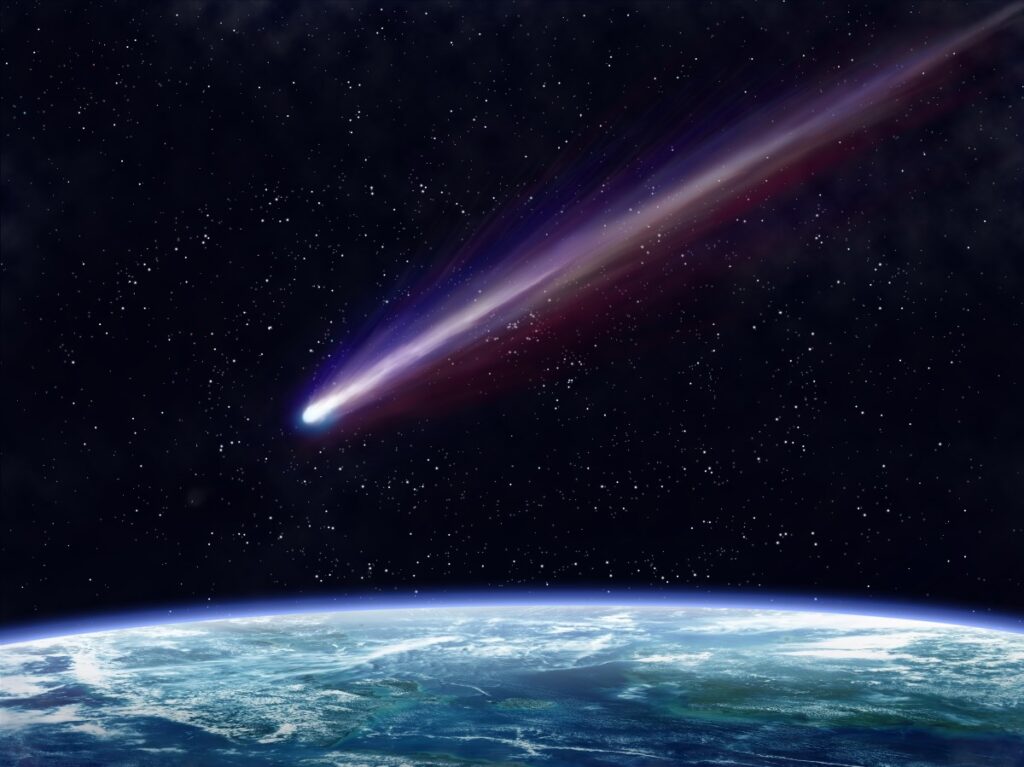
Skywatchers are being urged to mark their calendars as a newly tracked comet is set to make a relatively close pass by Earth in April, offering a potential viewing opportunity for those with the right equipment.
According to NASA’s April skywatching guidance, Comet C/2025 R3 will reach its closest approach to Earth on April 27, when it comes within about 44 million miles of the planet.
The comet is expected to be visible in the predawn sky for observers in the Northern Hemisphere through much of the month, with April 17 highlighted as one of the best opportunities to spot it.
Visibility Uncertainty
The celestial event has been met with excitement online, with space lovers sharing tips about how and when to see the comet, particularly as it coincides with other April skywatching highlights like Mercury’s peak visibility and the Lyrid meteor shower.
NASA notes that while the comet may be one of the brighter ones of the year, it will likely still require binoculars or a small telescope to view, as it is expected to reach a brightness of around magnitude eight. That places it beyond naked-eye visibility for most observers.
Additional reporting from Space.com highlights the uncertainty surrounding the comet’s brightness.
“Although the comet, known as C/2025 R3 (PanSTARRS), could become bright enough to be seen with the naked eye, it could just as easily remain visible only through binoculars and telescopes,” according to Space.com.
The comet’s journey through the inner solar system is also drawing attention from astronomers.
Space.com reported that, “Comet R3 (PanSTARRS) is due to reach perihelion—its closest point to the sun—on April 20, 2026,” placing it between the orbits of Mercury and Venus before it swings past Earth days later.
Visibility conditions will vary depending on timing and location. NASA advises looking toward the eastern sky before sunrise, particularly in mid to late April, when the comet will pass through constellations such as Pegasus and Pisces.
Observers in the Southern Hemisphere may have better evening viewing conditions in early May.
‘Notoriously unpredictable’
Despite growing excitement, experts caution that, “the brightness of comets is notoriously unpredictable,” meaning expectations could shift as the comet approaches.
The broader context has also fueled interest, as recent years have seen a resurgence in visible comets after a quieter period.
Several notable comets appeared in 2024 and 2025, raising hopes that C/2025 R3 could continue the trend.
NASA’s April skywatching guide also points to other notable events, including Mercury reaching its greatest elongation on April 3 and the Lyrid meteor shower peaking between April 21 and 22, offering multiple opportunities for stargazers throughout the month.
With the comet’s closest approach set for April 27, attention will remain on whether it becomes one of the standout astronomical events of 2026, or remains a more modest sight for dedicated observers.
Newsweek has reached out to NASA for comment via email.