
Hand it to Jared Isaacman. Barely three months after being confirmed by the Senate as NASA’s 15th administrator, the space agency’s new boss has really hit the ground running — and he’s planning to take America on a giant leap into space.
On Tuesday this week, NASA held an Ignition event outlining its plans for space exploration over the next five years. Here are just a few of the things Isaacman outlined at this event.
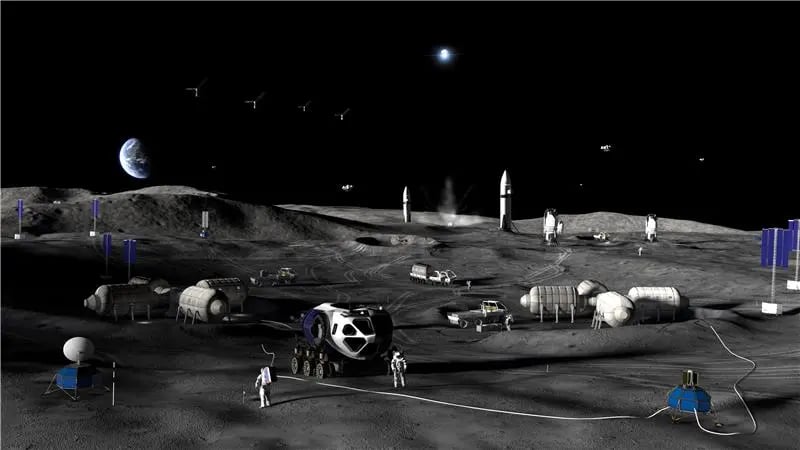
Image source: NASA.
Omnis Artemis in tres partes divisa est
First and foremost, we’re going back to the moon — and this restyled Project Artemis project is divided into three parts.
In phase 1, which begins now, NASA will proceed with plans to launch its Space Launch System rocket (SLS, built by Boeing (BA 1.96%)) and send a crewed Orion spacecraft (built by Lockheed Martin (LMT 1.88%)) on a course past the moon and back to Earth. This launch is designated Artemis II.
Next year will follow with Artemis III, in which an SLS rocket puts an Orion into low Earth orbit, where it will practice docking with SpaceX’s Human Landing System lunar lander and Blue Origin’s Blue Moon. The series of three flights culminates in Artemis IV, which will put two astronauts on the moon in 2028 for a weeklong mission.

Today’s Change
(-1.96%) $-3.80
Current Price
$190.56
Key Data Points
Market Cap
$150B
Day’s Range
$189.31 – $193.41
52wk Range
$128.88 – $254.35
Volume
240K
Avg Vol
7.4M
Gross Margin
4.85%
Simultaneously with this crewed lunar exploration effort will be a series of at least 30 robotic missions to the moon, deploying a series of cargo landers to deliver and test out equipment necessary for lunar exploration and setting up an eventual base on the lunar surface. These missions will fall under two separate NASA programs: Commercial Lunar Payload Services (CLPS) and Lunar Terrain Vehicle (LTV). To support this part of phase 1, NASA announced yesterday it has awarded a fifth cargo flight, IM-5, to Intuitive Machines (LUNR 8.89%), and Intuitive will develop an enlarged version of its Nova lander (Nova-D) for this mission.
Phase 1 alone will cost $10 billion, says Isaacman.
Partes 2 et 3
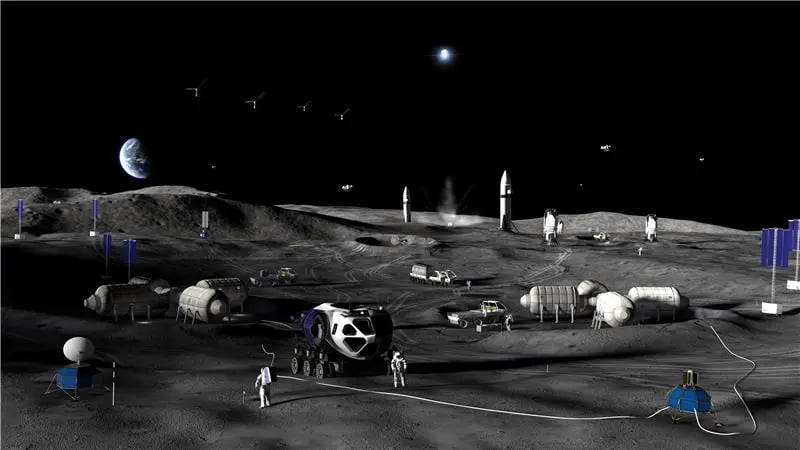
Beginning with Artemis V, flights will take place roughly once every six months and will be crewed. These launches will form part of the second phase of Ignition, with astronauts arriving on the moon to build out “early infrastructure,” including temporary habitations and pressurized rovers for exploration. (It’s unclear whether Boeing’s SLS will be used for future Artemis missions or whether NASA will switch to much cheaper rockets from SpaceX and Blue Origin — but I’d bet on the latter.)
Segueing into phase 3, NASA will use large cargo landers and Artemis missions to deliver heavier elements of lunar infrastructure. International partners will deliver Multipurpose Habitats (MPH, from Italy) and a Lunar Utility Vehicle (from Canada). No mention was made of a power source for the moon base, but it would seem likely that large deliveries of solar panels or even a small nuclear power plant might appear in this phase.
Completion of phases 2 and 3 will grow the cost of the entire moon base plan to $20 billion.
Meanwhile, back (around) Earth
But what about the International Space Station, you ask? Are we abandoning low Earth orbit in favor of the moon? Not exactly.
Plans continue apace for NASA to support space companies building private commercial space stations. Taking a step-by-step approach, NASA plans to build a government-owned core module that will attach to the existing International Space Station (ISS). Private space stations will temporarily attach to this module, be validated to ensure they’re safe, and then be allowed to detach to form independent space stations.
(Read more about the teams vying to build private space stations here.)
Incidentally, a continuing presence in low Earth orbit argues for a continuing need for spacecraft such as SpaceX’s Crew Dragon, Northrop Grumman’s (NOC 1.86%) Cygnus, and possibly Boeing’s Starliner to carry astronauts and supplies to the stations.
Onward to Mars
Last but not least: Mars.
Perhaps Isaacman’s most surprising announcement was Space Reactor-1 Freedom. Shifting from chemical rockets to atomic power, NASA will build “the first nuclear powered interplanetary spacecraft,” carrying a 25-kilowatt nuclear reactor, and fly it to Mars in 2028 — there to deliver multiple Ingenuity-class helicopter drones to further explore the Red Planet.
Who will build SR-1 Freedom? Isaacman didn’t say. We do know that among NASA, Defense Advanced Research Projects Agency (DARPA), and the U.S. Department of Energy, the U.S. government has at least three different nuclear spaceship engines in the works. Lockheed Martin is working on at least two of them and Intuitive Machines on one, with Westinghouse and BWX Technologies (BWXT 1.07%) lending a hand on the power plants.
It’s an exciting time to invest in space. Mr. Isaacman, “make it so.”