
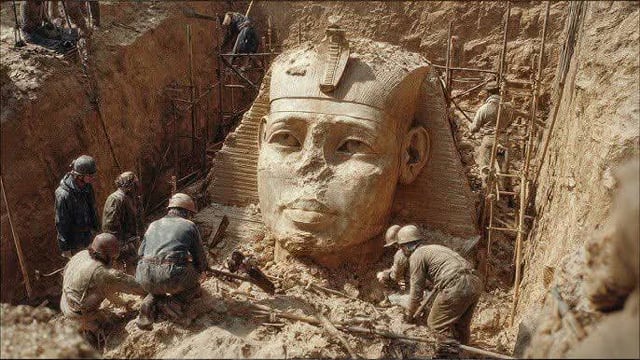
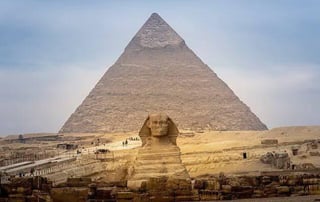
In recent days, claims attributed to an Italian research team have circulated suggesting the presence of a massive buried structure beneath the Giza Plateau, potentially a second statue similar to the Great Sphinx of Giza, located at an estimated depth of around 55 meters below the surface. These claims are said to rely on data obtained through remote sensing techniques, specifically satellite radar (SAR). According to statements attributed to the team leader, Filippo Biondi, analysis of the data revealed a geometric alignment between the Pyramid of Khafre and the known Sphinx, allegedly pointing to the location of a buried structure. The data is also claimed to indicate subsurface anomalies such as cavities, tunnels, or vertical formations. However, from a rigorous scientific standpoint, such claims must be treated with considerable caution. Satellite radar is capable of detecting variations in surface texture and density, but it does not provide direct imaging of complex archaeological structures at depths exceeding 50 meters with sufficient resolution to identify a statue or detailed form; most results represent geophysical anomalies that require ground verification. Furthermore, there is currently no peer-reviewed scientific publication confirming these findings with transparent methodology and reproducible data. In archaeology, major discoveries are not accepted without detailed publication, independent verification, and methodological scrutiny. The Giza Plateau is among the most extensively studied archaeological sites in the world, having undergone continuous excavation and survey since the nineteenth century using multiple techniques including ground-penetrating radar and seismic analysis, which makes the existence of a large undiscovered structure of this scale highly unlikely without substantial new evidence. Egyptian archaeologist Zahi Hawass has previously rejected similar claims, emphasizing that the area has already been thoroughly investigated, reflecting a broader academic consensus based on decades of accumulated data. Some proponents reference the Dream Stele of Thutmose IV, which depicts two sphinx figures, as supporting evidence; however, the prevailing academic interpretation considers this representation symbolic or artistic rather than literal proof of a second monument. At present, there is no reliable scientific evidence supporting the existence of a second Sphinx beneath the Giza Plateau, and such claims remain within the realm of unverified hypotheses based on indirect data interpretation. While not theoretically impossible, confirmation would require direct field validation through drilling or excavation, formal peer-reviewed publication, and independent replication by multiple experts. Until such steps are taken, the claim should be regarded as speculative rather than an established archaeological discovery, even though, if proven, it would significantly reshape current understanding of the Giza complex and its symbolic or architectural planning. #Giza #Sphinx #AncientEgypt #Archaeology #HiddenHistory #LostCivilization #Egyptology #Pyramids
by Professional-Fee3323
6 Comments
I’ll believe it when I see it.
This just in: we’ll never see it.
I don’t believe it.
When they first did their scan their were images of an unusual spiral structure. Nothing that looked anything like another sphinx. They arent just making shit up are they?
Why post AI crap to accompany this?
“scientific debate”
Nah.
> Scientific Debate Over a Controversial Discovery
There’s not scientific debate because there was no discovery. It’s just one dude claiming things.
I can claim some other things. How do you distinguish who’s right?
Shit I had AI nake up for me!