
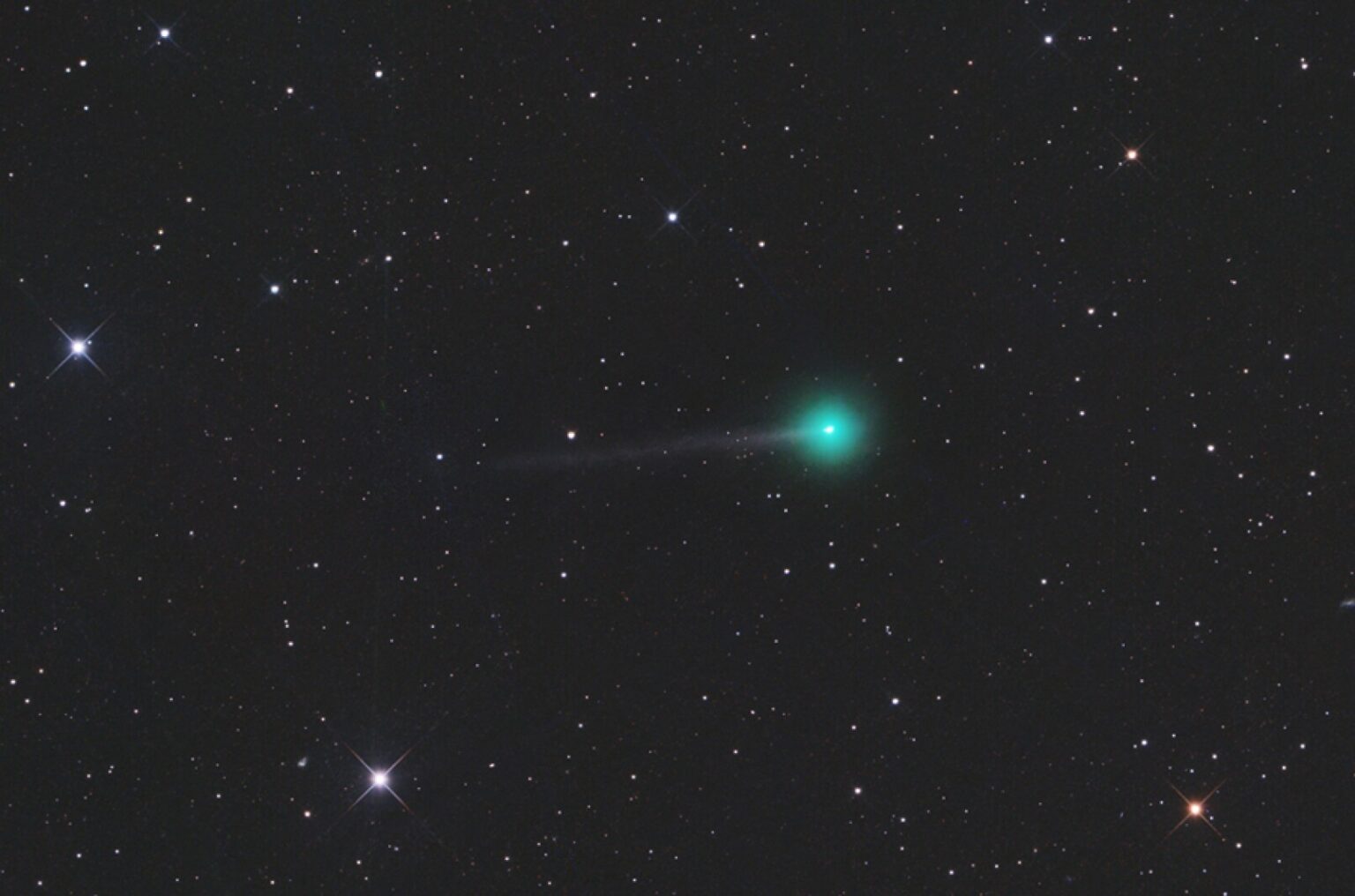
While the number of visible planets isn’t what it was in winter, Venus, the brightest of them, has returned in a big way. Any clear night, you’ll see it beaming low in the western sky at dusk. Together with Jupiter, higher up in the southwest, the two command our attention this month. Mars and Saturn are paired up in the morning sky, but still buried in the solar glare for observers in mid-northern latitudes. Ditto for Mercury.
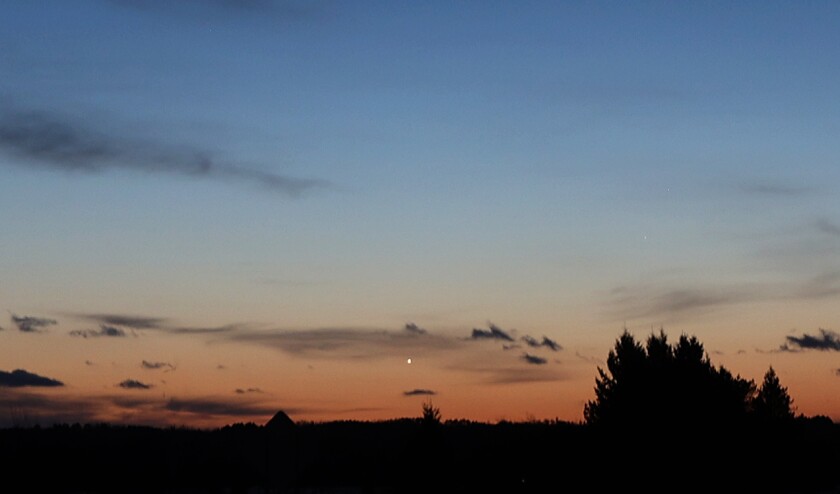
Look for Venus low in the western sky this month. It’s visible as soon as 20 minutes after sunset and very obvious by 40 minutes after. The Roman goddess of love and beauty, Venus will be visible at dusk through September.
Contributed / Bob King
Orion bends on one knee as he dips westward. Come May, the Hunter will exit the evening sky. Leo the lion is now the center of attention, standing high in the southern sky when darkness arrives. Vega, the leader and brightest star of the Summer Triangle asterism, pokes up in the northeast around 10 p.m. It’s still low in April, so you’ll notice it twinkles a lot. That’s because its light has to struggle through the thick, turbulent air at the bottom of the atmosphere, which deflects it this way and that.
Highlights in April include the Lyrid meteor shower, which will stream from a point just west of Vega on the mornings of April 22 and 23. While not a major shower, it’s still worth viewing, with some 15 meteors per hour visible from a dark sky site.
We have two potentially bright comets queued up. If it survives its perilously close solar passage on April 4, Comet MAPS will display a long, bright tail at dusk. Look for it low in the western sky about 20-30 minutes after sunset from about April 6-10. Meanwhile, Comet PanSTARRS, named for the automated telescopic survey that discovered it, will be visible low in the eastern sky near the Great Square of Pegasus at the start of dawn through about April 19. Both comets will likely be visible with the naked eye but bring binoculars just in case.
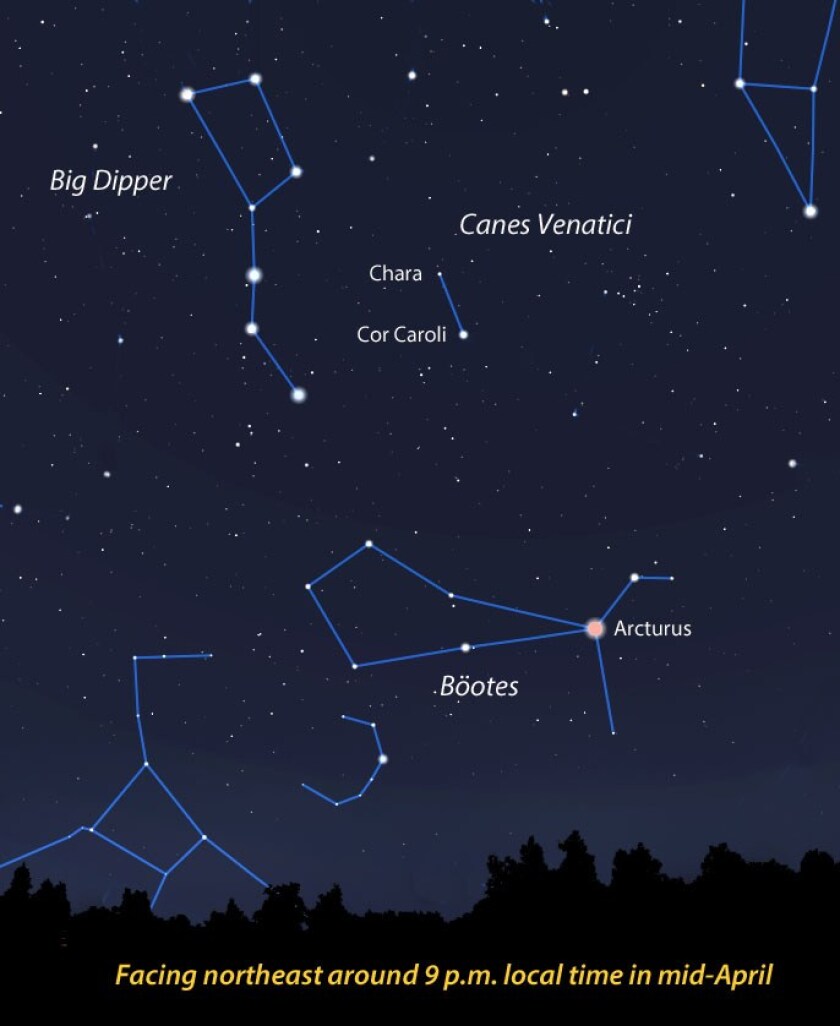
Just find the Big Dipper and look to the right of the handle to see Canes Venatici the hunting dogs. It has two modestly bright stars, Cor Caroli, a beautiful double star in a small telescope, and Chara.
Contributed / Stellarium
Our featured constellation is Canes Venatici (KAY-nees veh-NAT-uh-see) the Hunting Dogs. It’s the third of three constellations that feature dogs. The others are Canes Major (Big Dog) and Canis Minor (Little Dog). The figure represents a pair of leashed greyhounds jumping and snapping at Ursa Major the great bear but held in check by neighboring Boötes the herdsman. Consisting of just two bright stars, it’s easy to find just below the end of the Dipper’s handle. The constellation is a relatively new one, created by Polish astronomer Johannes Hevelius in 1687.
Download the free
for Android and iPhone to help you find and identify the current planets and constellations. It will also display Jupiter’s moons, visible in binoculars and small telescopes. Do a Google search, then install the app, set it in night mode (red screen) and point your phone skyward. For a free April 2026 sky map and calendar go to
www.skymaps.com/downloads.html
. For updates, aurora alerts and news, check out my Facebook at
https://www.facebook.com/astrobobking
.
Events (a.m. indicates the event happens in the morning sky)
April 1 – Full Pink Moon. Named for the moss pink flower, also known as mountain phlox. The moon rises in the east around sunset and shines all night. Moonrise in Duluth occurs at 7:36 p.m., just one minute before sunset.
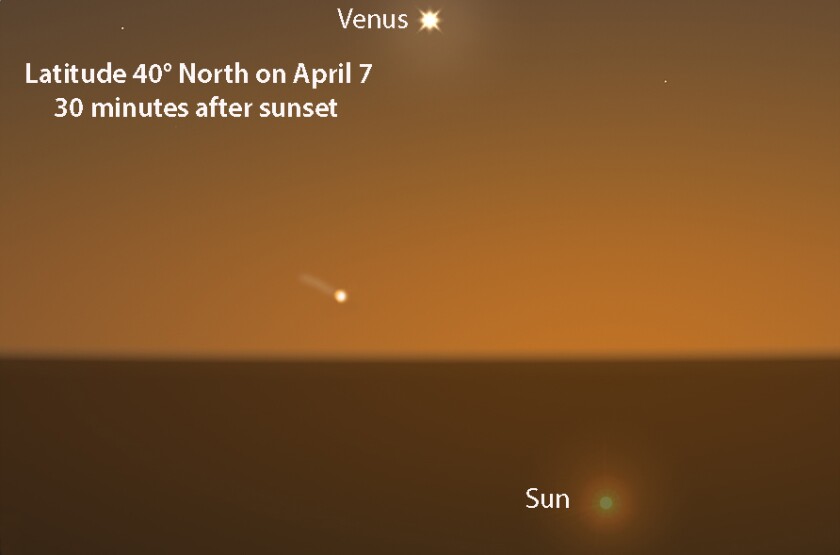
Although it may be visible sooner, Comet MAPS should be far enough from the sun low in the west about 20-30 minutes after sunset on April 7. Look for it below Venus at dusk.
Contributed / Stellarium
April 6-10 – Comet MAPS (C/2026 A1) may become naked-eye bright during early dusk. Or it may crumble and disintegrate! I’ll provide a more detailed map and the latest news in early April on my Facebook page (facebook.com/astrobobking).
April 3-11 – China’s Tiangong (Heavenly Palace) space station make passes across the southern sky during evening twilight. It will look like a bright star, but it’s noticeably fainter than the International Space Station (see below). For a complete list of flyovers for your city, log in to
, select your location and then click the blue Tiangong link.
April 9 (a.m.) – Last quarter moon. Rises around 1 a.m. and stands almost due south at sunrise.
April 10-19 (a.m.) – PanSTARRS (C/2025 R3) will be visible in binoculars (and possibly the unaided eye) at the start of dawn low in the eastern sky in the constellation Pegasus. I’ll provide a map showing its path on my Facebook page early in the month.
April 19-30 (a.m.) – The International Space Station makes one or two passes each morning during twilight. For a complete list of flyovers for your city, log in to
, select your location and then click the blue ISS link. Or download and install NASA’s Spot the Station app at the app store or Google Play.
April 17 – New Moon. The moon is near the sun in the daytime sky and not visible.
April 18 – Sliver crescent moon shines to the right of Venus. Look low in the northwestern sky at dusk.
April 22 – Waxing lunar crescent stands directly above Jupiter. Gemini’s brightest stars, Castor and Pollux, are also on the scene, shining above the moon.
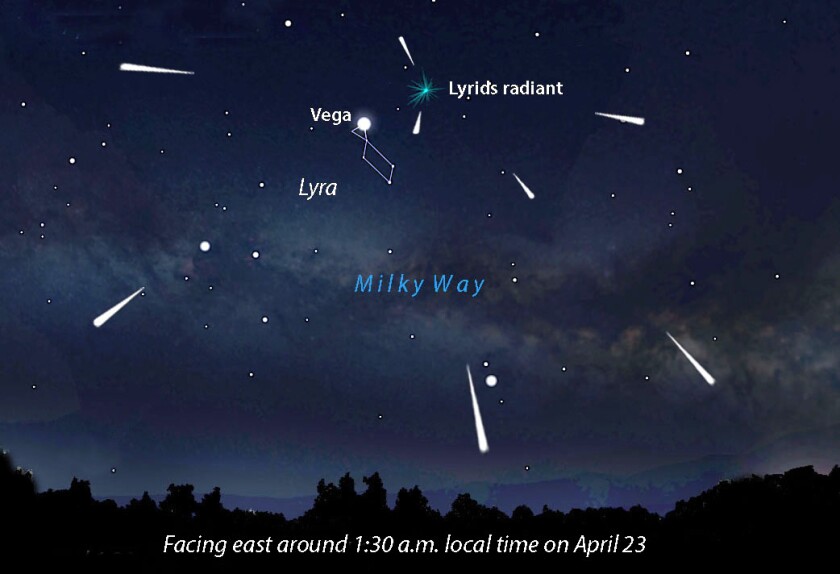
You can start watching for Lyrids as early as 11 p.m. local time, but they’ll be best between midnight and dawn, when the streaming point, called the radiant, stands high in the eastern sky. Face your darkest direction for the best view of the shower.
Contributed / Stellarium with additions by Bob King
April 22-23 (a.m.) – Peak of the annual Lyrid meteor shower with 15-20 meteors per hour from a dark sky visible on the morning of April 22 and April 23. No interference from the moon. Best viewing time will be from about 1-4 a.m., when the meteor radiant stands high in the southeastern sky. Lyrids originate from Comet Thatcher, discovered in 1861.
April 23 – The half-moon shines a few degrees to the right (west) of the Beehive star cluster in Cancer. Use binoculars to see them in the same field of view.
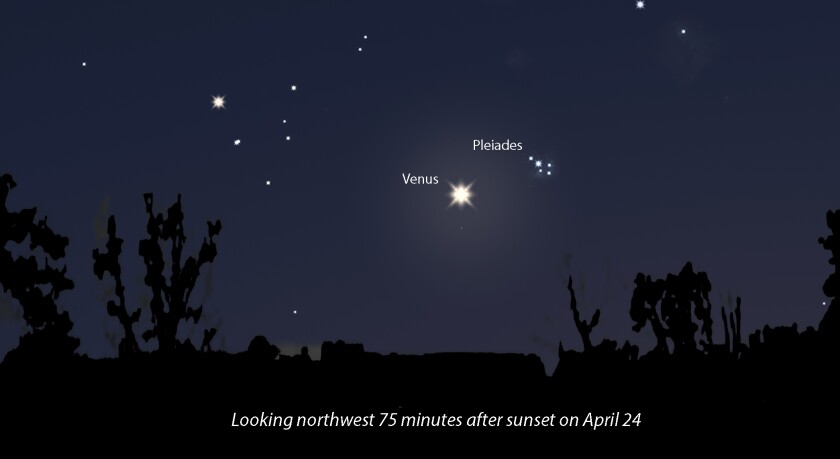
Venus slips by the Pleiades star cluster from April 23-25. Use binoculars for the best view.
Contributed / Stellarium
April 23-25 – Venus inches within a few degrees to the left of the Pleiades star cluster over these 3 nights. Will make an eye-catching sight especially in binoculars. Look for them both at dusk low in the northwestern sky.
April 25 – Very close conjunction of Regulus, Leo’s brightest star, and the waxing gibbous moon. Point your binoculars at the moon just as it’s starting to get dark, and you’ll spot Regulus immediately above it. From many locations in the Eastern Time Zone, the moon will cover up the star, an event called an occultation. For the rest of us, the occultation occurs in the daytime. Go to this link:
http://www.lunar-occultations.com/iota/bstar/0426zc1487.htm
for times when the star disappears and reappears for your city. Times shown are UT (Universal Time). Subtract 4 hours for EDT and 5 for CDT.
April 30 – Nearly full moon shines just to the right of Spica, Virgo’s brightest star.