
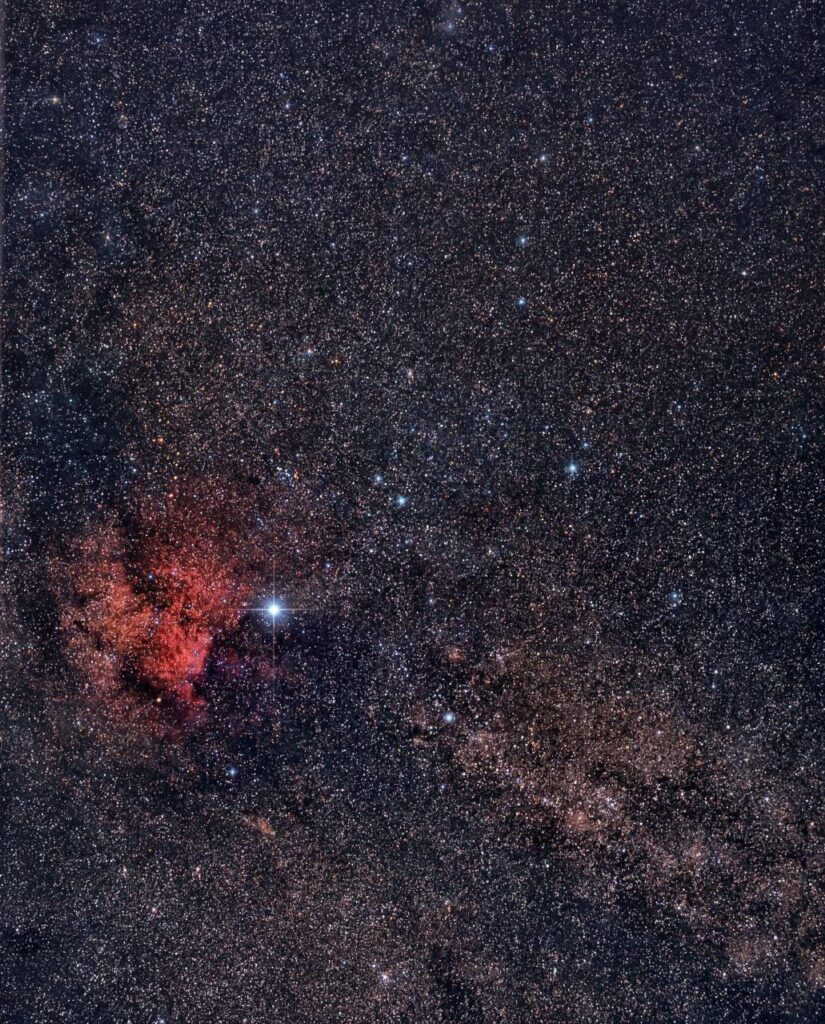
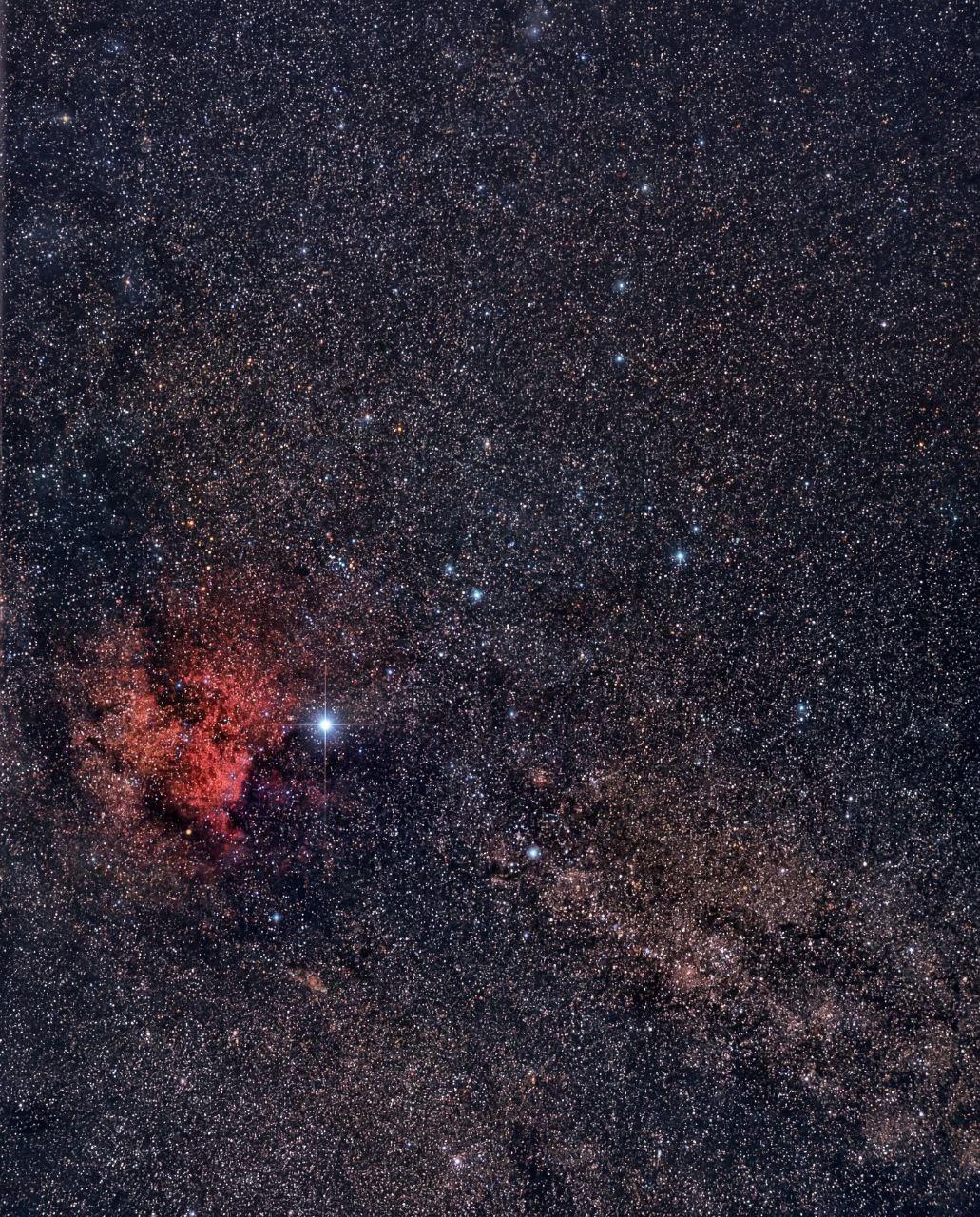
Not the original but these are my guess on what was used.
Technique: Long‑exposure astrophotography with stacked frames.
Filters: Hydrogen‑alpha (Hα) narrowband filter for the red glow. Possibly OIII/SII for color balance.
Optics: Likely a mid‑to‑large aperture telescope (8–12 inch reflector or refractor).
Camera: A cooled CMOS/CCD astro camera (ZWO ASI or QHY are common).
by MystraKynrae
26 Comments
Probably not since I don’t think life would be able to survive on a star but most likely on a planet flying around the dots.
Source? You can’t just repost pictures without credit.
Something looking in our direction saying the same
Life? Yes.
Intelligent life? Sometimes I doubt our own planet has it.
What if probability says, “nah”?
I remember as a kid staring at the night sky wondering if anything else was out there.
Maybe not ON the dot specifically, but near it.
One way to find out, is to go looking.
There doesn’t “have” to be, but it certainly seems like at least one of the rocks floating around the aforementioned dots would have some kind of life going on. There’s an awful lot of stuff for us to be the only ones. Timing certainly does factor into it. Did they rise to prominence and then destroy themselves already? Are they still microbial? Are they somewhere in between? Are all of those “dots” still dots?
Indubitably. But we’ll probably never meet them given how far away even the closest of those dots is.
Arent these dots galaxies? something like billions of planets in each one of them?
Heard about possibly using our sun as a telescope. It sounds absolutely nuts but making a telescope using gravitational lensing our star can magnify light from behind it relative to earth!
Without doubt.
Brother, there ain’t much life on *this* dot
And, if it’s intelligent, it won’t get involved with Earth.
>Technique: Long‑exposure astrophotography with stacked frames.
Likely. Not *very* long-exposures, because we’re not seeing anything of the Crescent, or Tulip, or Cygnus Loop. I would have to verify that those are in the field though; it’s a close call. OTOH, that could also be due in part to an IR-filter on a DSLR (see below).
>Filters: Hydrogen‑alpha (Hα) narrowband filter for the red glow. Possibly OIII/SII for color balance.
No; this is a wideband image.
>Optics: Likely a mid‑to‑large aperture telescope (8–12 inch reflector or refractor).
No, a common camera lens. I’d say somewhere around 50-100mm focal length.
The spikes on Deneb and some of the brighter stars indicate a Newtonian, but it could also be a post-processing effect, or strings in front of the lens aperture (a common ‘trick’).
>Camera: A cooled CMOS/CCD astro camera (ZWO ASI or QHY are common).
Shot with a DSLR that has *perhaps* had its IR-filter removed, but I might doubt even that. If not a DSLR, then an equivalent wide-band astrophotography camera such as those you list. I’d expect more red from a IR-modded camera (or an astrocam), f.e. around Sadr, but also just this general area, so I’m guessing unmodded DSLR.
I am 100% sure it’s on that one
Life on a star? I remember reading book my Herbert where stars were sentient.
you were right about the stars, each one is a setting sun
They’re probably looking at us thinking those dinosaurs are really scary
A million times zero is still zero.
The worlds best kept secret is that there is life on All of them.
Why? Because there is life here? Maybe this is the only planet with life.
https://youtu.be/7J_Ugp8ZB4E?si=YHm0sv4H7oyduLrV
Since we still have no idea how life began…not necessarily. Humans could be the ones to populate those dots one day
If i was in space say a spaceship would i see more blackness or stars clustered like this?