
ann26006 — Announcement
NOIRLab’s 18th annual astronomy festival, AstroDay Chile, connected thousands from the local community through science
27 March 2026
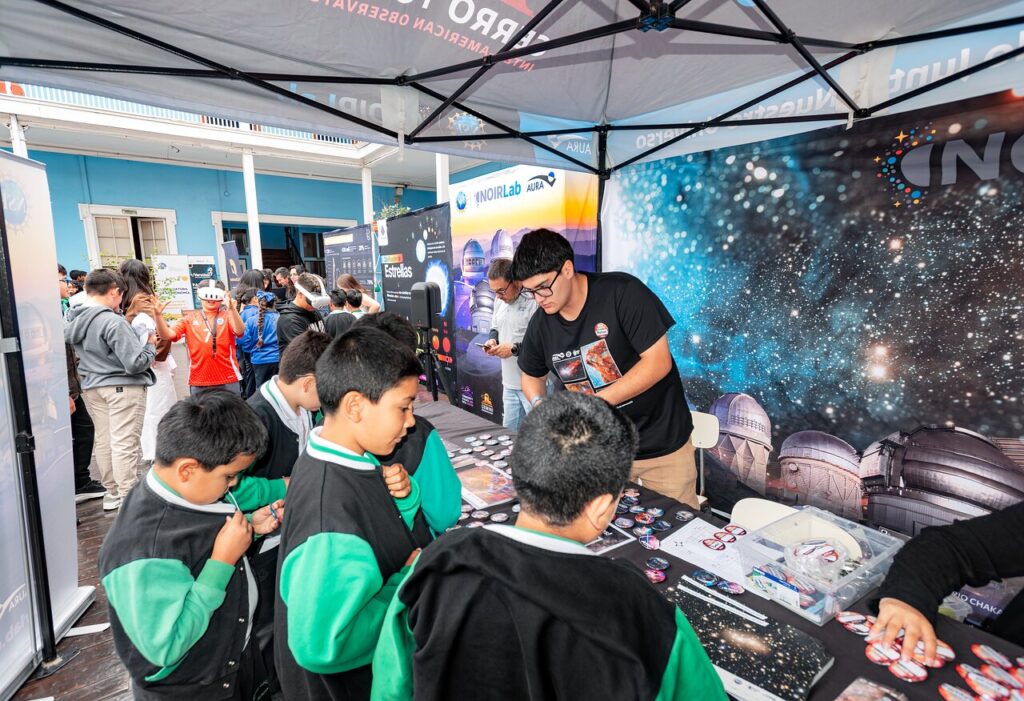
On Friday, 20 March 2026, NSF NOIRLab, funded by the U.S. National Science Foundation, and managed by the Association of Universities for Research in Astronomy (AURA), welcomed 4296 members of the community to AstroDay Chile 2026. As one of the most popular astronomy events in Chile, AstroDay Chile has been bringing astronomy-focused community activities to the Coquimbo region for 18 years.
This year’s event was held at Colegio Seminario Conciliar in La Serena. In attendance were professionals from Programs of NSF NOIRLab, such as NSF Cerro Tololo Inter-American Observatory, NSF–DOE Vera C. Rubin Observatory, and the International Gemini Observatory, as well as staff from AURA. The day featured exclusive talks by NSF NOIRLab astronomers, followed by engaging Q&A sessions with the public.
Observatorio Cruz del Sur, University of La Serena, the Office for the Protection of the Quality of the Northern Chilean Sky (OPCC), the European Southern Observatory (ESO), Las Campanas Observatory, and more, were present at interactive booths where attendees were able to discover and connect with the broader astronomy community. The AstroDay Chile team also hosted guided solar observing sessions, visits to the Museo Padre Picetti (Padre Picetti Museum), and tours of Tololito Observatory.
This year’s event also included immersive learning opportunities and specialized workshops with hands-on experiences to inspire participants of all ages. Workshop topics included rocketry, constellations, the Solar System, and more. NOIRLab educators also hosted the beloved activities RuBINGO (Rubin BINGO) and Astrobox.
As part of the celebration of Astronomy Day in Chile and within the activities of AstroDay, AURA, together with Ximena Lincolao, the Minister of Science, Technology, Knowledge, and Innovation, presented the 2025 AURA–Padre Picetti Award to astronomer and science communicator Jaime Giannelloni.
This annual initiative, started in 2014 by AURA, seeks to recognize leading teachers in Chile who demonstrate a special dedication towards astronomy and encourage new generations of scientists.
The ceremony, led by AURA Head of Mission in Chile, Alejandra Voigt, was attended by Minister Lincolao and two senators from the Coquimbo Region, Sergio Gahona and Matías Walker, adding great significance to the occasion. Representatives from organizations in Paihuano, Andacollo, Río Hurtado, Ovalle, and La Serena were also present at the event, which took place at Colegio Seminario Conciliar in La Serena.
“As a member of the 2025 evaluation committee, I was deeply impressed and moved by astronomer Jaime Giannelloni’s passion for science outreach for children, often from vulnerable communities, who, without opportunities like these, would not have the chance to open their minds to the Universe. And that is a great motivation for AURA to support and recognize work like Jaime’s,” says Voigt.
“I receive this award with great emotion, pride, and humility, because it is not only a personal achievement, but a collective one, thanks to the support provided by schools, institutions, and the Santo Domingo Science Park Foundation,” says Giannelloni.
As part of the AURA-Padre Picetti Award, in addition to a commemorative plaque, Giannelloni visited the Gemini South telescope and received an 8-inch Dobsonian telescope to continue his astronomy outreach work.
The AURA Padre Picetti Prize is inspired by the priest Juan Bautista Picetti from Seminario Conciliar School in La Serena, a renowned clergyman and enthusiastic teacher, who, with great patience and dedication, spent his life encouraging the passion for science in youth and children. Padre Picetti passed away in August of 2021.
More information
NSF NOIRLab, the U.S. National Science Foundation center for ground-based optical-infrared astronomy, operates the International Gemini Observatory (a facility of NSF, NRC–Canada, ANID–Chile, MCTIC–Brazil, MINCyT–Argentina, and KASI–Republic of Korea), NSF Kitt Peak National Observatory (KPNO), NSF Cerro Tololo Inter-American Observatory (CTIO), the Community Science and Data Center (CSDC), and NSF–DOE Vera C. Rubin Observatory (in cooperation with DOE’s SLAC National Accelerator Laboratory). It is managed by the Association of Universities for Research in Astronomy (AURA) under a cooperative agreement with NSF and is headquartered in Tucson, Arizona.
The scientific community is honored to have the opportunity to conduct astronomical research on I’oligam Du’ag (Kitt Peak) in Arizona, on Maunakea in Hawai‘i, and on Cerro Tololo and Cerro Pachón in Chile. We recognize and acknowledge the very significant cultural role and reverence of I’oligam Du’ag to the Tohono O’odham Nation, and Maunakea to the Kanaka Maoli (Native Hawaiians) community.
Links
Contacts
Luz María Aguirre
AURA
Tel: +56 9 9871 4645
Email: laguirre@aura-astronomy.org
Josie Fenske
Public Information Officer
NSF NOIRLab
Email: josie.fenske@noirlab.edu