

When it comes to successful fertilization, zero gravity means zero game, a new study suggests. When looking at sperm and eggs in simulated microgravity, scientists found that this environment hampered sperm navigation, fertilization and embryo development, posing serious challenges for the future of space colonization.
This human, mouse and pig study, published Thursday (March 26) in the journal Communications Biology, revealed that sperm became disoriented, mouse eggs had fewer successful fertilizations, and pig embryos experienced developmental delays, all due to microgravity.
Article continues below
You may like
Sperm in microgravity
Previous studies have shown that microgravity can impair estrogen production and lower sperm count in mice. But what goes on at a cellular level when the sperm and egg float in near-zero gravity remains unclear.
To simulate microgravity, the researchers used a device called a clinostat machine, which works “by continuously rotating cells or samples in multiple directions, essentially randomising the direction of gravitational pull so rapidly that the cells never get a chance to settle or orient themselves,” Nicole McPherson, a researcher who runs the Sperm and Embryo Biology Group at Adelaide University’s Robinson Research Institute and the study’s senior author, told Live Science via email. “From the cell’s perspective, there is no consistent ‘up’ or ‘down’, it experiences a kind of continuous free fall, which closely mimics what living cells experience in the weightlessness of space.”
With their space simulator, the researchers added human and mouse sperm to small mazes designed to mimic the female reproductive tract. In both cases, fewer sperm successfully navigated through the maze in microgravity compared with sperm that moved in Earth’s gravity.
“Many of the proteins found on sperm act as mechanosensors, tiny molecular devices that detect physical forces,” McPherson said. “Remove the force of gravity and it stands to reason that these sensors would be thrown off, disrupting the sperm’s ability to orient and navigate.”
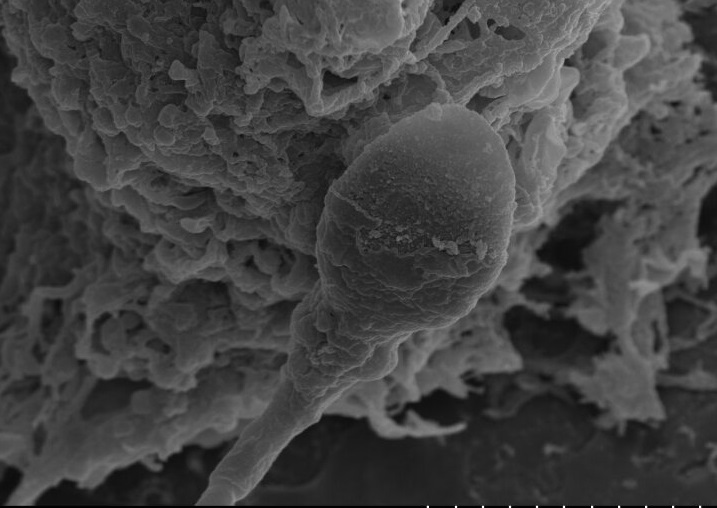
Researchers found that the navigational abilities of sperm are negatively impacted by a lack of gravity. (Image credit: Sperm and Embryo Biology Laboratory, Adelaide University)
Under normal conditions with Earth’s gravitational pull, the female reproductive tract releases the hormone progesterone after ovulation as a chemical signal to help sperm navigate toward the egg, McPherson said. To try to boost the odds that human sperm would reach the egg in microgravity, the researchers added this hormone to the system.
“It did help to some degree, but the concentrations needed to produce an effect were much higher than what would naturally occur in the female reproductive tract,” McPherson said.
In theory, high doses of progesterone could be administered, but McPherson cautioned that more research into safety and efficacy is needed before this hormone could be prescribed as a fertility enhancer for space travelers.
What to read next
Reduced fertilization and developmental delays
Next, the researchers looked at fertilization and embryo development for mouse and pig eggs. Successful fertilization was 30% lower for mouse eggs and around 15% lower for pig eggs in simulated microgravity, compared with in Earth’s gravity.
Six days after insemination, pig embryos showed signs of developmental delays. “After fertilisation, the embryo still needs to implant into the uterine wall,” a process that uses gravitational cues to work, McPherson said. “Then the embryo’s cells must organise themselves correctly to eventually form every organ in the body, sustained by a placenta that must function properly for the full duration of pregnancy. Microgravity has the potential to disrupt any or all of these stages.”
While these results pose significant challenges for the future of space colonization, they also give scientists better insight into how gravity affects the development of life here on Earth.
“From the moment a sperm begins its journey to the moment an embryo starts to develop, gravity appears to play a role we are only starting to uncover,” McPherson said. “Gravity is not just a backdrop to life, it is deeply embedded in the biological processes that create it.”
Lyons, H. E., Nikitaras, V., Arman, B. M., McIlfatrick, S. M., Nottle, M. B., Gonzalez, M. B., & McPherson, N. O. (2026). Simulated microgravity alters sperm navigation, fertilization and embryo development in mammals. Communications Biology. https://doi.org/10.1038/s42003-026-09734-4
Human spaceflight quiz: How well do you know our journey into space?