
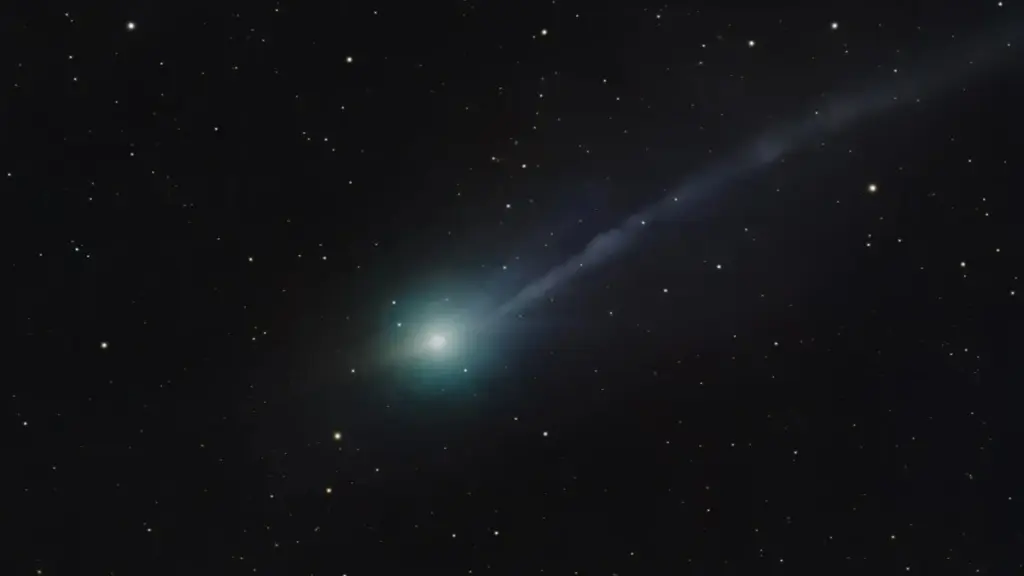
Measurements obtained with the James Webb Space Telescope (JWST) show that the interstellar object 3I/ATLAS contains unusually high levels of deuterium in both water and methane, based on infrared spectroscopic observations conducted on December 22 and 23, 2025.
Two independent studies analyzing the data report D/H ratios of (0.95 ± 0.06)% in water and (3.31 ± 0.34)% in methane, exceeding those measured in Solar System comets by more than an order of magnitude.
The isotopic composition of 3I/ATLAS differs significantly from known Solar System bodies. Deuterium enrichment in cometary material is a known tracer of formation conditions, as fractionation processes preferentially enhance deuterium in cold environments.
The elevated D/H ratios observed in both water and methane suggest that the material in 3I/ATLAS formed under conditions where such fractionation was efficient, typically at temperatures at or below approximately 30 K.
Spectroscopic analysis of methane and its deuterated form (CH3D), detected in the coma of 3I/ATLAS, provides a direct measurement of deuteration in organic molecules beyond the Solar System. The derived methane D/H ratio of (3.31 ± 0.34)% is approximately 14 times higher than that measured in comet 67P/Churyumov–Gerasimenko, representing one of the highest values recorded for this molecule.
Both studies interpret isotopic signatures as consistent with formation in a cold protoplanetary disk and potentially within a prestellar or interstellar cloud environment.
In such regions, ion–molecule reactions and grain-surface chemistry enhance deuterium incorporation into water and organic molecules. The presence of elevated D/H ratios in both water and methane suggests that these processes operated efficiently during the formation of 3I/ATLAS.
The high D/H ratios of water and methane in 3I/ATLAS are a natural consequence of formation in a high D/H elemental ratio environment as a result of locally cold conditions in the protoplanetary disk and prior interstellar cloud, according to Roth et al. “Thus, 3I/ATLAS formed in an environment very different from that in which our Sun and planets originated.”
“The abundance of C, H, O, N and S-bearing species in 3I/ATLAS demonstrates the existence of volatile
compounds around other stars, that could lead to complex, potentially pre-biotic chemistry, during the early history of our Galaxy,” the authors of a study led by Martin Cordiner said.
Additional isotopic measurements, including elevated 12C/13C ratios in carbon-bearing species, further distinguish 3I/ATLAS from Solar System material and suggest formation in a chemically different environment. Carbon isotopic ratios measured exceed normal Solar System values and are interpreted as evidence for formation in a relatively low-metallicity region of the Galaxy.
When interpreted using models of Galactic chemical evolution, the combined isotopic signatures suggest that 3I/ATLAS may have formed early in the history of the Milky Way, approximately 10–12 billion years ago.
The estimate is derived from the observed carbon isotopic composition and its relation to stellar nucleosynthesis and enrichment over time, although the precise origin and age remain uncertain.
The detection of deuterated methane in 3I/ATLAS is particularly notable due to its rarity. Prior to this observation, CH3D had been securely detected in only one Solar System comet through in situ measurements.
The JWST observations provide a rare remote detection of methane deuteration in material originating outside the Solar System.
Astrochemical models hint at the possibility that methane can achieve higher levels of deuteration than water due to differences in formation pathways and reaction energetics. Gas-phase ion–molecule reactions and grain-surface chemistry both add to deuterium enrichment, particularly in cold, dense environments where such processes are most efficient.
The relative enrichment observed in 3I/ATLAS is consistent with such mechanisms, although current models do not fully reproduce the highest measured values.
The interpretation of the isotopic signatures remains uncertain and depends on models of disk chemistry and Galactic chemical evolution. Additional observational and theoretical work will be needed to determine whether current models can fully account for the extreme deuterium enrichment measured in 3I/ATLAS.
While the observed isotopic composition is consistent with formation in a cold, chemically distinct environment, further observational and theoretical work is required to determine whether existing models of protoplanetary disk chemistry fully account for the extreme deuterium enrichment observed in this object.
References:
1 Cordiner, M., Roth, N. X., Micheli, M., Villanueva, G., Farnocchia, D., Charnley, S., Biver, N., Bockelee-Morvan, D., Bodewits, D., Chandler, C. O., Crovisier, J., Drozdovskaya, M. N., Furuya, K., Kelley, M. S. P., Milam, S., Noonan, J. W., Opitom, C., Schwamb, M. E., & Thomas, C. A. (2026). Isotopic evidence for a cold and distant origin of the interstellar object 3I/ATLAS [Preprint]. arXiv. https://doi.org/10.48550/arXiv.2603.06911
2 Roth, N. X., Cordiner, M., Milam, S., Villanueva, G., Charnley, S., Biver, N., Bockelee-Morvan, D., Bodewits, D., Crovisier, J., Drozdovskaya, M. N., Farnocchia, D., Furuya, K., Kelley, M. S. P., Micheli, M., Noonan, J. W., Opitom, C., Schwamb, M. E., & Thomas, C. A. (2026). Isotopic signature of organic molecules from beyond the Solar System: An enriched methane D/H ratio in the interstellar object 3I/ATLAS [Preprint]. arXiv. https://doi.org/10.48550/arXiv.2603.20445
3 The Anomalously High Abundance of Deuterium in 3I/ATLAS – Avi Loeb/Medium – March 25, 2026