
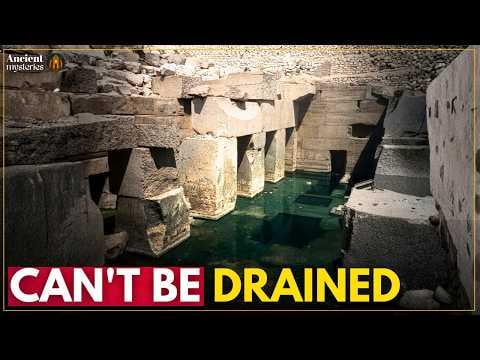
Behind the Temple of Seti I at Abydos, there's a structure buried 50 feet underground that has been permanently flooded for at least 2,000 years. The ancient Greek geographer Strabo described descending into it and finding it already filled with water.
Engineers attempted to pump 500 gallons per minute out of it. The water level didn't drop. Modern studies found the water comes from multiple underground sources, deep aquifers and ancient Nile water that feed the structure continuously.
Inside are massive granite pillars weighing up to 100 tonnes, joined with precise stone engineering specifically designed to survive in a permanently wet environment. There's a 15-metre water channel running through it. The layout deliberately blocks visitor access and behaves nothing like a tomb, it functions more like a hydraulic system.
Egyptologists attribute it to Seti I around 1280 BC. But the construction style is megalithic, undecorated, using stones ten times heavier than anything else Seti built and matches the Valley Temple at Giza, not the ornate temple sitting directly above it.
Full breakdown: https://youtu.be/UXzWw9uOwa4
by AwakenedEpochs
1 Comment
Thermoluminescence dating proves that the stone underneath the blocks of the Osireion were last exposed to light during the 19th dynasty. Additionally, modern damage to one of the walls revealed a dovetail connecting brackets bearing Seti’s cartouche. The bracket would have been completely inaccessible after construction was completed.
For these reasons, there is no reasonable grounds to doubt that he commissioned the site.
Yes, it resembles Old Kingdom sites. It was designed to imitate that style. The Osireion is no more an Old Kingdom site than the White House is an Ancient Greek site.