
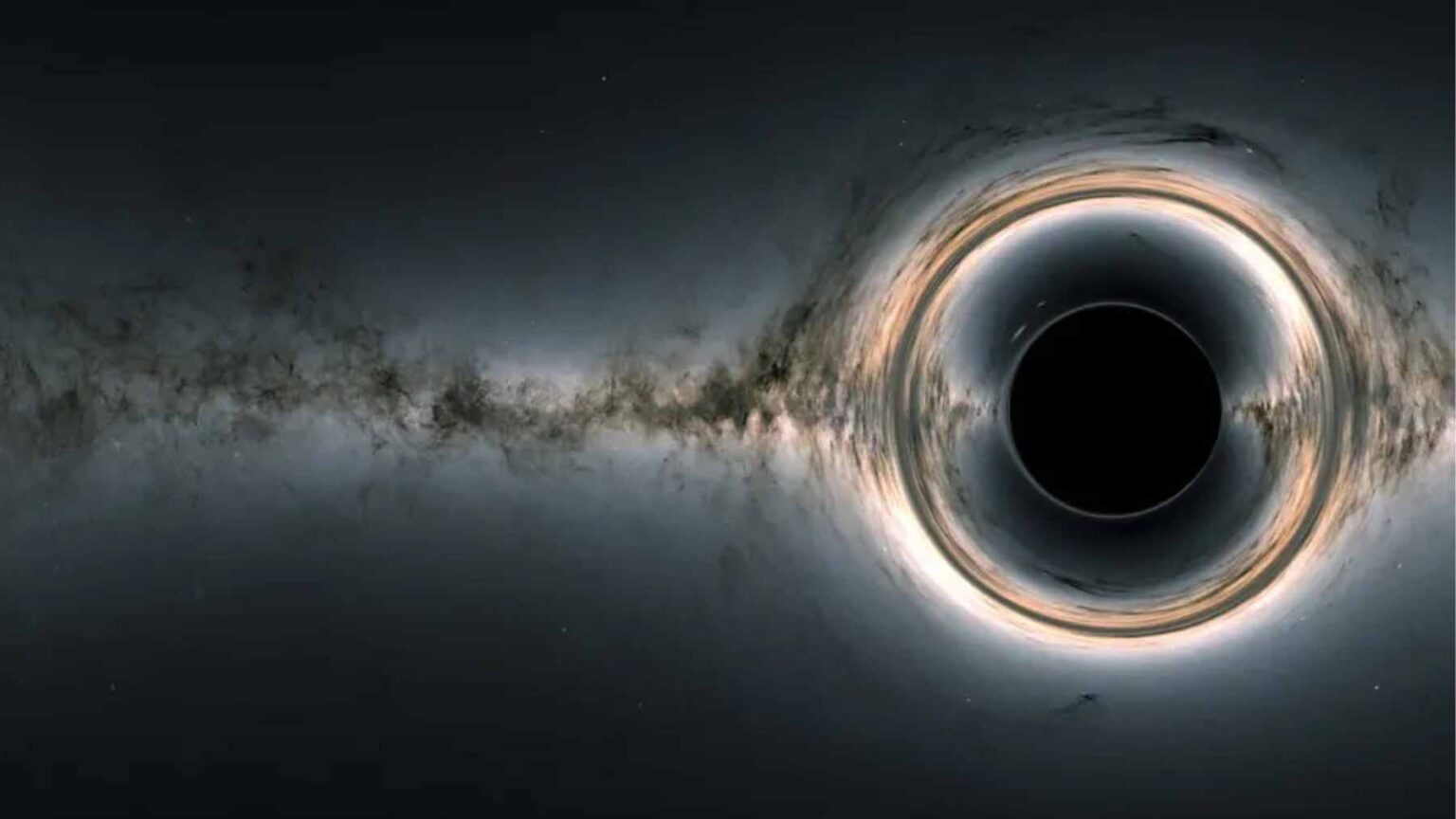
Forget the movie scene where a spaceship dives into a glowing tunnel and pops out next to another galaxy. A new line of research suggests that what many people call a wormhole is something very different.
The original Einstein Rosen bridge looks less like a cosmic tunnel and more like a quantum mirror that links two opposite directions of time. That quiet change in interpretation could reshape how scientists think about black holes and even what happened “before” the Big Bang.
From sci-fi tunnel to misunderstood bridge
In 1935, Albert Einstein and Nathan Rosen were not trying to help starships travel faster. They were struggling with a tough question in gravity and quantum theory. How do you describe a particle inside the curved spacetime of general relativity without breaking the rules of quantum physics?
Their answer was a strange construction in the math. They showed that a particle could be represented by a “bridge” connecting two mirror copies of spacetime.
Later on, other physicists noticed that this bridge looked a bit like a tunnel and popularized the idea that it might act as a wormhole connecting distant regions of the universe.
The problem is that general relativity does not allow anyone to actually cross that tunnel. Calculations in the 1960s showed that an Einstein Rosen bridge closes too quickly for even light to pass through. It is unstable and non-traversable, which means it is a useful mathematical structure but not a practical shortcut across the cosmos.
A new take two arrows of time
The new study, led by Enrique Gaztañaga together with K. Sravan Kumar and João Marto, revisits that old bridge with fresh tools from quantum theory in curved spacetime.
Instead of treating the bridge as a space tunnel, the authors argue that it naturally appears when you accept that one physical universe can be described using two “arrows of time” at once.
In simple terms, imagine the quantum state of a field split into two halves. In one half, time flows the way we experience it: your coffee cools down, ice cubes melt, stars burn their fuel.
In the other half, the math describes a mirror image where time runs in the opposite direction. Both halves together form a complete description of reality at the microscopic level.
Most of the time, physicists quietly ignore the time reversed half and choose a single arrow when they solve problems.
According to the new work, that shortcut breaks down near extreme gravitational horizons, such as those around black holes, or in a universe that first contracts and then expands. In those situations both arrows must be kept, and Einstein Rosen bridges show up as the bookkeeping device that ties them together.
What happens to information in a black hole?
This idea touches one of the most stubborn puzzles in modern physics: the black hole information paradox. In the 1970s, Stephen Hawking showed that black holes emit a faint thermal glow now known as Hawking radiation and can slowly evaporate.
That process seems to wipe out all details about the matter that fell in, which clashes with the quantum rule that information must be preserved.
The new framework suggests a different view. Seen with only one arrow of time, information appears to cross the event horizon and vanish forever. In the full two-arrow picture, the authors argue that the information continues to evolve but along the reflected direction of time that our macroscopic senses never experience.
Nothing is actually lost, it just migrates from the time direction we call “future” to its time-reversed partner. Black holes become mirrors in spacetime rather than shredders of information.
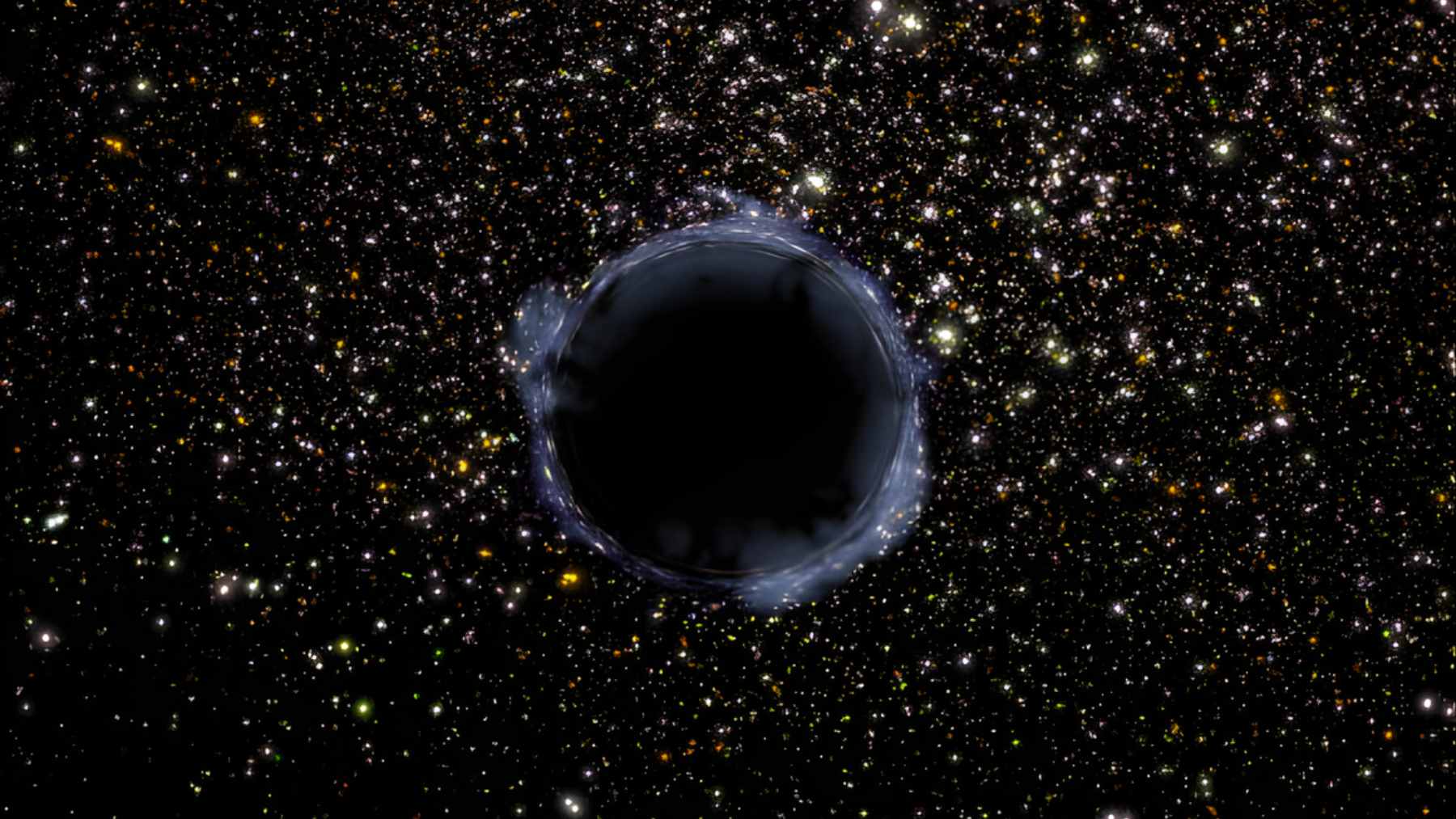 Rather than a tunnel to distant galaxies, new theoretical models suggest wormholes act as a “quantum mirror” linking our expanding universe to a time-reversed partner.
A bounce instead of a beginning
Once you accept that time can be described in two opposite directions at the quantum level, a bigger possibility appears. What if the Big Bang was not the ultimate beginning but a bounce between a previous phase of cosmic contraction and the expanding universe we see today?
In that scenario, Einstein Rosen bridges would not connect distant places in space. They would connect different epochs of cosmic history.
Our universe could even be the inside of a black hole that formed in a “parent” cosmos, with the bounce playing the role of the Big Bang. The authors point out that this is still a hypothesis, but it is one that does not require new exotic matter or a complete rewrite of known physics.
Intriguingly, the team argues that there might already be hints of this hidden structure in the sky. They focus on a long-standing oddity in the cosmic microwave background, the faint afterglow of the Big Bang. Some maps of that radiation show a small preference for one spatial orientation over its mirror image.
In their analysis, this kind of parity asymmetry is hundreds of times more probable in a model that includes the mirror time component than in the standard inflation picture.
If relics from a previous phase survived the bounce, some of them could look like small black holes that drift through our present universe. A fraction of the mysterious dark matter might even be made of such objects, although that part of the story still needs to be tested with future observations in the expanding universe we see today.
What this really changes
For anyone hoping to escape traffic jams through a handy wormhole, this research brings a dose of reality. It does not offer faster than light travel or science fiction portals between stars. What it offers is subtler and, in many ways, deeper.
The work hints that time itself may be more symmetric than our everyday experience suggests. At the smallest scales and in the most extreme corners of the cosmos, the universe might keep track of two interlocked time directions at once and our expanding universe could carry echoes from a previous chapter.
The study was published in Classical and Quantum Gravity.