
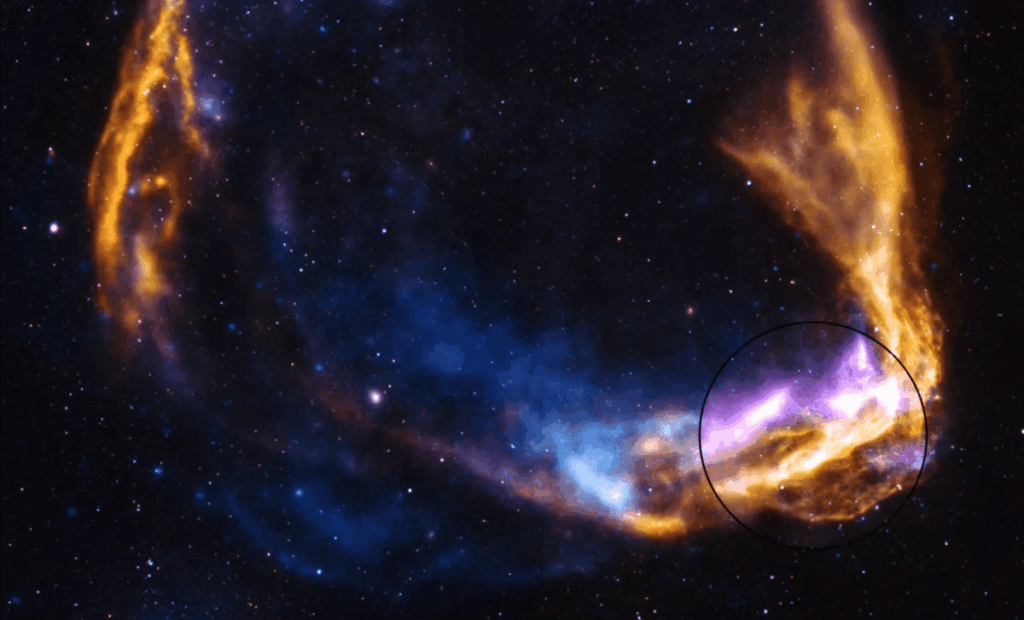
A new study from NASA reveals that a supernova observed nearly two millennia ago expanded inside a pre-formed cosmic cavity, offering strong evidence about the type of stellar explosion that created it. The findings reshape how scientists interpret one of the oldest recorded supernova events and deepen our understanding of stellar death.
The Ancient Explosion That Still Echoes Today
The object at the center of this research is RCW 86, a vast supernova remnant located in our galaxy and long associated with a “guest star” recorded by Chinese astronomers in 185 A.D.. For centuries, that historical observation stood as one of humanity’s earliest documented encounters with a stellar explosion. Today, modern instruments allow scientists to revisit that same event with unprecedented precision.
Using advanced X-ray observations, researchers can effectively “rewind” the aftermath of the explosion by studying how its shockwaves move through space. These shockwaves still carry energy from the original blast, heating surrounding gas and accelerating particles across vast distances. The structure of RCW 86 appears uneven and complex, which initially made it difficult to determine how the explosion unfolded.
The latest analysis reveals that the remnant’s unusual shape is not random. It reflects the environment created by the star before it died. That realization transforms RCW 86 from a simple relic into a detailed record of stellar evolution, preserved across nearly two thousand years.
NASA’s X-Ray Observations Reveal A Hidden Cavity
According to data gathered by NASA’s Chandra X-ray Observatory, the supernova expanded within a low-density cavity carved out by the star itself before the explosion occurred. This cavity acted like a cosmic bubble, allowing the blast wave to travel faster and farther than it would have in denser surroundings.
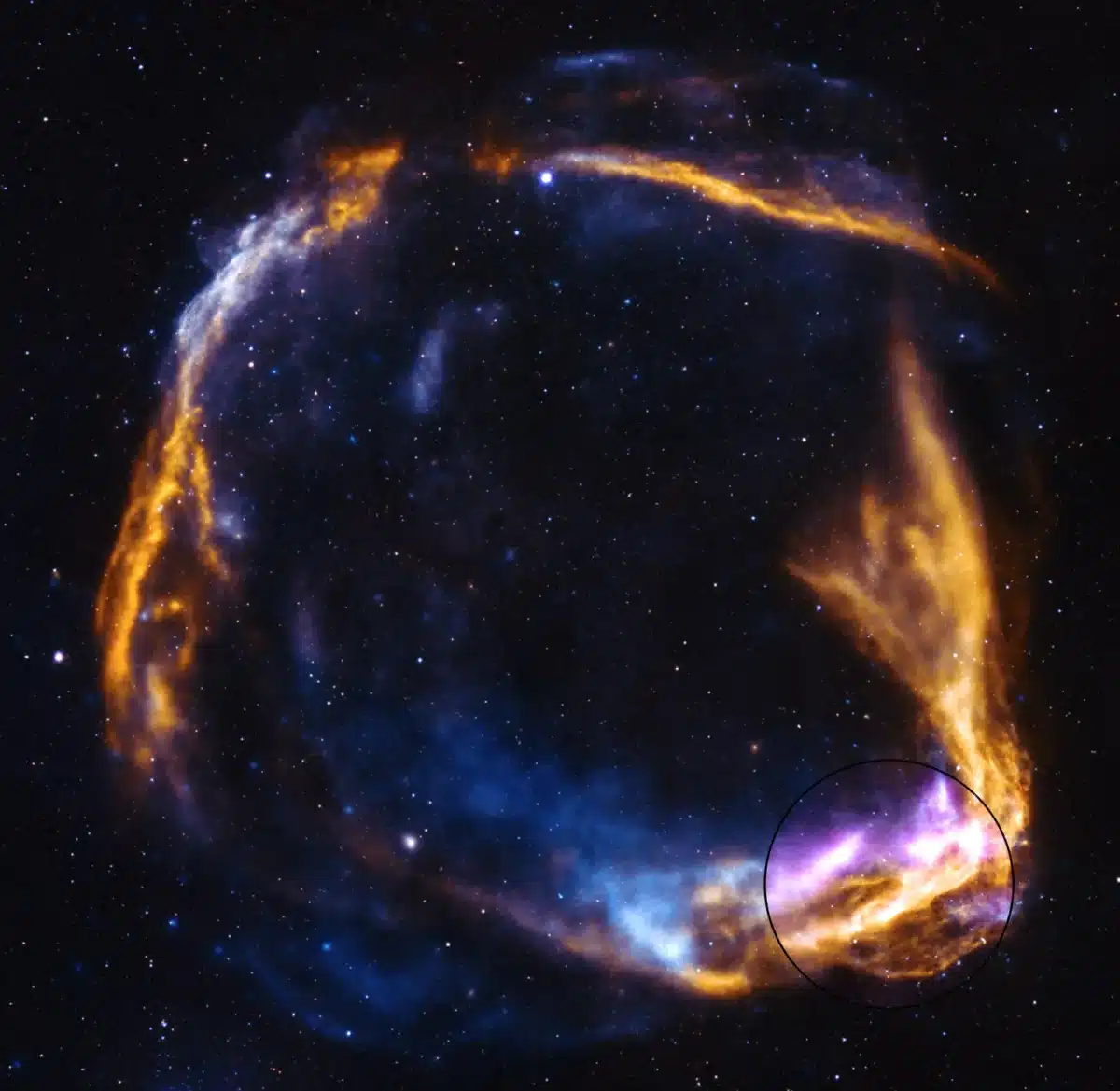 NASA’s IXPE observed the outer rim of the supernova remnant highlighted in purple in the inset. Data from IXPE is combined with data from NASA’s Chandra X-ray Observatory and ESA’s XMM-Newton. The yellow represents low-energy X-rays, while blue shows high-energy X-rays detected by Chandra and XMM-Newton. The starfield in the image comes from the National Science Foundation’s National Optical-Infrared Astronomy Research Laboratory (NOILab).
NASA/ X-ray: Chandra: NASA/CXC/SAO, XMM: ESA/XMM-NEWTON, IXPE: NASA/MSFC; Optical: NSF/NOIRLab; Image Processing: NASA/CXC/SAO/J.
This discovery explains a long-standing puzzle: why parts of RCW 86 appear to be expanding at unusually high speeds. In regions where the surrounding material is thin, the shockwave encounters less resistance, maintaining higher energy and velocity. In contrast, denser regions slow the expansion, creating the asymmetrical structure observed today.
The study highlights how pre-supernova activity can shape the aftermath of an explosion in dramatic ways. Rather than being passive events, supernovae are deeply influenced by the life history of the stars that produce them. The cavity surrounding RCW 86 stands as direct evidence of that influence, offering a rare glimpse into conditions that existed before the explosion itself.
Evidence Points To A Type Ia Supernova
One of the most significant outcomes of this research is the growing evidence that RCW 86 originated from a Type Ia supernova. These events occur when a white dwarf star in a binary system accumulates material from a companion star until it reaches a critical threshold and undergoes a thermonuclear explosion.
This classification matters because Type Ia supernovae play a central role in astronomy. They serve as “standard candles” used to measure cosmic distances, helping scientists map the expansion of the universe. Confirming the nature of RCW 86 strengthens confidence in models that describe how these explosions behave over time.
The presence of the cavity aligns with scenarios in which the white dwarf system influenced its surroundings before detonating. This adds weight to the interpretation that the explosion was not caused by the collapse of a massive star, but by a more controlled thermonuclear process. The distinction is critical for understanding how different types of supernovae contribute to the chemical enrichment of the galaxy.
A Living Laboratory For High-Energy Physics
Beyond identifying the type of explosion, RCW 86 serves as a natural laboratory for studying extreme physics. The shockwaves generated by the supernova continue to accelerate particles to near-relativistic speeds, contributing to the population of cosmic rays that permeate the galaxy.
X-ray emissions detected by NASA reveal regions where gas is heated to millions of degrees, producing high-energy radiation that can only be observed from space. These observations allow scientists to examine how energy is transferred through interstellar material and how magnetic fields interact with expanding shock fronts.
Each new dataset adds another layer of detail to this evolving picture. The remnant is not static; it continues to change as it expands, offering ongoing opportunities to test theories about particle acceleration, plasma behavior, and energy distribution on cosmic scales.
The renewed study of RCW 86 demonstrates how modern technology can extract new insights from ancient events. What began as a brief observation in the night sky nearly two thousand years ago has become a cornerstone of astrophysical research, connecting human history with the dynamic processes that shape the universe.