

For decades, the peculiar shard occupied a unique space between fringe speculation and legitimate scientific curiosity. Its unusual composition and alleged properties, including a supposed capacity for levitation, made it a prized object of fascination for UFO hunters and researchers alike. The story of how it ended up in a government lab is almost as wild as the claims surrounding it.
The specimen’s path to official scrutiny reads like a fever dream. It passed through the hands of Tom DeLonge’s To the Stars Academy, yes, the Blink-182 frontman who turned UFO research into a second career, before landing with AARO, the All-Domain Anomaly Resolution Office, which is the U.S. government body dedicated to investigating unidentified anomalous phenomena. AARO then tasked Oak Ridge National Laboratory, originally established during WWII to research atomic weapons, with conducting a thorough material analysis. The results were recently published.
A Composition That Raised Eyebrows, and Questions
The specimen is a magnesium alloy. According to AARO and Oak Ridge National Laboratory’s published findings, its main components are magnesium and zinc, with bismuth, lead, and other trace elements also present. That mixture was immediately flagged as unusual, uncommon, in the report’s own words, by today’s manufacturing standards.
Scientists were specifically asked to determine whether the sample could be of extraterrestrial origin and whether its bismuth content might suggest it had once functioned as a terahertz waveguide — a metal object that directs electromagnetic waves emitted by an energy source. The magnesium’s isotopic signature had undergone some separation of lighter and heavier isotopes, likely the result of heat stress and physical or chemical manufacturing processes. Yet it remained within the normal range for magnesium that forms on Earth.
Further still, the magnesium showed a proportion of isotopes that occurs only within our solar system, a signature that, as the report explains, originates from a particular star-forming region and is therefore unique to each star system. As for the lead found in the alloy, its isotopic signatures matched those of lead that originates on Earth so precisely that scientists concluded they could not have come from any other body, not even the moon.
The Levitation Theory, Tested and Dismantled
The most eye-catching claim attached to this specimen was the idea that it could, in theory, be capable of inertial mass reduction, levitation, in plain language. That hypothesis rested on the possibility that the object was constructed as a terahertz waveguide. According to Harvard University theoretical physicist Avi Loeb, who was not involved in the study, “waveguides can only channel radiation for purposes of communication, data collection, or heating — but the conjecture for the UAP was that they were used for levitation. That would represent a technology unknown to humans.”
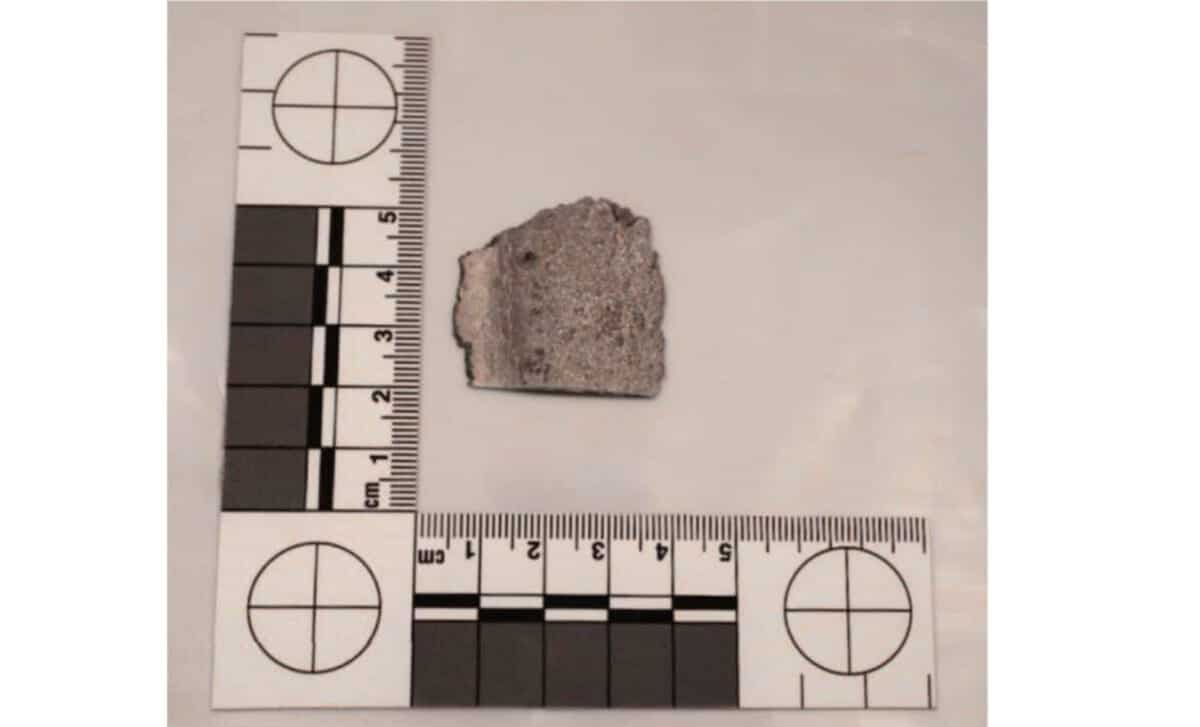 View of the as-received bulk specimen – © To The Star
For that theory to hold water, the specimen would have needed a single, uncontaminated layer of pure bismuth between layers of the magnesium alloy. Pure bismuth can guide terahertz waves in a way that surpasses standard microwave technology. The problem is that the bismuth in this sample is neither pure nor arranged in a single layer. There are multiple bismuth layers, and the bismuth itself contains lead, both of which, the report makes clear, would disrupt its ability to function as a waveguide.
Scanning transmission electron microscopy confirmed that the crystalline structure of the magnesium closely resembled that found in alloys manufactured on Earth. No alien technosignatures. No alien biosignatures either, naturally occurring substances associated with life that scientists also looked for and did not find.
A Terrestrial Object, an Open-Ended Story
According to the joint ORNL and AARO report, the most plausible origin story for this object is rooted in post-WWII materials research. At the time, magnesium alloys were poorly understood and actively being studied for use in lighter, stronger aircraft, which would make an experimental, oddly composed alloy both historically plausible and entirely of this world. The report states with a high level of confidence that “all data indicate the material was manufactured terrestrially — albeit using an uncommon mixture of elements by today’s standards — and then incurred damage caused by mechanical and heat stressors.”
That conclusion hasn’t fully satisfied everyone involved. To the Stars Academy released a statement following the analysis, noting that the reports “do not offer a firm conclusion as to the origin and purpose of the material along with other seeming anomalies,” and signaled that the organization still has more questions. A meeting between To the Stars scientists and the ORNL team was anticipated.
Worth noting: the Roswell incident itself, the supposed UFO wreck to which this specimen has long been connected, was already explained decades ago. The debris found at the original site turned out to be wreckage from a U.S. Air Force balloon used to spy on Soviet nuclear experiments, not a flying saucer. This latest analysis, as reported by Popular Mechanics, fits into that same broader pattern: extraordinary claims, methodical science, and a result that closes one door while leaving others conspicuously ajar.