
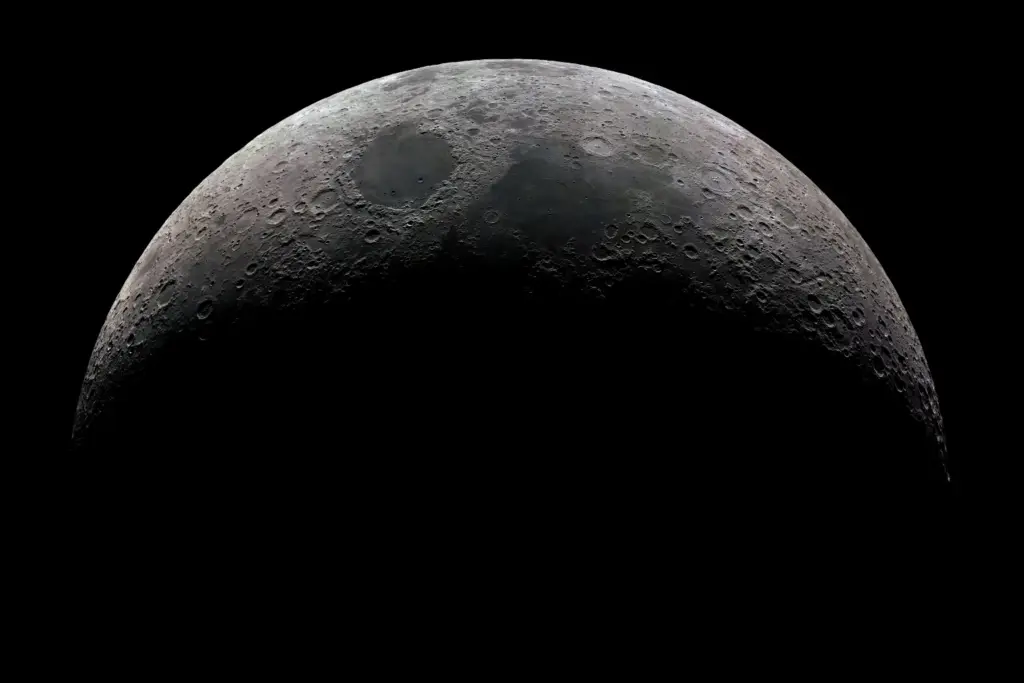
Today’s headlines continue to center on Iran, a country some six thousand miles from the US. Meanwhile, I’m focusing on a location approximately 231,000 miles (the distance varies throughout the year) from us: NASA has announced plans to construct a $20 billion base on the moon’s surface.
Humans were last on the moon in 1972. Why go back now?
Joseph Silk, a Johns Hopkins and Oxford astrophysicist, explains that telescopes constructed there could see much further into space, adding immeasurably to our knowledge of the universe. He adds that rare earth elements critical for modern technologies are “a thousand times more abundant” on the moon than on earth.
And there’s the residual benefit of space exploration. Over the decades, CAT scans, baby formula, home insulation, camera phones, and portable computers and mice were all derived from technology first developed for space travel.
But there’s more. In his 1962 speech announcing the goal of traveling to the moon that decade, President John F. Kennedy cited the great British explorer George Mallory, who died on Mount Everest. When asked why he wanted to climb it, Mallory said simply, “Because it is there.”
President Kennedy added: “Well, space is there, and we’re going to climb it.”
There is something in us that wants to make an impact in life that surpasses and outlives us. This is a “signal of transcendence” (to use sociologist Peter Berger’s phrase), a desire that points to a dimension for which this transitory world is a means to an eternal end.
You and I are unlikely to seek such significance through space travel, but we can nonetheless live this day for its highest purpose.
How?
“The last of the human freedoms”
A traditional Jewish response to someone grieving the death of a loved one is to say, “May their memory be a blessing.” This sentiment has ancient roots.
Wise King Solomon observed, “The memory of the righteous is a blessing, but the name of the wicked will rot” (Proverbs 10:7). Righteous translates the Hebrew for someone who is “upright” and “devout,” while wicked describes the opposite, a person who is unrighteous, criminal, and impious. When the former are remembered, people thank God for them and are blessed by their memory, while the reputation and memory of the latter will “rot” and decay over time.
I think of Adolf Hitler, who was hailed as a national savior when he rose to power in Germany but whose name is now synonymous with the absolute worst of humanity. By contrast, Harry Truman was one of the most unpopular politicians in the United States when he left office in January 1953, but historians today rank him among our greatest presidents.
I say all of that to say this: Our character is more important to our impact on the world than our circumstances. We cannot always control or predict the latter. However, as Holocaust survivor Viktor Frankl wrote in Man’s Search for Meaning, “Everything can be taken from a man but one thing: the last of the human freedoms—to choose one’s attitude in any given set of circumstances, to choose one’s own way.”
The famed psychiatrist added: “Between stimulus and response there is a space. In that space is our power to choose our response. In our response lies our growth and our freedom.”
But there’s a catch.
“The young man who rings the bell at the brothel”
The theologian and novelist Frederick Buechner observed, “Lust is the craving for salt of a person who is dying of thirst.” The French philosopher Simone Weil would have agreed, asserting that “all sins are attempts to fill voids.”
However, the “voids” we attempt to fill are ultimately symptoms of a single source. As the Scottish novelist Bruce Marshall had one of his characters say, “The young man who rings the bell at the brothel is unconsciously looking for God.”
You and I possess a “God-shaped emptiness” because we were created for intimacy with our Creator. The psalmist therefore spoke for us all: “My soul longs, yes, faints for the courts of the Lᴏʀᴅ” (Psalm 84:2).
Accordingly, he prayed, “Blessed are those who dwell in your house, ever singing your praise!” (v. 4). When we experience such intimacy with the Almighty, though we travel through the deserts of the “Valley of Baca,” we “make it a place of springs” (v. 6). This is why the psalmist could say to God, “A day in your courts is better than a thousand elsewhere” (v. 10).
But there’s a catch.
“It was character that got us out of bed”
The key to the spiritual life is being yielded daily to the Spirit (Ephesians 5:18). However, our spiritual enemy wants us to do anything more than he wants us to do this. Accordingly, Oswald Chambers warned, “Christian work may be a means of evading the soul’s concentration on Christ.”
We can focus on working for God in his “courts” so fully that we do not walk with him through the day. Consequently, as Chambers noted in today’s My Utmost for His Highest reading, “If we are going to retain personal contact with the Lord Jesus Christ, it will mean there are some things we must scorn to do or think, some legitimate things we must scorn to touch.”
The good in this world can be the enemy of the best in the next. This is because, as Jesus said, “My kingdom is not of this world” (John 18:36), and our Father now “calls you into his own kingdom and glory” (1 Thessalonians 2:12).
One day “the kingdom of the world” will “become the kingdom of our Lord and of his Christ, and he shall reign forever and ever” (Revelation 11:15). The best way for our lives to be significant on that day is to make him our King today.
Whatever it takes, whatever he asks, whatever the cost.
Zig Ziglar noted,
“It was character that got us out of bed, commitment that moved us into action, and discipline that enabled us to follow through.”
Will you partner with the Spirit in choosing all three today, to the glory of God?
Quote for the day:
“Your commitments can develop you or destroy you, but either way, they will define you.” —Rick Warren
Our latest website resources: 