
Comets don’t usually break apart on cue. Most of the time, scientists only see the aftermath, long after the event has passed. But during a routine observation, researchers got unusually lucky.
A distant comet began breaking apart while the telescope was already watching, giving them a rare chance to track the process almost as it unfolded.
C/2025 K1 (ATLAS) breaks apart

The comet, known as C/2025 K1 (ATLAS), was not even supposed to be the focus of the observation.
“This comet got observed because our original comet was not viewable due to some new technical constraints after we won our proposal,” said co-investigator John Noonan, a research professor in the Department of Physics at Auburn University in Alabama.
“We had to find a new target – and right when we observed it, it happened to break apart, which is the slimmest of slim chances.”
At first, nothing seemed unusual. Then the data came in.
“While I was taking an initial look at the data, I saw that there were four comets in those images when we only proposed to look at one,” said Noonan. “So we knew this was something really, really special.”
How comets break apart
Comets are not solid rocks. They are more like loose collections of ice, dust, and frozen gases. When they swing close to the Sun, heat and pressure build up inside them. That can cause cracks, outbursts, or even total breakup.
This one did not just crack. It split into at least four separate pieces. Each fragment carried its own glowing cloud of gas and dust, called a coma.
From Earth-based telescopes, those pieces looked like blurry dots. From space, they were clear and distinct.
“The irony is now we’re just studying a regular comet and it crumbles in front of our eyes,” said principal investigator Dennis Bodewits, also a professor in Auburn University’s Department of Physics.
The telescope captured three images over three days, from November 8, 2025, through November 10, 2025. In that short window, the breakup was already underway. One of the smaller fragments even split again during the observation period.
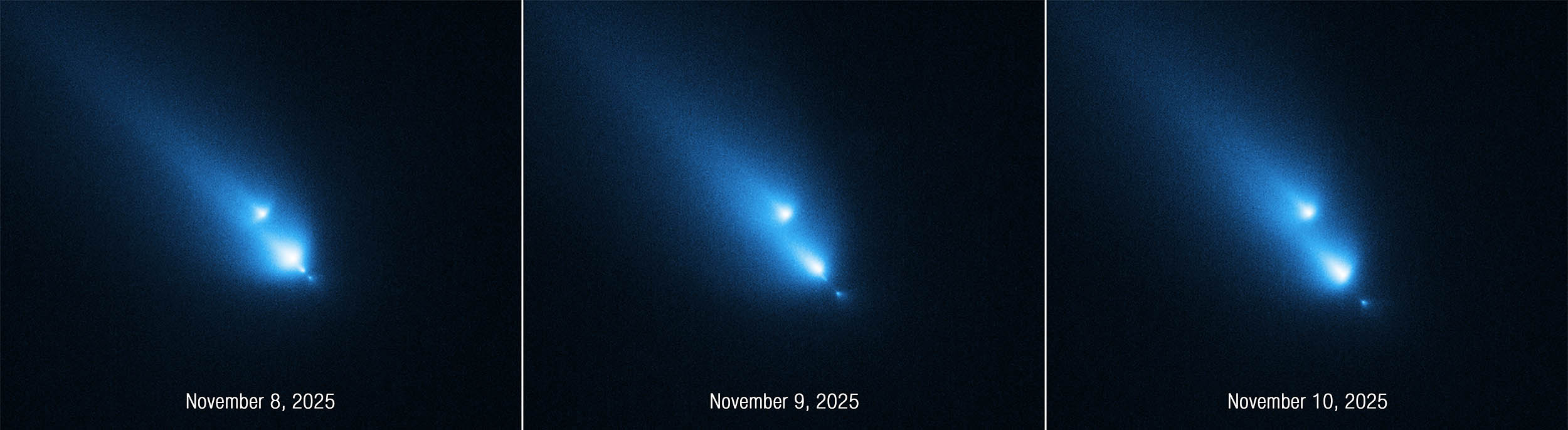 This series of images from NASA’s Hubble Space Telescope of the fragmenting comet C/2025 K1 (ATLAS) was taken over the course of three consecutive days: Nov. 8, 9, and 10, 2025. This is the first time Hubble has witnessed a comet so early in the process of breaking up. Credit: NASA, ESA, Dennis Bodewits (AU). Click image to enlarge.Why comets matter
Comets are some of the oldest objects in the solar system. They formed more than 4.5 billion years ago, back when the planets were still taking shape. In many ways, they act like time capsules.
“Comets are leftovers of the era of solar system formation, so they’re made of ‘old stuff’ – the primordial materials that made our solar system,” said Bodewits.
Comets are not pristine objects – they have been heated and exposed to radiation from the Sun and cosmic rays.
That makes it difficult to tell whether their composition reflects original material or changes over time, although cracking one open can reveal ancient, unprocessed material inside.
That is what makes events like this so valuable – a breakup exposes layers that have been hidden for billions of years. It gives scientists a rare look at material that has not been altered by sunlight or radiation.
A mystery hidden in the dust
The timing of the breakup raised a new question. The comet likely began falling apart about eight days before the telescope captured it. But observers on Earth did not see a sudden brightening right away.
That delay does not quite add up. When fresh ice is exposed, it should react quickly to sunlight. It should heat up, release gas, and create a bright cloud of dust almost instantly. But that is not what happened here.
Researchers think something slowed the process down. One idea is that a dry layer of dust formed over the fresh ice first, then blew off later. Another possibility is that heat had to sink deeper below the surface before pressure built up enough to push material outward.
“Never before has Hubble caught a fragmenting comet this close to when it actually fell apart,” said Noonan. “Most of the time, it’s a few weeks to a month later. And in this case, we were able to see it just days after.”
“This is telling us something very important about the physics of what’s happening at the comet’s surface. We may be seeing the timescale it takes to form a substantial dust layer that can then be ejected by the gas.”
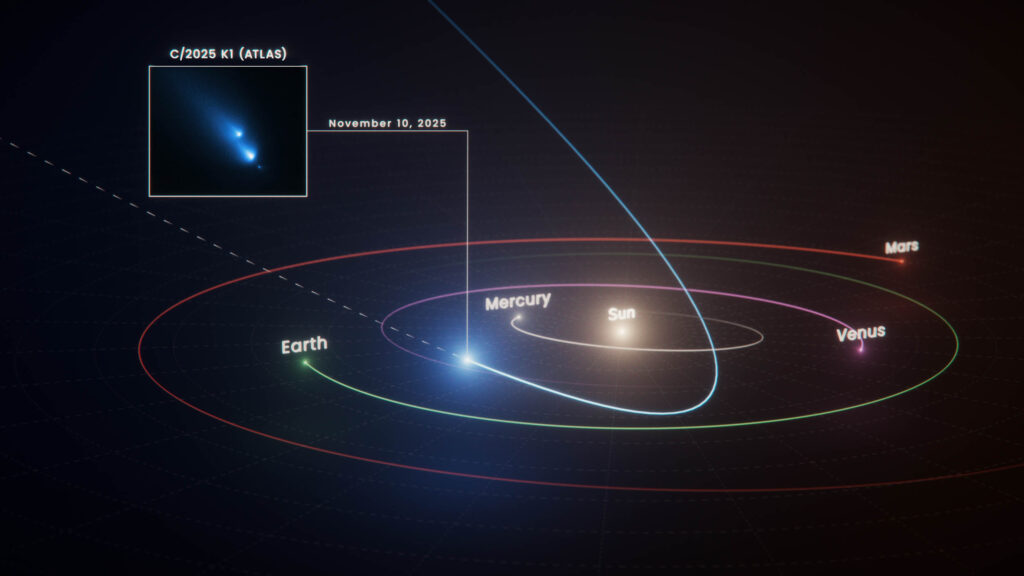
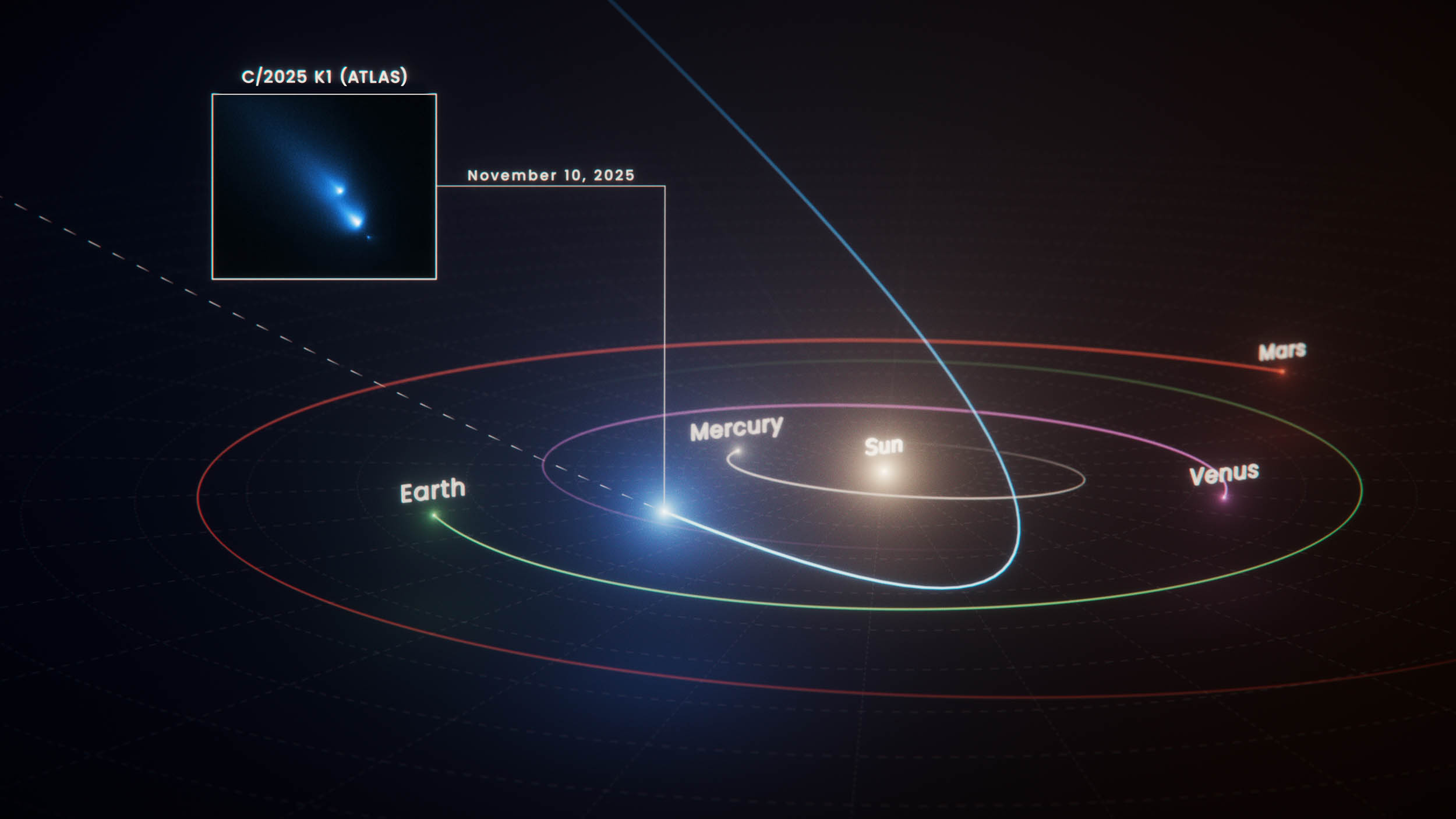 This diagram shows the path Comet C/2025 K1 (ATLAS), or K1, took as it swung past the Sun and began its journey out of the solar system. NASA’s Hubble Space Telescope captured the inset image of the fragmenting comet just a month after K1’s closest approach to the Sun. Credit: NASA, ESA, Ralf Crawford (STScI). Click image to enlarge.A strange chemical signature
There is another twist. Early observations from ground-based instruments show that this comet is unusual on a chemical level. It appears to be low in carbon compared to most comets.
That matters because carbon is a key ingredient in many organic molecules. Its absence could point to a different origin or a different history of heating and change over time.
More detailed data from space-based instruments are expected to reveal what is really going on inside these fragments.
Those results could help scientists better understand how the solar system formed and how different types of comets evolved.
Drifting into deep space
The remains of the comet are now drifting far from Earth, about 250 million miles away. The fragments are moving through the constellation Pisces and heading outward, likely never to return.
What started as a backup plan turned into a rare moment of discovery. A comet broke apart, and for once, someone was watching at exactly the right time.
The full study was published in the journal Icarus.
—–
Like what you read? Subscribe to our newsletter for engaging articles, exclusive content, and the latest updates.
Check us out on EarthSnap, a free app brought to you by Eric Ralls and Earth.com.
—–