
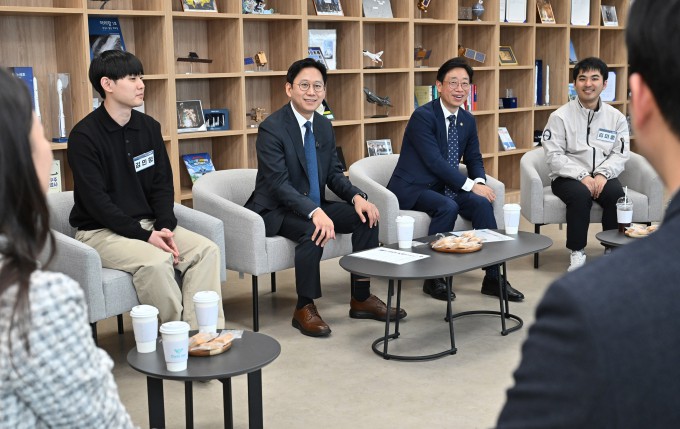
Bae Kyung-hun, Deputy Prime Minister and Minister of Science and ICT, holds a meeting with KASA Administrator Oh Tae-seog and staff during his visit to the Korea AeroSpace Administration in Sacheon, South Gyeongsang Province, on the 25th. Provided by the Ministry of Science and ICT.
■ Bae Kyung-hun, Deputy Prime Minister and Minister of Science and ICT (MSIT), visited the Korea AeroSpace Administration (KASA) in Sacheon, South Gyeongsang Province, on the 25th to review the progress of major pending tasks and encourage employees. On this day, KASA reported on its key plans for 2026 to become one of the world’s top five space powers, as well as on major issues such as the low-orbit satellite communication network and the progress of the KASA Organizational Innovation Advisory Committee. The Deputy Prime Minister encouraged the staff, saying, “Despite its short time since opening, KASA successfully completed the fourth launch of the Nuri rocket last November, which was jointly prepared by the public and private sectors.” He also urged, “I ask that the MSIT and KASA continue to work as one team to make the aerospace industry a flagship industry for our country.” The Deputy Prime Minister also checked the progress of the Space Data Center demonstration project, which is being handled by KASA as part of the K-Moonshot Project reported at the Science and Technology Ministers’ Meeting on the 11th. Afterward, the Deputy Prime Minister had lunch and a tea meeting with young KASA employees, listened to their difficulties, such as settlement conditions, and said, “I will actively provide support so that KASA can move beyond the settlement stage and grow into a key ministry leading the nation’s future advanced strategic industries.”
■ MSIT’s 1st Vice Minister, Koo Hyuk-chae, attended the ‘Korea Senior Scientists and Engineers Association’s 10th Anniversary Symposium’ held at the Korea Institute for Advanced Study (KIAS) on the 25th to congratulate the association on its 10th anniversary. At the event, attended by about 80 senior scientists and engineers who have contributed deeply to the science and technology community from all over the country, Vice Minister Koo Hyuk-chae delivered a congratulatory speech and a lecture on the government’s science and technology policy direction, and listened to various opinions from the science and technology veterans. Vice Minister Koo stated, “The reason the Republic of Korea has become a global technology leader today is thanks to the dedication and wisdom of our senior scientists and engineers. We will build upon the achievements of our senior scientists and leap even higher through science and technology investment that accelerates innovation and a great transition to Artificial Intelligence (AI).” He added, “The MSIT will actively support senior scientists and engineers so that their experience can contribute to strengthening cutting-edge technology competitiveness and revitalizing the research ecosystem.”
■ The MSIT announced that it will begin accepting applications from industry, academia, and research sectors starting March 25 for about 2,000 Graphics Processing Units (GPUs) that it plans to lease from private cloud companies to strengthen domestic AI R&D capabilities. It also stated that regular applications for government-owned GPUs from industry, academia, and research will start in April. The recruitment of users for about 2,000 advanced GPUs will be carried out through two programs: the High-Performance Computing Support Program (for industry, including SMEs and startups) and the AI Research Computing Support Project (for academia and research). Through the High-Performance Computing Support Program, 1,000 advanced GPUs will be allocated to the industrial sector, including SMEs and startups. Users can select and utilize GPU resources as needed, from 1 to 16 units, depending on the size of their training data. Youth enterprises will receive a 50% discount on usage fees, and regional and youth enterprises will be given extra points in the selection evaluation. The AI Research Computing Support Project will allocate 1,000 advanced GPUs for innovative and challenging AI research in academia and the research community, providing GPUs free of charge on a server-unit basis to offer researchers an optimal environment. This year, an ‘Early-Career Researcher’ track has been newly established, with 30% of the total resources prioritized for this track to provide broader research opportunities and nurture future AI research talent. The MSIT will hold a joint briefing session at COEX in Gangnam, Seoul, on April 2 to help applicants understand the application methods and future procedures for both programs.
■ The National Institute of Meteorological Sciences (NIMS) of the Korea Meteorological Administration (KMA) announced on the 25th that it has submitted its 10-year climate prediction results, produced with its own decadal climate prediction system, to the World Meteorological Organization (WMO). The data will be used in the annually published ‘WMO Global Annual to Decadal Climate Update.’ This submission is significant as it includes South Korea’s prediction data in the globally co-produced near-future climate outlook, enhancing the reliability and utility of climate predictions through international cooperation. The ‘WMO Global Annual to Decadal Climate Update’ has been published annually since 2020 and contains the current status of climate change confirmed through observations and a climate outlook for the next five years. South Korea has been participating since 2025 by producing 10 individual ensemble prediction results. South Korea installed the decadal climate prediction system on KMA’s Supercomputer No. 5 and has been producing prediction data since 2025. Based on this, it announced the decadal climate outlook on January 23, and this prediction data will also be reflected in the upcoming WMO 2026–2030 Global Annual to Decadal Climate Update. NIMS plans to continue enhancing the utility and reliability of near-future climate information while jointly verifying and comparing South Korea’s near-future climate prediction capabilities within the international joint outlook system through sustained international cooperation.
■ The Korea Institute of Geoscience and Mineral Resources (KIGAM) announced on the 25th that it visited the China Geological Survey (CGS) in Beijing, China, on the 23rd and signed a memorandum of understanding (MOU) to strengthen cooperation in the field of geosciences. The signing ceremony was attended by key officials from both organizations, including KIGAM President Kwon Lee-kyun and CGS Deputy Director-General Xu Xueyi. They agreed to strategically expand geoscience cooperation between Korea and China and to strengthen a practical cooperation framework for sustainable development and resolving common issues in the Northeast Asia region. The two institutions agreed to expand cooperation into various fields, including carbon neutrality, structural geology, geological hazards, groundwater, underground space utilization, and clean energy. In basic geology, they will promote joint research on Mesozoic tectonics and lithospheric evolution in Northeast Asia, focusing on the Yellow Sea Basin and adjacent areas. In the field of geological hazard response, they will proceed with the development of AI-based landslide detection technology, dataset construction, and pilot applications. Through discussions with the Chinese Academy of Geological Sciences (CAGS), an affiliate of the CGS, they agreed to jointly promote research on natural hydrogen and the construction of an integrated geological map of Northeast Asia. The two institutions will conduct joint basic research for the exploration and development of natural hydrogen, a promising next-generation clean energy source, and will cooperate on defining natural hydrogen systems, identifying formation mechanisms, and developing exploration techniques.
■ The Korea Institute of Materials Science (KIMS) announced on the 25th that it held the ‘KIMS Materials Processing Technology Academy – Casting Technology Course’ at its headquarters in Changwon, South Gyeongsang Province, on the 19th, with the aim of strengthening the competitiveness of the domestic materials and parts industry. The event’s organizing department, the Industrial Technology Solution Center, has been continuously offering education on core materials processing technologies such as casting and forging, following last year’s courses on heat treatment and surface treatment. Casting technology is a core foundational technology that marks the starting point for manufacturing metal materials and parts. Its importance is growing in response to industrial environmental changes, such as the trend towards lighter and higher-performance components in the mobility industry and the shift to eco-friendly processes. The course covered a range of theoretical and practical topics, including the principles of casting structure formation and defect control measures, lightweighting and die-casting technology, and trends in aluminum cast alloy technology for mobility. Additionally, a session for receiving and consulting on corporate technical difficulties was held at the end of the course, providing a venue for solving technical problems in the industrial field and strengthening cooperation between research institutions and companies.
Copyright ⓒ DongA Science. All rights reserved.