
NASA continues to plan for the launch of the first crewed mission around the Moon in more than 50 years one week from today. Weather or technical issues could still delay the launch, but the agency is gearing up for launch on April 1 with a series of events beginning Friday. The crew of three Americans and one Canadian will spend 10 days in space traveling further from Earth than anyone since the Apollo era.
The launch of Artemis II from Kennedy Space Center is targeted for 6:24 pm ET on Wednesday, April 1. It can only take place when the Earth and Moon are correctly aligned. Opportunities are available every month. In April, the dates are April 1-6 and April 30.
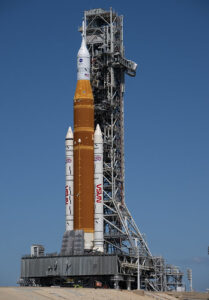
The Space Launch System (SLS) rocket and Orion spacecraft had to return to the Vehicle Assembly Building for repairs in February, but rolled back to Launch Complex 39B on March 20 where it is awaiting the “go” for launch.
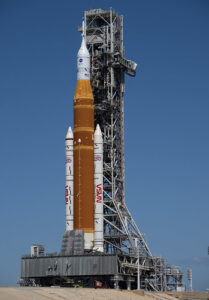 The SLS/Orion stack back at Launch Complex 39B, March 20, 2026. Photo credit: NASA
The four astronauts — NASA’s Reid Wiseman, Victor Glover, and Christina Koch and Canadian Space Agency’s Jeremy Hansen — entered a 14-day quarantine at Johnson Space Center on March 18. They’ll fly to Kennedy Space Center on Friday and remain in quarantine there until launch.
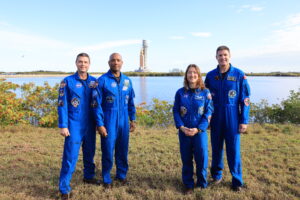 L-R: Artemis II astronauts Reid Wiseman, commander (NASA); Victor Glover, pilot (NASA), Christina Koch, mission specialist (NASA), and Jeremy Hansen, mission specialist (Canadian Space Agency) at Kennedy Space Center, Jan. 17, 2026, as their SLS rocket and Orion spacecraft (in the background) roll to Launch Complex 39B for the first time.
The list of events includes —
Friday, March 27, 2:30 pm ET: crew arrival at KSC, greeted by NASA Administrator Jared Isaacman and Canadian Space Agency President Lisa Campbell
Sunday, March 29, 9:30 am ET: crew answers media questions from their quarantine quarters
Sunday, March 29, 2:00 pm ET: NASA news conference
Monday, March 30, 5:00 pm ET: NASA news conference following Mission Management meeting
Tuesday, March 31, 1:00 pm ET: NASA pre-launch news conference
Wednesday, April 1:
7:45 am ET, coverage of tanking of the SLS rocket
12:30 pm ET, NASA launch coverage begins
6:24 pm ET, launch
approximately 2.5 hours later, NASA post-launch news conference
Artemis II will be the first crew to fly to the distance of the Moon since Apollo 17 in December 1972. A test flight, they will not orbit the Moon much less attempt to land, but will use a free-return trajectory to swing around the Moon and back to Earth even if the Orion propulsion system does not perform as planned.
The SLS rocket will put Orion into earth orbit where it will stay for about a day to test out spacecraft systems including life support. Then Orion’s engines will fire to send the crew on a 9-day trek past the Moon and back to Earth, splashing down in the Pacific Ocean.
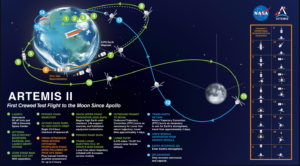 Credit: NASA
Artemis I, am uncrewed test flight, took place in November-December 2022. NASA just released plans for the next flights, with Artemis III as an earth-orbiting test flight next year and two lunar landing missions, Artemis IV and V, in 2028. Yesterday NASA laid out plans over the next 10 years to build a lunar base for sustained presence on the Moon.
Last Updated: Mar 25, 2026 10:13 pm ET