
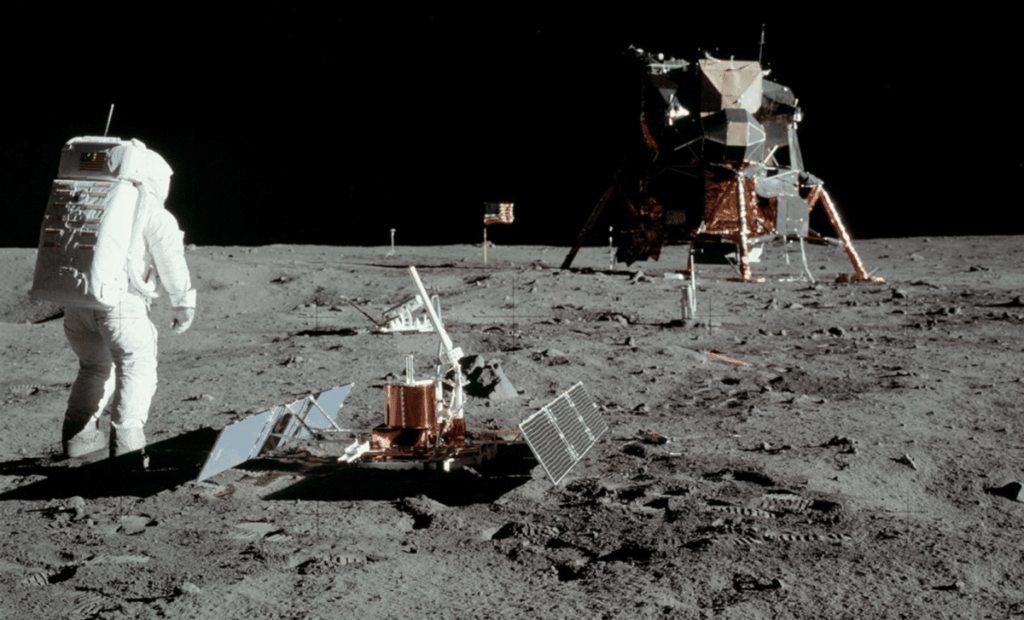
A new study from Los Alamos National Laboratory reveals that future Artemis missions may rely on fiber-optic cables to monitor seismic activity across the Moon, opening a new path for understanding its internal structure and improving astronaut safety.
A New Approach To Detect Moonquakes Across Vast Distances
The Moon is far from geologically silent. Beneath its dusty surface, subtle tremors ripple through its crust, known as moonquakes. These events hold critical clues about the Moon’s interior, yet tracking them has remained a major technological challenge since the Apollo era. Traditional instruments, while precise, are limited in range and require complex deployment.
Researchers at Los Alamos National Laboratory are now proposing a radically different approach: using fiber-optic cables as distributed seismic sensors. These cables, already used on Earth for telecommunications, can detect vibrations along their entire length, effectively turning kilometers of cable into a continuous sensing system.
“The moon has a lot of seismic activity, but deploying traditional seismic sensors like seismometers is extremely difficult and costly,” said Carly Donahue, a scientist at Los Alamos National Laboratory and corresponding author on the two papers. “Fiber-optic cables are lightweight, robust and inexpensive, so we wondered: Could they be used on the surface of the moon to detect seismic activity there?”
This shift could allow future missions to monitor vast areas of the lunar surface without the need for multiple heavy instruments, dramatically expanding the scale of seismic observation.
Why Fiber Optics Could Outperform Traditional Seismometers
Conventional seismometers provide high-quality data but are inherently limited to a single location. On the Moon, where deploying equipment requires significant effort and cost, this creates a major bottleneck in data collection.
Fiber-optic sensing operates differently. Through a method known as distributed acoustic sensing (DAS), laser pulses sent through the cable detect minute disturbances caused by vibrations. Every segment of the cable acts as an individual sensor, offering continuous coverage across long distances.
“Seismometers sit in one location and are good at collecting data from that one site. But what about further away?” Donahue explained. “We wanted to know if it would be possible to use a robot or rover to launch fiber-optic cables across many kilometers on the surface of the moon without burying them and still get useful data.”
This concept introduces a scalable, efficient alternative. Instead of deploying multiple stationary instruments, a single rover could lay down kilometers of sensing infrastructure in one mission, reducing both cost and complexity.
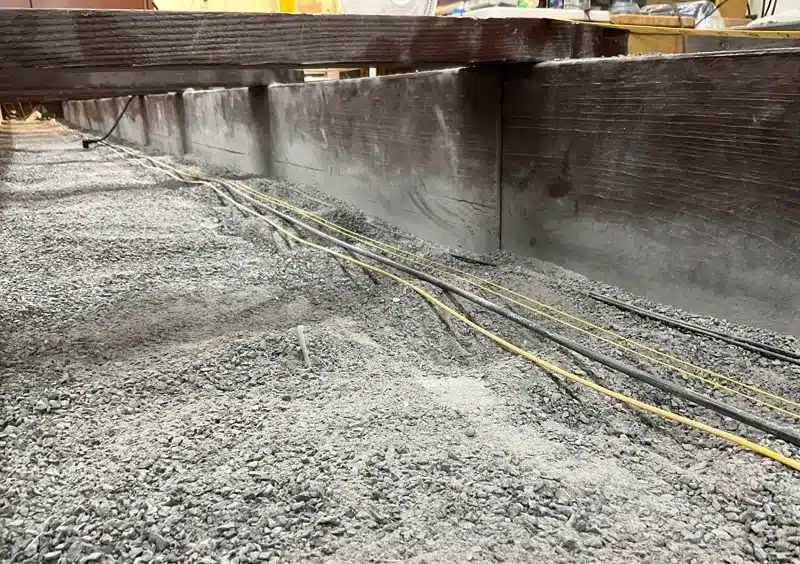 Fiber-optic cables lie on the surface and beneath crushed basalt in an indoor lab at Los Alamos National Laboratory to determine whether they could be used on the surface of the moon to detect moonquakes. The crushed basalt simulates the lunar surface.
Image credit: Los Alamos National Laboratory
Robotic Deployment Could Redefine Lunar Exploration
One of the most compelling aspects of this approach is how easily it integrates with robotic exploration. Future lunar rovers could deploy fiber-optic cables autonomously, eliminating the need for astronauts to perform time-consuming and risky installation tasks.
“If so, it would be a much cheaper, more efficient way to gather data without requiring an astronaut to travel long distances to install sensors or the extensive on-site support systems used during the Apollo missions,” Donahue added.
This aligns closely with NASA’s broader vision for the Artemis program, which emphasizes sustainability, automation, and long-term infrastructure on the Moon. Fiber-optic systems could become part of a permanent lunar network, continuously monitoring seismic activity and even supporting communication systems.
Unlocking The Moon’s Hidden Interior
Understanding moonquakes is more than a scientific curiosity. These seismic signals provide insights into the Moon’s internal layers, thermal evolution, and tectonic activity. They also carry practical implications for future lunar habitats.
Frequent or unexpected seismic activity could pose risks to structures, equipment, and astronauts. A distributed sensing system would allow mission planners to map high-risk zones and design safer landing and habitation strategies.
The data gathered could also refine models of how the Moon formed and evolved, shedding light on broader planetary processes across the solar system.