
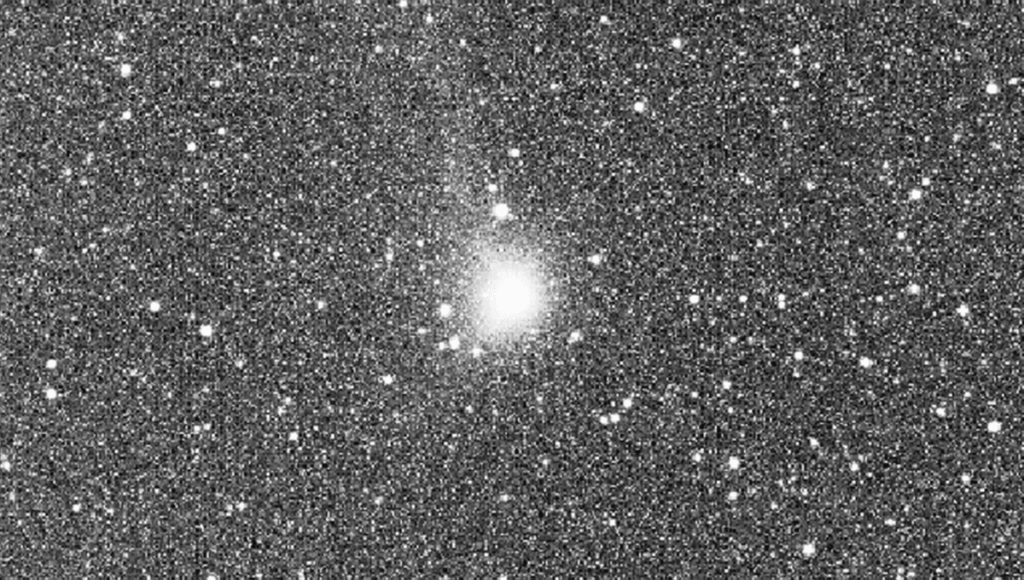
As interstellar comet 3I/ATLAS makes its closest approach to gas giant Jupiter, a team of astronomers has concluded it may be even older than we thought. By analysing its chemical composition, they might also have found key information about the location of its home system, and an earlier era of the Milky Way’s past.
Last year, the Asteroid Terrestrial-impact Last Alert System (ATLAS) detected an object hurtling through our Solar System on a path that would eventually take it right back out again. Further observations confirmed that this object – now called 3I/ATLAS – is an interstellar comet; the third interstellar object we’ve ever detected passing through our Solar System.
It has since gone on a whistle-stop tour of the Solar System, with its path bringing it (relatively) close to Mars, Earth, and now Jupiter. Predictions had it passing the gas giant at a distance of 0.35832 astronomical units (AU) on 16 March, where 1 AU is the average distance between Earth and the Sun.
At that distance, it is almost within Jupiter’s “Hill radius”, the region around a massive body where its gravity dominates over more distant objects like the Sun. For Jupiter, this begins at around 53 million kilometers (33 million miles), or 0.355 AU, so it is possible that the comet’s path will be altered by the encounter.
We shall have to wait for further observations and analysis on that front, but in the meantime, a new team has published a study analyzing the object’s composition, and attempting to glean a little information on where and how it was created.
Previous estimates of the comet’s age have come back with a wide range of possibilities, placing it between 3 and 10 billion years old, potentially making it far older than our Solar System. Attempting to trace its path back through time has also yielded a few possibilities about where it came from, with the thick disk of the galaxy and the thin disk both being possibilities. This is something the team hoped to pin down further by using spectral imaging observations from the James Webb Space Telescope.
“Tracing the orbital trajectory back more than ∼ 10 Myr is difficult due to unpredictable (chaotic) gravitational interactions within the inhomogeneous Galactic environment,” the team explains in their paper, which has yet to be peer reviewed. “Additional, [sic] isotopic information will help illuminate 3I/ATLAS’s origin, leading to a better appreciation of how it can fit into, and help improve our understanding of, the processes of planet formation and Galactic chemical evolution.”
Looking at 3I/ATLAS, the team found an elemental composition “unlike any Solar System body” we have studied so far, or any in our cosmic neighborhood.
“The water in 3I/ATLAS is enriched in deuterium, at a level of D/H = (0.95 ± 0.06)%, which is more than an order of magnitude higher than in known comets, while its range of 12C/13C ratios (141–191 for CO2 and 123–172 for CO) exceeds typical values found in the Solar System, as well as nearby interstellar clouds and protoplanetary disks,” the team explains, adding that these unusual ratios indicate a non-local origin.
The team writes that the data points towards the comet forming in a carbon- and oxygen-rich system with moderately high metallicity.
“Both these criteria can be fulfilled by an early burst of massive star formation (within a few giga-years of the Galaxy’s formation), followed by a slower period of further enrichment of carbon (and other elements) by low-mass AGB [asymptotic giant branch] stellar outflows.”
According to the team, the object likely originated as long ago as 10-12 billion years. And although the comet’s trajectory suggests a thin disk origin is more likely, it is compatible with an origin in the thick disk, and it is here where the team thinks the spectral data fits best.
“Such extreme isotopic signatures indicate formation at temperatures ≲ 30 K in a relatively metal-poor environment, early in the history of the Galaxy,” the team writes.
“When interpreted with respect to models for Galactic chemical evolution, the carbon isotopic composition implies that 3I/ATLAS accreted roughly 10–12 billion years ago, following an early period of intense star formation. 3I/ATLAS thus represents a preserved fragment of an ancient planetary system, and provides direct evidence for active ice chemistry and volatile-rich planetesimal formation in the young Milky Way.”
As well as it being interesting to find where this specific comet came from, the study has implications for life in our galaxy. Studying the environments of other planet-forming systems is not easy, and these visitors provide a window of opportunity to do so. If 3I/ATLAS is as old as this study predicts, that’s pretty interesting.
“The abundance of C, H, O, N and S-bearing species in 3I/ATLAS demonstrates the existence of volatile compounds around other stars, that could lead to complex, potentially pre-biotic chemistry, during the early history of our Galaxy,” the team explains in their conclusion.
As always, further study is needed, but we are now running out of time to do so. Following its close encounter with Jupiter, 3I/ATLAS will head out of the Solar System in the direction of the Gemini constellation, despite what more conspiracy-minded people would like you to believe.
The paper is posted to pre-print server arXiv.