
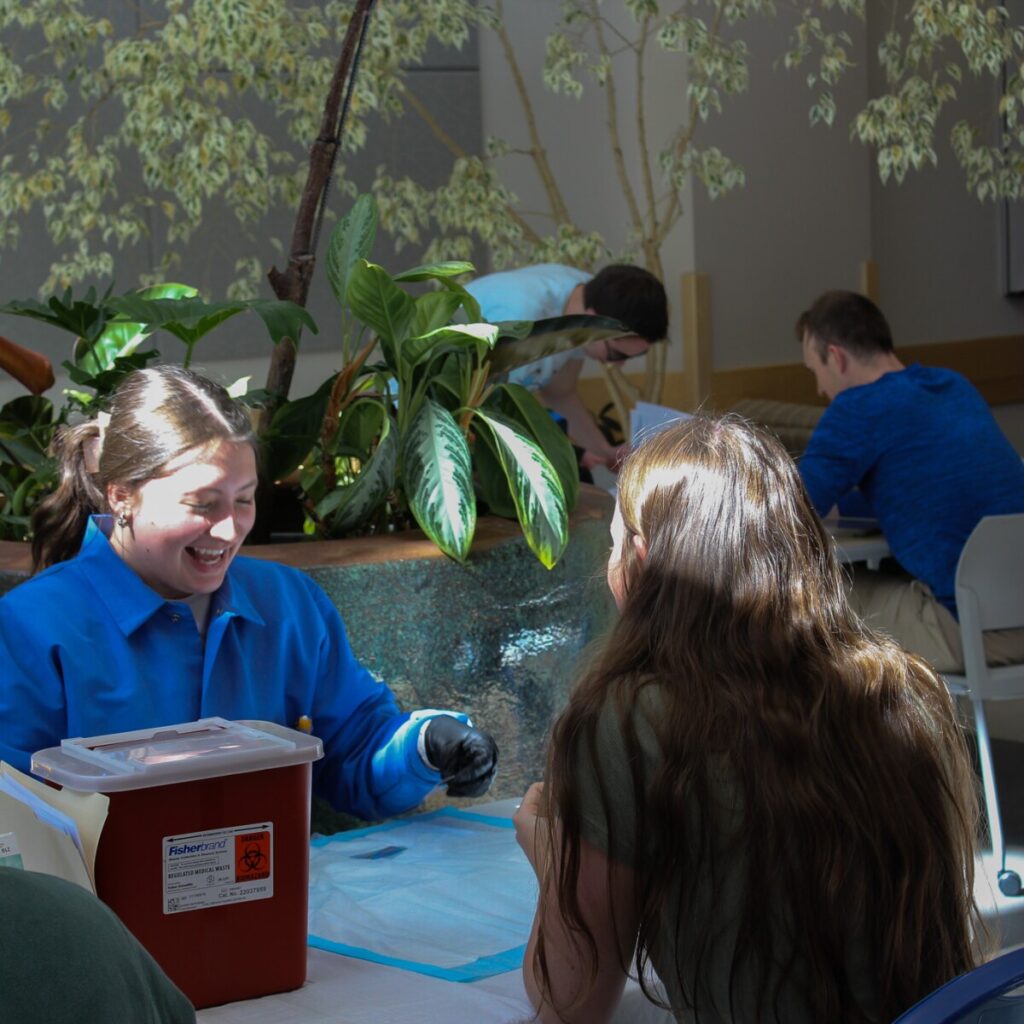
The Brigham Young University Medical Laboratory Science Association offered students the opportunity to learn their blood type in a few short minutes.

A student association member helps a student learn her blood type. Students learned their blood type in minutes. (Myriam Danielson)
After filling out a waiver, students were assisted in the blood typing process by association members.
The process began with a finger prick. The blood was then placed on a glass slide and tested with antisera. Antisera exposes red blood to antigens — corresponding antigens present in the red blood cells created agglutination, or clumping, and allowedstudents to determine different blood types.
Lauren Skryzycki, a sophomore neuroscience major, shared her first-time experience at the blood typing event.
“I felt like she explained it well. So even if I didn’t have any knowledge going into it, I’d know what was happening to me, and it was cool to figure out what my blood type was,” Skryzycki said.
The majority of members within the association are medical laboratory science majors. These majors are essential to healthcare, but their work is often unseen.
Medical laboratory science major and senior Seth Moline explained the role the major plays in the healthcare system.
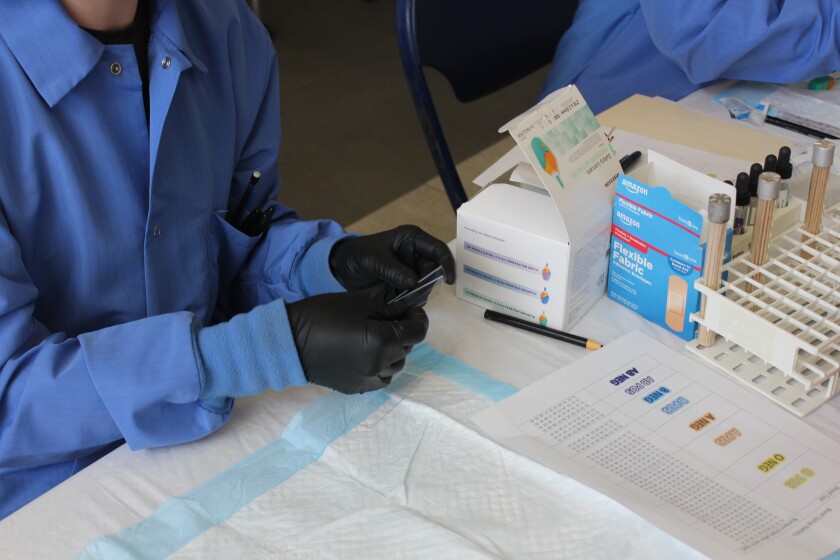
A student association member preps a blood test. There are 48 human blood types recognized within the global population. (Myriam Danielson)
“You basically are like behind the scenes people in the hospital that run all the tests. So if a patient’s sick or again something’s wrong with them, we run all the tests and then give those results back to the doctor and they will diagnose the patient.“ Moline said.
Knowledge of one’s blood type is essential in many aspects. Blood typing allows for safe blood transfusions, knowledge of blood type correlated health risks and allows for blood donation.
Morgan Carn, a senior medical laboratory science major and Medical Laboratory Science Association president, explained why blood typing is important to her.
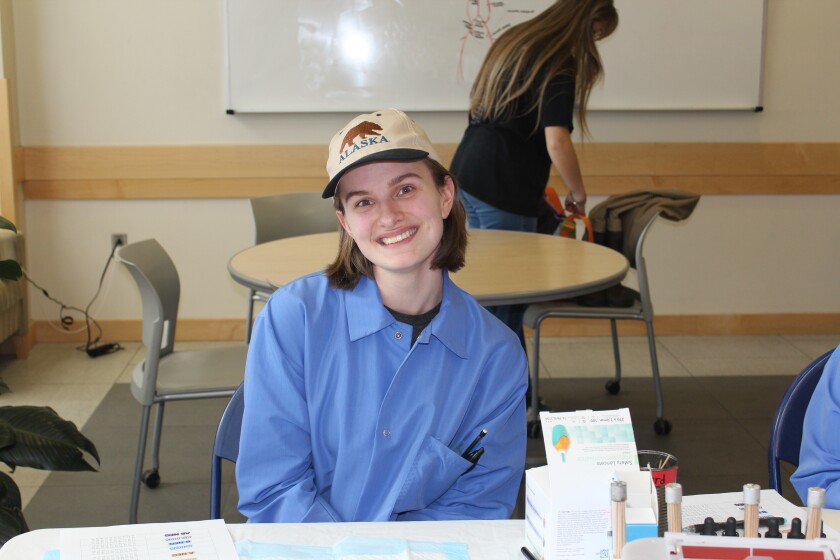
Morgan Carn is the president of the Medical Laboratory Science Association. The club has put on multiple different events centered around the major. (Myriam Danielson)
“Even just knowing your blood type can encourage people to donate, if you have a blood type that can donate to so many people, and you can make a really big difference,” Carn said. “This is kind of just like the first step of the process is knowing what kind of blood type you have and what you can donate.”
According to reports from the Red Cross, the United States is currently in a blood shortage. This has caused an increased need for donors.
Through knowledge of their blood type, there is a hope that students will learn something new and possibly use that knowledge to help someone else.
The blood typing event is usually held once every semester in the Life Sciences Building.
“I’m scared of blood. I don’t really like the needle thing, but like you couldn’t even see and it was just like the smallest prick ever … it was very fast, very simple, you know, a pretty overall fun experience,” Skryzycki said.