
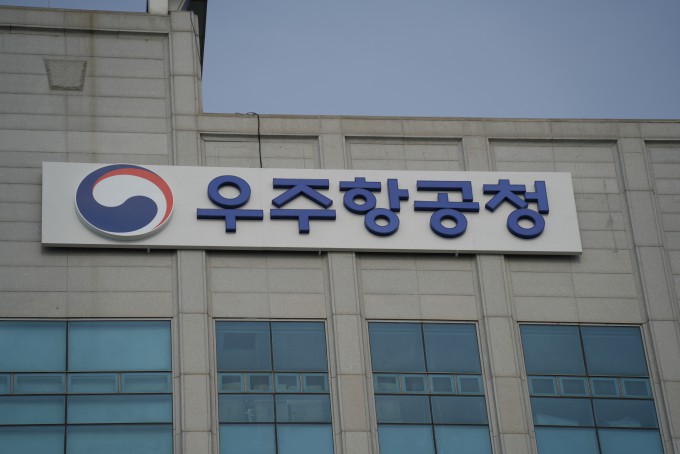
The Korea AeroSpace Administration (KASA) building. Credit: KASA
The Korea AeroSpace Administration (KASA) is expanding its joint research with the U.S. National Aeronautics and Space Administration (NASA) on L4 exploration, deep space exploration, and space weather.
KASA announced on the 24th that it is holding the ‘2nd KASA-NASA Bilateral Team Meeting for Deep Space Exploration’ at the Korea Astronomy and Space Science Institute (KASI) from the 24th to the 27th.
This is the second meeting, following the first one held in March of last year at NASA’s Goddard Space Flight Center. It was organized as a follow-up to the cooperation agreement and joint statement signed by both parties in September 2024 to flesh out the mission concept for exploring the Sun-Earth Lagrange point 4 (L4) and to specify joint research on deep space communication and space weather.
A Lagrange point is a location in space where the gravitational forces of the Sun and Earth and the orbital motion of a spacecraft are balanced. It is gaining attention as an exploration base because a probe can remain there with significantly less fuel. There are five such points, from L1 to L5, with L4 and L5 considered the most stable locations for an object to maintain its position.
NASA, the European Space Agency (ESA), and researchers from both South Korea and abroad have proposed L4 as an advantageous observation point for monitoring and predicting space radiation from solar activity. By conducting simultaneous observations from multiple directions in conjunction with existing observation points between the Sun and Earth (L1) and on the far side of Earth (L5), the accuracy of space weather forecasting and warnings can be greatly improved.
Researchers from NASA Headquarters, Goddard Space Flight Center, and Johnson Space Center, along with those from domestic research institutes and universities such as KASI, the Electronics and Telecommunications Research Institute (ETRI), and the Korea Atomic Energy Research Institute (KAERI), are participating in this meeting. Scientists from both countries will discuss deep space exploration strategies as equals.
Participants will share their research findings in groups focused on deep space optical communication, space weather, and space radiation, and will establish a mid- to long-term plan for the joint development of an L4 heliospheric observatory and its space weather observation payloads.
Deep space optical communication is a laser-based technology that offers 10 to 100 times higher transmission speed and capacity than conventional radio wave communication, along with superior security. It is regarded as a next-generation core technology for exploration of the Moon, Mars, and L4, as well as for commercial space communications.
Space weather refers to the collective effects of solar activity on the Earth and the space environment. It can cause GPS interference, communication failures, and satellite loss. Spacefaring nations like the United States and European countries operate government-led forecasting systems. In March of this year, Lloyd’s of London, a global insurance specialist, projected that potential global economic losses from space weather damage could reach up to $2.4 trillion (approximately 3,598.8 trillion won).
Space radiation consists of high-energy particles emitted by solar activity, which can cause satellite malfunctions and expose aircraft passengers to radiation. NASA classifies space radiation as a top health risk for astronauts. Consequently, governments worldwide consider establishing space weather and space radiation forecasting and warning systems a key task for protecting national critical infrastructure.
Noh Kyung-won, Vice Administrator of KASA, stated, “Since the launch of KASA, the Korea-U.S. collaboration in deep space exploration has rapidly expanded from the L4 mission concept to areas like deep space optical communication. We will use this meeting as an opportunity to devise multifaceted support measures so that researchers from both countries can incrementally advance a broad program of joint deep space exploration.”
Copyright ⓒ DongA Science. All rights reserved.