
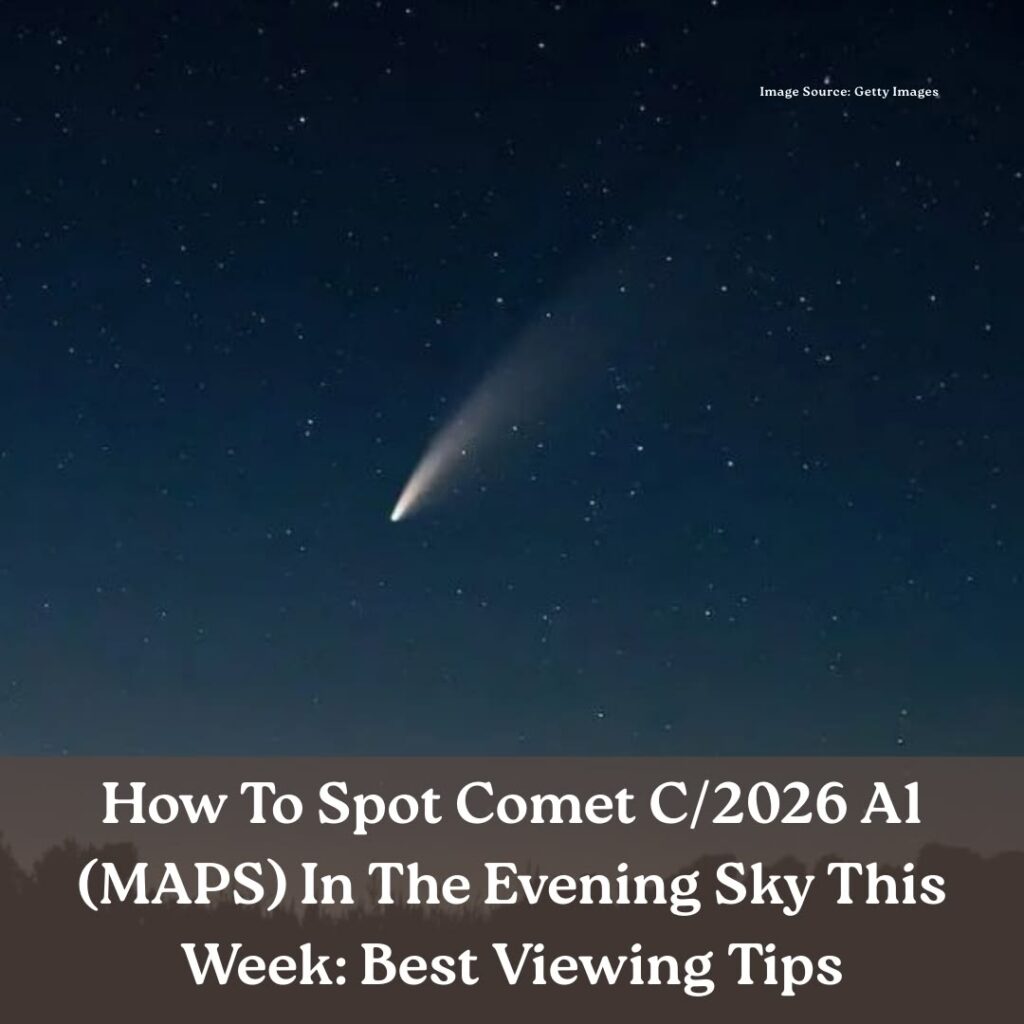
Astronomy enthusiasts worldwide are preparing for a rare celestial event as Comet C/2026 A1 is set to reach peak visibility on April 4, 2026. Expected to be one of the brightest comets of the decade, the comet will be visible to the naked eye in both Northern and Southern Hemispheres, offering a spectacular display for stargazers and casual skywatchers alike.
🔹 Comet Overview
Designation: C/2026 A1
Type: Long-period comet, originating from the Oort Cloud
Closest Approach to Earth: April 4, 2026
Magnitude: Expected between 0 and +1, making it easily visible without telescopes
Tail: Estimated 20–25 million km long, composed of dust and ionized gases
Astronomers predict that C/2026 A1 will outshine most stars in its region of the sky, providing a rare opportunity for photography, research, and public engagement in astronomy. (nasa.gov)
🌌 Best Viewing Tips
Location: Seek areas with low light pollution such as parks or rural zones.
Time: Optimal viewing is just before dawn or after sunset, when the sky is darkest.
Equipment: While visible to the naked eye, binoculars or a small telescope will enhance the tail’s details.
Direction: Look towards the eastern horizon at dawn, and western horizon at dusk, depending on your latitude.
Amateur astronomers are encouraged to photograph and share images online, contributing to real-time observations of the comet’s brightness and tail structure. (phys.org)
🔹 Scientific Significance
Comets like C/2026 A1 provide valuable insights into early solar system material, as they are primitive icy bodies containing volatile compounds and dust from the solar system’s formation. Researchers hope to study its composition, orbit, and behavior to understand comet evolution and potential meteor shower connections.
🌍 Public Engagement
Planetariums, astronomy clubs, and observatories are planning live streaming events and viewing parties. Social media campaigns aim to educate the public about comet observation safety, emphasizing the use of unaided eyes or binoculars and discouraging the use of telescopes without guidance for first-time viewers.
📅 Final Thoughts
The arrival of Comet C/2026 A1 is expected to captivate millions and may inspire a new generation of amateur astronomers. Whether observing solo in a backyard or participating in organized viewing events, April 4 offers a once-in-a-lifetime celestial experience.