
WASHINGTON — SpaceX Chief Executive Elon Musk revealed more technical, but not financial, details about his company’s plans to deploy an orbital data center constellation.
At a March 21 event in Austin, Texas, Musk outlined an initiative by SpaceX, along with automaker Tesla and artificial intelligence company xAI — also run by Musk — to massively increase production of high-end computer chips needed for both terrestrial and space applications.
The Terafab project seeks to produce one terawatt of processors annually, which Musk said is 50 times the combined production rate of all manufacturers of chips used today in advanced applications such as AI.
Those processors, he said, are the “missing ingredient” in his plans to deploy a large constellation of satellites to serve as an orbital data center.
“We either build the Terafab or we don’t have the chips, and we need the chips, so we’re going to build the Terafab,” he said.
SpaceX filed an application with the Federal Communications Commission in late January for a constellation of up to one million satellites that would be used as an orbital data center for AI applications. The company provided few technical details about the constellation, including the size of the satellites, in that application.
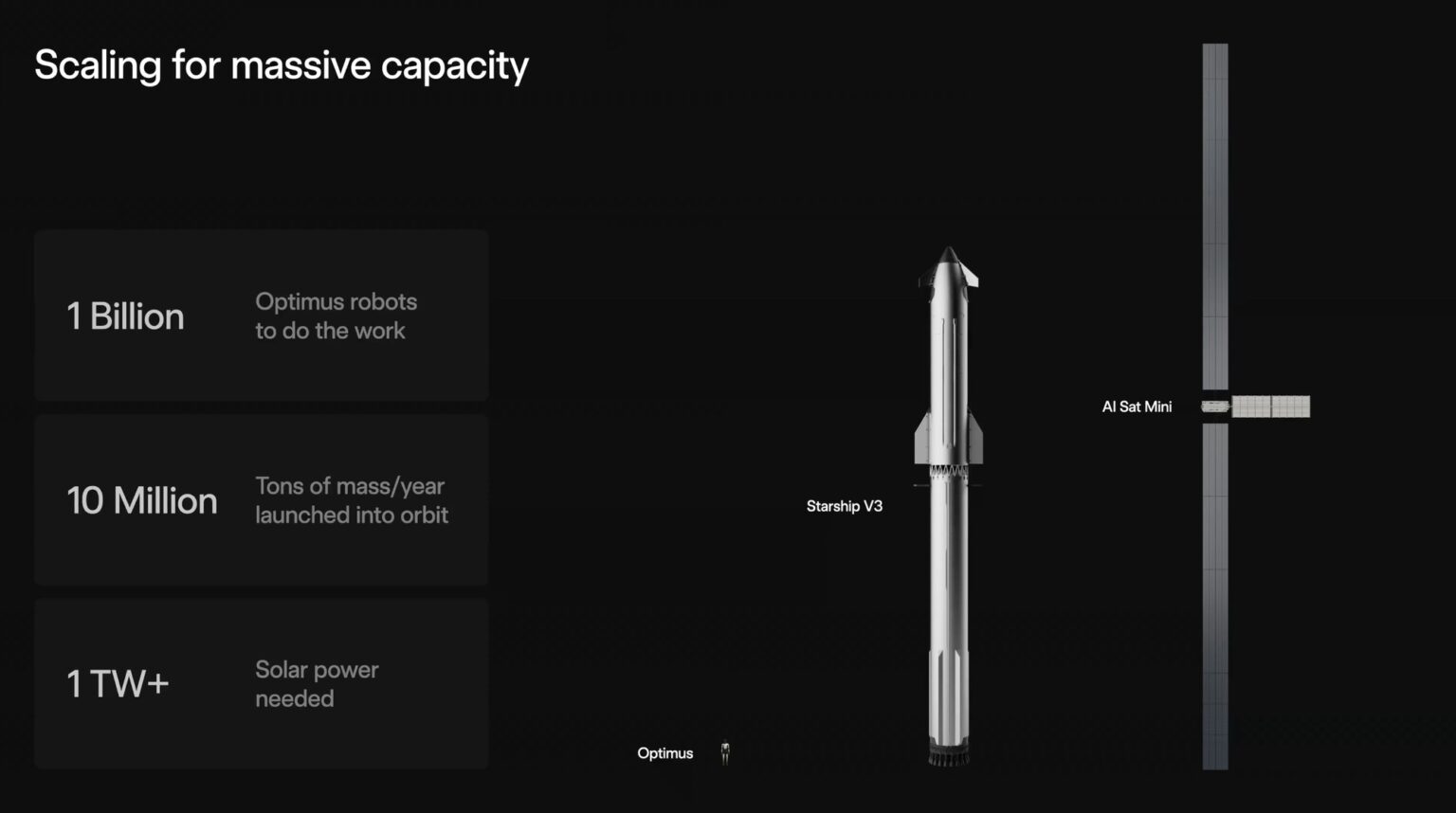
In his talk, Musk showed an illustration of an “AI Sat Mini” that he said would initially be used in the constellation. Each satellite would provide 100 kilowatts of power for AI processors on board.
The satellite is dominated by large solar arrays. The illustration, which Musk said was to scale, showed the satellite towering over SpaceX’s Starship V3, which is 124 meters tall. If the spacecraft was shown at the same scale as Starship, it would be more than 170 meters long.
The spacecraft also features a large radiator covering about 100 square meters to remove heat. Musk downplayed concerns about heat rejection, a common critique of concepts for orbital data centers, noting that the radiator is a small fraction of the size of the solar arrays.
“For some reason there’s been a bizarre debate about radiators in space,” he said. “It’s safe to say SpaceX knows how to do heat rejection in space with 10,000 satellites in orbit.”
The “mini” designation for the satellite, Musk said, reflects plans for future larger satellites with a megawatt of power.
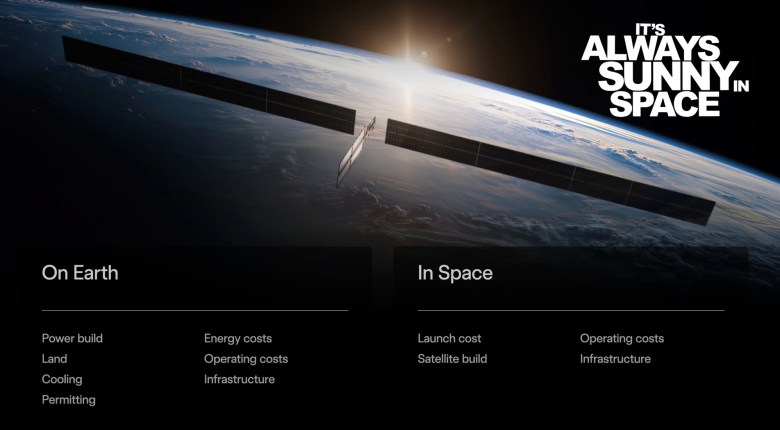 A SpaceX illustration comparing terrestrial and orbital data centers. Credit: SpaceX
He reiterated past claims that data centers in space will be more cost-effective than terrestrial data centers in as little as two to three years, citing abundant solar power and a lack of real estate constraints.
“As soon as the cost to orbit drops to a low number, it immediately makes extremely compelling sense to put AI in space,” he said. “Increasing power on Earth becomes harder over time and more expensive over time, but in space it becomes actually cheaper and easier over time.”
The Terafab initiative will start with an “Advanced Technology Fab” in Austin, near an existing Tesla factory. Musk said the “vast majority” of the production from that facility will go to a chip called D3 optimized for use in space, designed to run hotter than terrestrial chips and with radiation protection.
Musk did not disclose any schedules for developing the Advanced Technology Fab or other elements of the Terafab project, or for building and launching the AI Sat Mini spacecraft. SpaceX, in its FCC application, asked for waivers from standard deployment milestone deadlines for its orbital data center constellation since the Ka-band spectrum requested for it will be used on a non-interference basis with others.
Musk also did not discuss costs for Terafab and the orbital data center constellation. Advanced chip fabrication factories can cost tens of billions of dollars to build. TSMC, a Taiwanese company that is one of the leading producers of advanced chips, is spending $65 billion to build three chip fabs in Arizona and announced a year ago plans to invest an additional $100 billion for several additional fabs and related facilities in the United States.
Musk concluded his presentation with a video showing future data center satellites being built on the moon and launched using an electromagnetic mass driver. Those satellites, he said, would be needed to place a petawatt of computing in space. A petawatt is 1,000 terawatts.
“I just want to live long enough to see the mass driver on the moon,” he said. “That’s going to be incredibly epic.”
Related