
RAPID CITY, S.D. (KOTA) – Researchers at South Dakota Mines have completed the first measurement of a rare particle interaction that could help scientists understand why the universe contains more matter than antimatter.
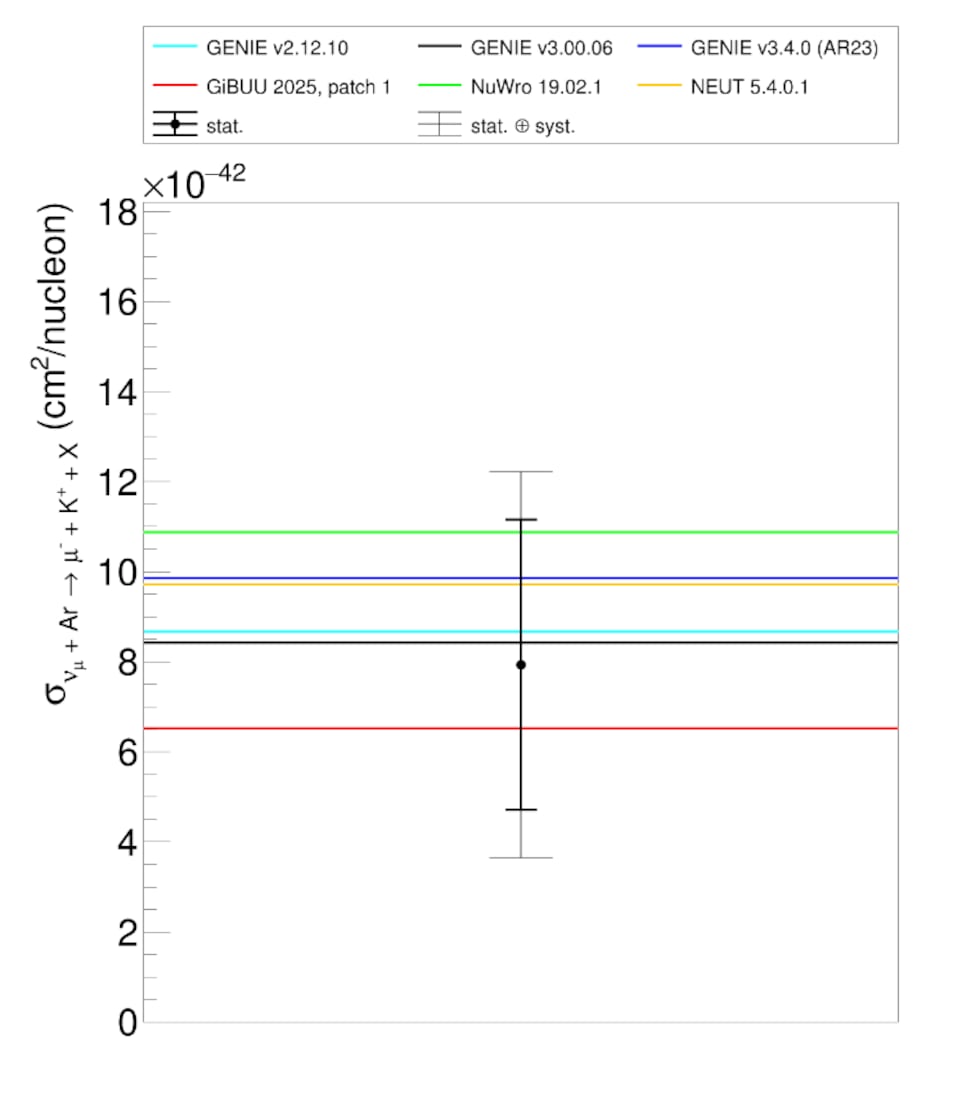
The team analyzed three years of data and identified eight instances of neutrinos colliding with argon atoms to produce particles called kaons. The measurement marks the first time this interaction has been observed in a liquid argon detector.
“This is the first time in the world this rare process on an argon target has been measured,” said Jairo Rodriguez, a postdoctoral researcher at South Dakota Mines who led the analysis.
The research required examining hundreds of thousands of neutrino interactions to find 10 candidate events. Rodriguez said eight of those candidates were determined to be kaon production events.
Neutrinos are fundamental particles that pass through ordinary matter in vast quantities. Trillions of neutrinos pass through each square centimeter of a person’s body every second, Rodriguez said.
“They are really, really tiny and they don’t usually interact with regular matter,” Rodriguez said. “They just pass through all the matter.”
The particles pass through matter so easily that it would take a block of lead stretching from the sun to Jupiter to stop them, he said.
Scientists study neutrinos because the particles may help explain fundamental questions about the universe, including why matter is more abundant than antimatter. Current theories suggest the universe began with equal amounts of both, but matter now dominates.
The experiment used a detector filled with liquid argon cooled to minus 300 degrees Fahrenheit. Creating these conditions required cutting-edge cryogenic technology that could also drive future research in quantum computing and space exploration, professor of physics David Martinez Caicedo said.
 Researchers at South Dakota Mines have completed the first measurement of a rare particle interaction that could help scientists understand why the universe contains more matter than antimatter.(South Dakota Mines)
When a neutrino occasionally collides with an argon atom, it can produce various particles. The kaon production that Rodriguez’s team measured is extremely rare.
The measurement is significant for future experiments searching for proton decay, a theoretical process in which protons break down into other particles, including kaons. Detecting proton decay would reshape scientists’ understanding of matter.
“In theory we have something that is called proton decay,” Rodriguez said. “This theory proposes that all the matter that we are composed of, the protons, are not stable particles.”
The research will continue at the Deep Underground Neutrino Experiment, or DUNE, which is being built at the Sanford Underground Research Facility in Lead. DUNE will use the same liquid argon technology, but on a much larger scale. It will contain around 40,000 tons of liquid argon.
Rodriguez said the larger scale will reduce background interference when searching for proton decay and other rare processes and lead to more refined data.
South Dakota Mines served as the lead institution for the measurement within an international collaboration driving research into neutrinos. Rodriguez completed the analysis as part of his doctoral research at the university.
See a spelling or grammatical error in our story? Please click here to report it.
Do you have a photo or video of a breaking news story? Send it to us here with a brief description.
Copyright 2026 KOTA. All rights reserved.