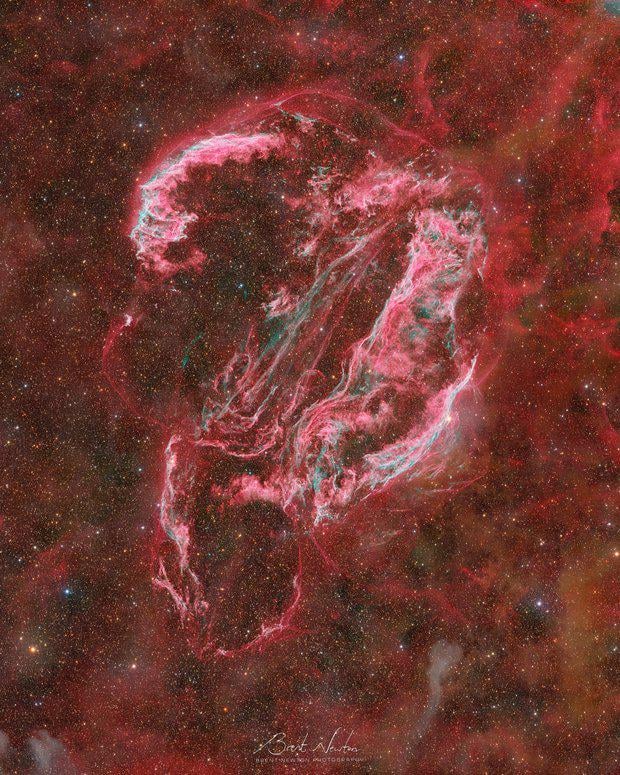
Aight, you all know this target, Summer fan favorite, but one which, as with many emission regions around the sky, is primarily slapped with a ton of Ha/Oiii for nights on end followed by an hour of RGB spammed at the end for proper star colors. Most of the big integrations on Astrobin follow this strategy, too. Not really my thing, no offense. I’m a big fan of True Color, in so much that it can be accomplished when using both monochrome sensors and narrowband imaging. I want that sweet dim broadband cloudiness so I dumped a considerable amount of time into the LRGB side of things. I still got a bunch of narrowband too, but mostly because when the Moon is up I’m too lazy to switch targets. This pursuit of True Color also leads me to use an Hβ filter, a sort of rarity in the amateur imaging side of things. A lot of us do that guesstimation where we splash a little of the HA into the Blue channel to simulate the Hβ contribution and call it good. I’ve certainly done that. But I started using the Hβ filter a couple years back because it takes the guesswork out of it. And because SII is stupid. If you theorize that Hβ basically looks like HA but with worse SNR, you’re right, but that’s really all I need it to do.
Anyway, I spent over 3 months of nights getting this one from September through Christmas. As it got further West my nights got less productive. I was getting a handful of subs each night by the end of it, but altogether it was ~350 hours in capture, culled down to 326.5 for the final stack (which itself is a 2-panel mosaic).
If you want to see comparative shots, the Astrobin page has the “NBRGB” (RGB + Narrowband), regular LRGB, and starless versions of each. Plus an HOO mix and colorized narrowband shots for comparison. Plus a full description of my workflow. Mosaics are always tricky when it comes to ensuring the panels are totally gradient-free and getting down to the true background, especially in RGB, was tedious. I also had a little dust spec on the camera from recent desiccant treatment and that unfortunately imparted a diffraction spike on everything bright, so it took a lot of delicate CloneStamp treatment to slowly erode that out. And third, the narrowband signal was overpowering on the broadband dust, so ensuring the orange-brown areas on the right “survived” the narrowband combination took some careful masking (which is also why the LRGB version if also included on the AB page).

2 Comments
Aight, you all know this target, Summer fan favorite, but one which, as with many emission regions around the sky, is primarily slapped with a ton of Ha/Oiii for nights on end followed by an hour of RGB spammed at the end for proper star colors. Most of the big integrations on Astrobin follow this strategy, too. Not really my thing, no offense. I’m a big fan of True Color, in so much that it can be accomplished when using both monochrome sensors and narrowband imaging. I want that sweet dim broadband cloudiness so I dumped a considerable amount of time into the LRGB side of things. I still got a bunch of narrowband too, but mostly because when the Moon is up I’m too lazy to switch targets. This pursuit of True Color also leads me to use an Hβ filter, a sort of rarity in the amateur imaging side of things. A lot of us do that guesstimation where we splash a little of the HA into the Blue channel to simulate the Hβ contribution and call it good. I’ve certainly done that. But I started using the Hβ filter a couple years back because it takes the guesswork out of it. And because SII is stupid. If you theorize that Hβ basically looks like HA but with worse SNR, you’re right, but that’s really all I need it to do.
Anyway, I spent over 3 months of nights getting this one from September through Christmas. As it got further West my nights got less productive. I was getting a handful of subs each night by the end of it, but altogether it was ~350 hours in capture, culled down to 326.5 for the final stack (which itself is a 2-panel mosaic).
If you want to see comparative shots, the Astrobin page has the “NBRGB” (RGB + Narrowband), regular LRGB, and starless versions of each. Plus an HOO mix and colorized narrowband shots for comparison. Plus a full description of my workflow. Mosaics are always tricky when it comes to ensuring the panels are totally gradient-free and getting down to the true background, especially in RGB, was tedious. I also had a little dust spec on the camera from recent desiccant treatment and that unfortunately imparted a diffraction spike on everything bright, so it took a lot of delicate CloneStamp treatment to slowly erode that out. And third, the narrowband signal was overpowering on the broadband dust, so ensuring the orange-brown areas on the right “survived” the narrowband combination took some careful masking (which is also why the LRGB version if also included on the AB page).
**Equipment:**
– TS Optics 86mm Petzval (459mm Focal Length, F/5.4)
– ZWO ASI6200MM-P, Antlia LRGB, HA, Oiii, Baader Hβ
– AstroPhysics Mach2GTO Mount
**Exposures:**
– Lum, Red, Green, Blue: 401, 367, 363, 376 x 300”
– 3nm HA, 3nm OIII, 8.5nm Hβ: 422, 427, 356 x 600”
**Misc Details:**
– Software: N.I.N.A. (capture), PHD2 (guiding), AstroPixelProcessor (Mosaic), PixInsight (Calibration and Post)
– Location: Starfront Observatories, TX, Bortle 1ish
Great work!