
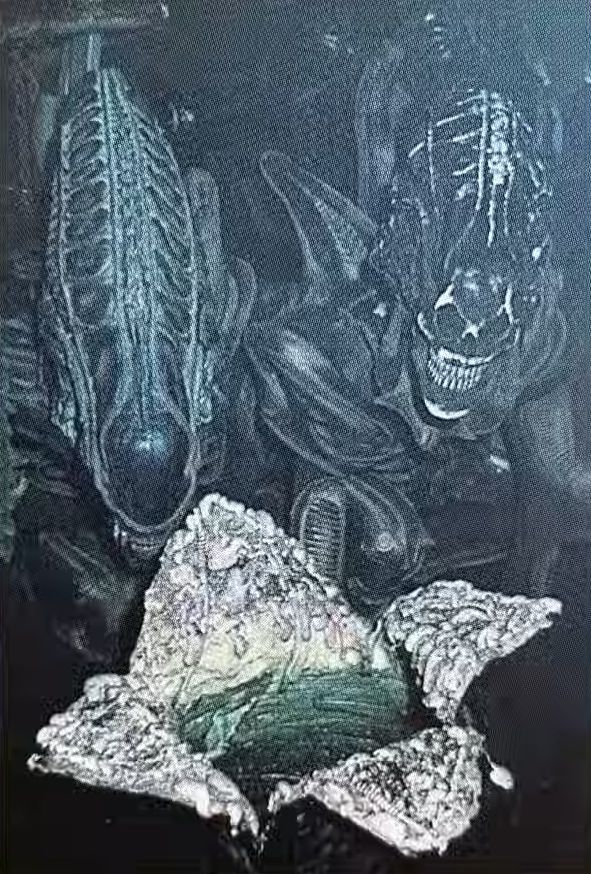
Alien War was a total reality experience that first appeared in the in Glasgow in 1992 before opening at London’s Trocadero Centre in 1993. Led by live Colonial Marines, guests were hunted through pitch-black corridors by Xenomorphs in a mission that felt all too real. The attraction closed there after a flood in August 1996.
We sat down with David Watson, one of the original Colonial Marine performers from the Trocadero era. David shares an incredible ‘behind-the-armour’ look at the attraction—from the frantic auditions at Planet Hollywood and the nerve-wracking opening night with Sigourney Weaver, to the mishaps of fighting aliens in the dark. David appeared on Episode 41 of the AvPGalaxy Podcast. You can watch the interview below and read on for a transcription. Please note that the accompanying transcript has been edited for clarity and brevity.
https://www.avpgalaxy.net/files/podcasts/avpg_pc_episode41.mp3
From Fan to Frontline
Alien War Poster
Aaron Percival: Could you just tell us a little bit about yourself? Who are you and what do you do?
David Watson: Of course. Well, I’m from Clitheroe in Lancashire. I’m a country lad and a science fiction fan. I don’t get much time to indulge in my interests in science fiction these days. Back in the 90s, I was a huge Alien fan, and I think that probably made the whole experience that bit more special because I wasn’t just someone going into that experience as a job. It was a real dream come true for a die-hard fan.
I’m 44 or 45 years old; I forget, as you tend to do as you get older. Now I work as a prop maker and a set designer for children’s television, which again ties very much into my experiences at Alien War. Seeing all that stuff going on around me was fascinating, absolutely fascinating. As Aaron said, it is something that you can find very little information on the internet about. I don’t think there are any real interviews, so to be able to come on and chat about it and indulge myself with a captive audience is a pleasure.
Eric Adams: Do you remember the first time you saw one of the films and which one would you say is your favourite?
David Watson: Basically, I was born in 1971, and like a lot of children, I always loved monsters and anything that could create fear, excitement, and adrenaline. As a young child, I remember with my sisters in a big family, always enjoying sitting up late on a Friday night. There were no videos then, so you were sitting watching old Boris Karloff, old Bela Lugosi, black and white horror films, and then later on the old Hammer Horrors.
I remember being little and, obviously, children are very much driven by heroes. I was very much into my Doctor Who, Tom Baker, Captain Kirk, and Luke Skywalker. I had an active imagination as children do. One Friday night or Saturday night, I remember my mum letting us stay up to watch a film. It was Alien. I didn’t know anything about it at all. She said, “It is called Alien.” This must have been a couple of years after it had been released in the cinema, so it must have been 1980 or 1981.
I sat up watching this film, having previously been treated to these older films. To suddenly get this high-tech world that you were immersed in, that Ridley Scott created with this real dark edge to it, was incredible. As a child who enjoyed horror and science fiction, this was a film that combined both and really knocked the socks off it. I was used to wobbly sets on Blake’s 7 and Doctor Who, but to suddenly see this really impressive world that was real was the magic of film. There was no internet, so the magic of film was that you really did believe in these things, which made them all the more real.
To cut a long story short, as soon as it started, I was just absolutely mesmerised and pulled into this world that was created and loved it. It terrified me, my sisters, and my mum. I think what also appealed to me, which struck a chord in me, was being used to male action heroes and suddenly seeing this twist, which had never really been done before. You expect Dallas to be the guy at the end, battling it out with the Alien, bashing it around the head with a fire extinguisher. Then you see Ripley, this brilliant character portrayed by Sigourney Weaver, who is just absolutely stunning. I was mesmerised by her. It was such a novelty, and it struck a chord in me. That’s how I first saw Alien and loved it.
To expand on that, during this time, home video was coming in, but it was only families that had money that had video players. We didn’t have a video player. I remember my auntie going off on holiday for a few weeks, and she lent us her video player. It was a big thing. “Do you want to borrow our video player while we’re away?” She brought over some tapes to go with it. For the summer holidays of that year, we ended up with my auntie’s video player and about four cassettes, one of them being Alien.
It was such a novelty in those days to be able to put a film in, to be able to pause it, to be able to rewind it, and fast-forward it. My whole family, and probably every family on the street, was invited into our house to watch Alien. We became a little cinema and we all enjoyed it. The whole family liked the film. That was my introduction to Alien.
Several years later, I remember having the radio on and it came over the radio: “Sigourney Weaver is in London at the moment filming a sequel to Alien.” We were all like, “Wow, brilliant!” because we’d all invested ourselves in this film. To hear that they were doing a sequel was really exciting. There is a lot I could say about the second film and the effect it had on me because everyone is in agreement that it is just a brilliant sequel. Some people prefer the first one; some people prefer the second one. I loved Aliens. It surpassed everything I could imagine. As I said, there was no internet, so you couldn’t have a sneak peek on Google and get pictures from behind the scenes. It was down to your own imagination and your anticipation of what it was going to be. Right up to that point, I thought the whole film was going to be set on Earth. I think I’d heard it somewhere in a news snippet that the Aliens are on Earth. So, I was in for a real treat and a real surprise with what James Cameron did with the sequel.
Aaron Percival: You’re not the only one, obviously, who thinks it was better. All of the films have their own charm, but there’s no denying that Aliens had such a massive impact on the franchise going forward. You see that with Alien War. It was all themed around Aliens, wasn’t it?
David Watson: Oh, completely. In fact, the interesting thing is, the guys who set up Alien War, Gary Gillies and John Gorman, I believe, had somehow got access to Pinewood. It was Pinewood where Aliens was filmed, wasn’t it? They’d gone and asked about it. These places, at the end of the day, are just big factories. They’d gone down and expressed an interest, and this guy said to them, “Yeah, it’s all out there. Go and have a look in the skip. Go and have a look in the storage container.” They’d gone and had a look, and all these panels… because they were both fans, which is another great thing about this whole story, they were both fans of the films. They’d gone and been able to secure a container that was full of set pieces and panels and everything from Aliens.
Aaron Percival: I don’t know the full story myself either, but there’s a fellow who was involved in getting it all put together called Harry Harris. He is very well known among the community as a very big collector of screen-used props and costumes. He has a nice accounting of some of the early days of the attraction, getting it all put together and where all the props that were used came from.
David Watson: Yeah, I’ve seen Harry’s site. I’ve never met Harry, but I have conversed with him online a couple of times. It is brilliant that he’s done that. It is a brilliant resource that he’s got going there. It is a great little archive full of really great information and brilliant photographs.
Aaron Percival: Let’s talk a little bit about Alien War now, specifically. Let’s talk about how you got involved. How did you first become aware of it?
David Watson: Well, I was aware of Alien War because I used to get Starburst magazine. That used to be a monthly. I subscribed to that for several years, so they’d always keep me up to date with what was going on. I was aware that there was some sort of planned attraction, and I remember there being one issue where they had some designs and conceptual art as to what was going to be included in Alien War. It was all really exciting. At the time I was in Clitheroe, I was quite heavily involved in amateur dramatics, and I was also working in a factory making windows. We’d have the radio on, but you could barely hear over the sound of all the machinery.
One afternoon, Steve Wright was talking on Radio 2. He liked to keep his audience informed as to what was going on. One of the articles that he came up with was an opening very soon in the Trocadero in London: a new Aliens themed attraction where you get to come face-to-face with the Alien. “At the moment, they are looking for crew. So if you are interested, write to this address.”
I swear to God, I was in this workshop and my ears pricked up as soon as I heard Aliens. All my colleagues that I worked with, who were a great bunch, knew that I liked the films. Everyone kind of switched the machines off as he read the address out. We managed to jot down the address. I think I got the first line and Tom got the second line and we got the postcode. That night I went home and I thought, “Right, I really want to make sure that I write a good letter here.” So I wrote a really short letter and I just put, “Look, I’d love to be involved in any way whatsoever. I’d love to audition. I’ll come down and I’ll spend the week stirring up buckets of Alien slop for the Queen or whatever. I’d just love to be involved. I’m passionate about it.”
Then I got back a letter, which was just a photocopy. I’ve still got it somewhere. It was just a really short, generic letter and it just said, “Hi, thanks for expressing an interest. We will be holding auditions at Planet Hollywood sometime in early October or late September 1993. Please dress appropriately. Remember that you will be applying for the part of a hardened Space Marine, so please make an effort and dress appropriately.”
To get this letter was brilliant. It was a case of getting my head down and trying to prepare for it, which meant really frantically… it was so fast. It’s funny because linking up to this interview, I guess it’s brought back a lot of memories because I’m recollecting stuff that’s 23 years ago. I do remember my uncle at the time was over from Canada. It was me, my mum, my auntie and uncle, and my other uncle. I managed to scratch together, I don’t know how I did it now.
When you look at the resources online today on The Aliens Legacy, it tells you how to make your own fan costumes. But there was nothing of this sort back then. There were no resources. So I remember I really wanted to have a good outfit. I remember getting all sorts of random materials and bits and pieces and putting together almost like a vest, like a tabard-style piece of armour that I think I made out of some of that metallic foam that you get to put behind radiators. Then I sprayed it up and put a little padlock on it and some little clasps. I got some army combats and a hat—a Nostromo hat, which was not accurate. I should have had a Sulaco one, but it was what I had.
I did what I could. I had a little ear set thing. Luckily, I had an old Pulse Rifle, an old Comet Miniatures… they were a firm that I don’t know if they are still going now, but they used to do lots of different model kits, lots of garage kits. I’d splashed out one year and bought this really hideous, really bad… it wasn’t accurate at all. It was an old fibreglass Pulse Rifle. It was a horrible thing. I’ve still got it somewhere. I did that all up and sprayed it up and everything. Anyway, in the end, I had a pretty good kit. I had a pretty good outfit. I cut some old Wellington boots up and made little shin guards and stuff.
I travelled down to London to the Planet Hollywood location along with hundreds of others. There were lots of people there. Interestingly enough, about the Pulse Rifle—you wouldn’t even dream of doing it now, but I went in 1993 and travelled the length and breadth of London with the butt of a resin Pulse Rifle sticking out of a bag. You just wouldn’t even give it a second thought, and my parents didn’t think, “Oh, David, that’s a bit dodgy.” I succeeded. I was able to transport this gun from one side of London to central London to get to this audition.
We were all standing there. There were lots and lots of people there queuing right around the block to get into Planet Hollywood. It was a great atmosphere. Everyone was excited. The majority of people there were fans. I think there were very few people there who just saw it as an acting job. There were a few of them, but they were a good group of people and morale was good. There was a good sense of camaraderie among everybody. People were chatting. “Where have you come from?” “I’ve driven down from wherever,” “I’ve come over from Ireland.” Of course, Planet Hollywood was a great location, high profile and everything.
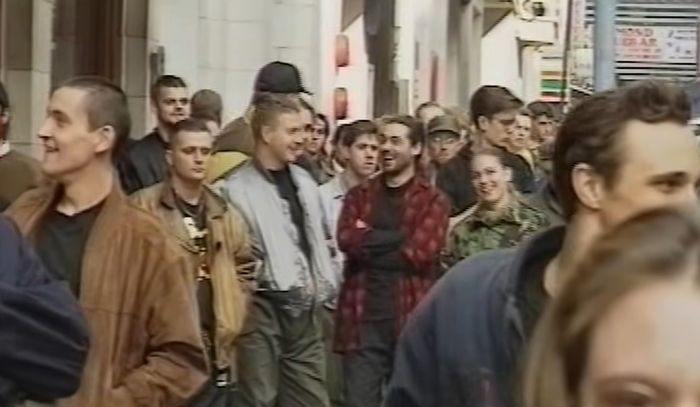
People queuing to audition for Alien War.
The day progressed and we went from standing outside to getting into the foyer and going down into this big area. It was a madhouse. It got quite late in the afternoon. This is how I remember it. It got quite late in the afternoon and it looked like things had got a bit chaotic. There were lots of people everywhere but nothing seemed to be happening. Then I do remember this one guy coming out with a clipboard and he scanned around the room very quickly. By this time, the queue had gone to nothing. There were still lots of people there, but there was no order to it at all.
He’d come out, glanced around the room, and he ushered me over to him and another guy and another guy. He said, “Look, I’m going to be honest with you. We’re running out of time. We never expected so many people to turn up. We’ve run out of scripts, so I have nothing to give you. I’ve been told to come out here and find people that look like they’ve made an effort.” So it turns out that making that effort at home and doing the costume paid off. He thought, “Well, this guy looks like he wants to do this.”
Me and four other lads and girls were taken down to a cinema underneath Planet Hollywood. There was a viewing cinema, like a private area of it. We went down and there was a cameraman there filming it. I’ve never seen that surface, whatever was filmed. I think they were always talking about doing some sort of behind-the-scenes thing. It was very quick. We were ushered in very fast. Gary and John must have been there and it was just like, “Look, we’ve no scripts to give you. We can’t tell you anything what to say. Just improvise. Just imagine that you are a hardened Space Marine, you are a Colonial Marine, and you have a group of people with you that you need to take around the base.”
I stood there and I just thought, “Well, this is my shot.” I don’t have a deep voice. I don’t. But I put on a really deep voice and I put on this terrible American accent. I just went for it. I said, “Welcome to the Weyland-Yutani research facility. In a few moments’ time, you’ll be taken on a tour of the base. Some of these corridors can go on for miles, so you need to make sure you stay together as a group.” I just improvised it. I don’t know what I came out with; I dread to think. That was that. Then we were just told, “Thank you very much for coming, off you go.” Off we went and I went back up to Lancashire and thought, “Well, that was great. Met some great people, had some great fun, great experience. I’ve got a good costume.”
That might have been on the Friday and they’d said to us, “If you don’t hear anything by Wednesday, then you’ve not got anything,” which is fair enough. I remember being at work on Wednesday and dying to get home from work because there were no mobile phones then, it was your landline. I got home from work and there was nothing. But I had a feeling. Sometimes in your life, you have a feeling. I wasn’t too disappointed. I thought, “Right, okay.”
The following night, I was getting ready to go off for rehearsals, as I was quite heavily involved in amateur dramatics at the time. I remember being in the shower afterwards and my mum shouting up to me. She shouted, “David! Alien War is on the phone!” I legged it downstairs with a towel around me. It was a girl called Julia [Lennon] who worked at Alien War that I got to know in time. She said, “David, just phoning to let you know that we really liked your audition and we’d love you to come back down for a second audition this week.” Moments like that in your life are few and far between. It was like floating on air. It was just a brilliant, amazing feeling. It was like, “Wow!”
I was very much a country mouse. I didn’t really know London at all. I went down again for another audition. I didn’t know anything about it. We didn’t receive any kind of instructions as to how to prepare for it. I got down there and the auditions took place in a disused office block above the Trocadero in the tower above it. I’d say there were about 50 people in there. It was a whole day with Gary and John there and their right-hand man. I think Julia was quite instrumental in taking care of the logistics of the auditions.
It was a day of improvising and walk-throughs. It was quite full-on. I don’t really remember too much about it, but I do remember it was good fun and it allowed you to improvise. They gave you a lot of freedom to do a lot of different things. I remember at that point, there were discussions about having not only roles for Marines and Aliens but also roles for scientists as well. That eventually got dropped; it never happened in my time there. But I think there was also some talk of having a couple of character roles as staff at the laboratory at the base.
Eric Adams: I did wonder about that, if that was planned, because when I went for it, I got the feeling that we should be seeing some technicians or something at work. That’s interesting to find out.
David Watson: I think the thoughts with the whole initial speech by the Marine in that first briefing room, I think there were thoughts of having that be done by a laboratory technician or something before all hell breaks loose, and that’s when the Marine bursts in. But that never materialised as far as I’m aware. It was a great day and at the end of the day, it was a long day. They did that whole thing where they stood up at the end and went, “Right, everybody, thank you for coming. We are going to read some names from this list now. If you’d like to stand up and go and stand in that corner there.” They started to read these names from this list and quite a few people got up and went and stood in the corner. Of course, you’re thinking, “Are they in or out?”
Then they said to the people that had stood up—the names that had been called out—they said, “Thank you very much for coming. I’m afraid you’ve not been successful. Thank you very much.” We gave them a round of applause and they all left. Then they turned to us—it must have been Gary and John—and they said, “Welcome to Alien War, everybody. You’re all crew.” Basically, from that first audition where there were several hundred, I believe they’d narrowed it down to 50. I think they had about 40 jobs available, 40 vacancies on the actual crew for Alien War. Everybody was thrilled to pieces. We all said our goodbyes and went off and it was like, “Right, see you next week for rehearsals.”