

Congratulations! You’ve just invented the world’s first teleporter – and with it the ability to transport yourself from one place to any other instantly.
The first thing most people would think of now is how much this is going to shave off the morning commute or a visit to far-flung relatives.
You, however, want to explore the Solar System with it. You want to see all those worlds you’ve only seen in photographs; see what it’s like to try to stand on a gas giant, get up close and personal to an icy moon, experience the massive emptiness between the worlds.
 Credit: Sean Gladwell / Getty Images
You may want to pause a minute, however, as some of these places are not at all hospitable for the unwary traveller.
Don’t worry though, we’re here to help – we’ve put together a list of places you might want to avoid.
Venus
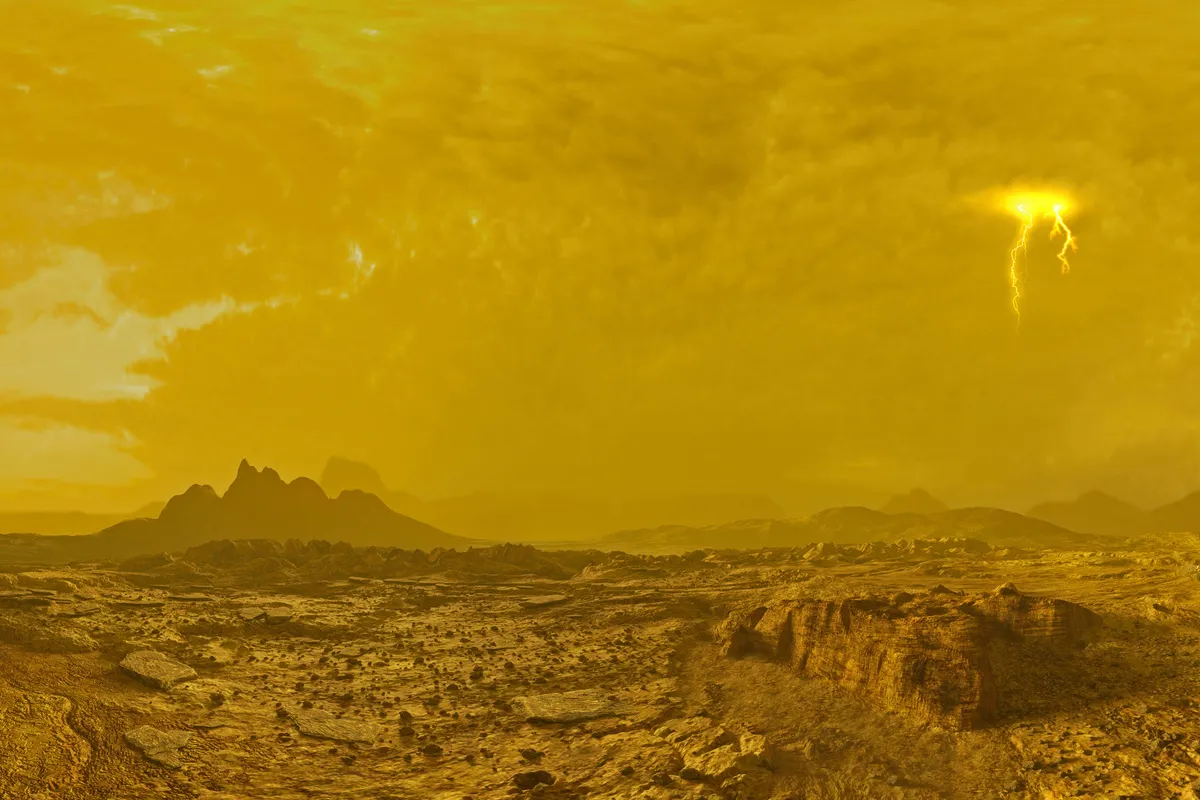 Illustration showing what it’s like on planet Venus. Credit: Mark Garlick / Science Photo Library / Getty Images
While technically not the closest most of the time, Venus is the planet in the Solar System that we get closest to – around 38 million km (24 million miles) at the nearest pass. So, it might feel right to you to pop over for a visit.
Of course, being the first human being to set foot on another planet might feel like a lot of pressure, and if you don’t like pressure, this might not be your ideal destination.
The surface pressure on Venus is 93 bar. That’s the equivalent of over 600kg (1,350lb) resting on every square inch of your body.
It would be like having a small car sitting on your thumbnail.
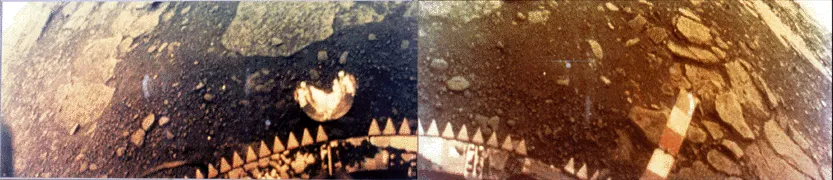 In 1982, the Soviet probe Venera 13 took the first ever colour photos from the surface of Venus. – Soviet Planetary Exploration Program, NSSDC
The longest any human-made object survived on Venus was the Venera 13 probe – it lasted 127 minutes thanks to a hermetically sealed pressure vessel that protected its instruments.
Your instruments, though, are significantly more vulnerable.
You should also pack your shorts, a fan and some water as Venus is hot and dry. Hot enough to melt lead, in fact; and all the water evaporated 70 million years ago.
Let’s try going somewhere else instead.
The rings of Saturn
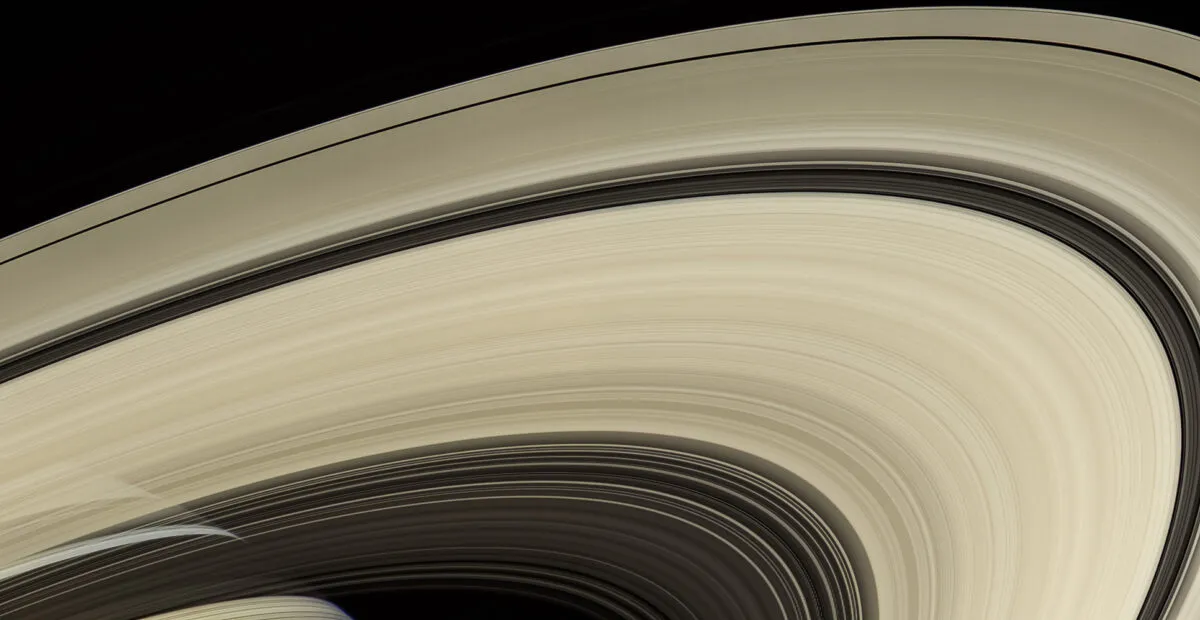 Saturn’s rings may look picturesque, but if you found yourself in them you’d be shredded to bits. Credit: NASA/JPL-Caltech/Space Science Institute
Perhaps the most iconic, Instagrammable destination in the Solar System is Saturn’s rings.
They would surely make a perfect holiday snap that just radiates cool… and, unfortunately, gamma rays. Lots of gamma rays.
This high-energy radiation is created by galactic cosmic rays interacting with the particles making up the rings, and with no atmosphere to absorb them, this place will give you a serious case of radiation sickness… one that you won’t come back from.
You probably won’t have to worry about that, though.
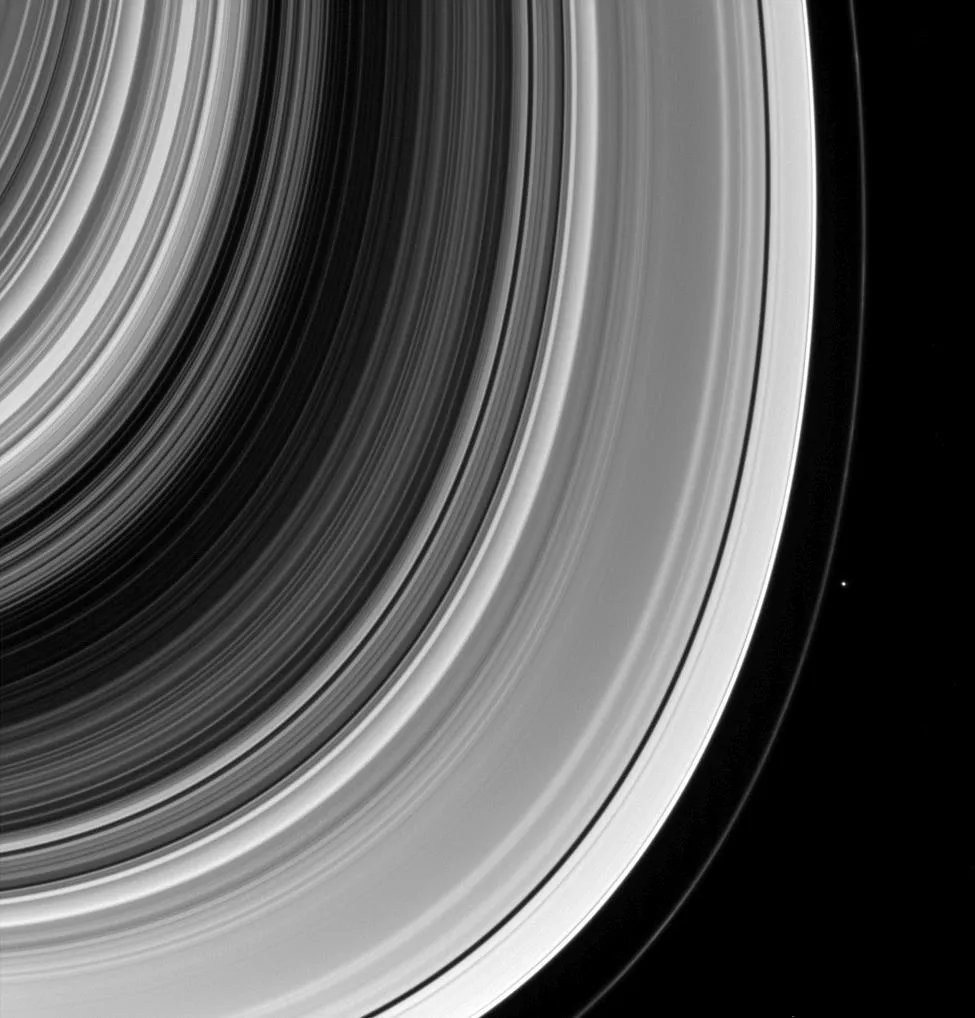 Spectacular view of Saturn’s rings, as seen by the Cassini spacecraft. Credit: NASA/JPL-Caltech/Space Science Institute
The particles that make up Saturn’s rings are ice and rock remnants that can be as small as a grain of sand and as large as a mountain, all travelling at thousands of miles an hour, or sometimes very slowly, but often colliding.
Teleport into the middle of that and you could find yourself being transformed into mincemeat instantly.
Or, more worryingly, very slowly – at the rate of 1cm per second. That’s certainly enough time to regret the trip.
Titan
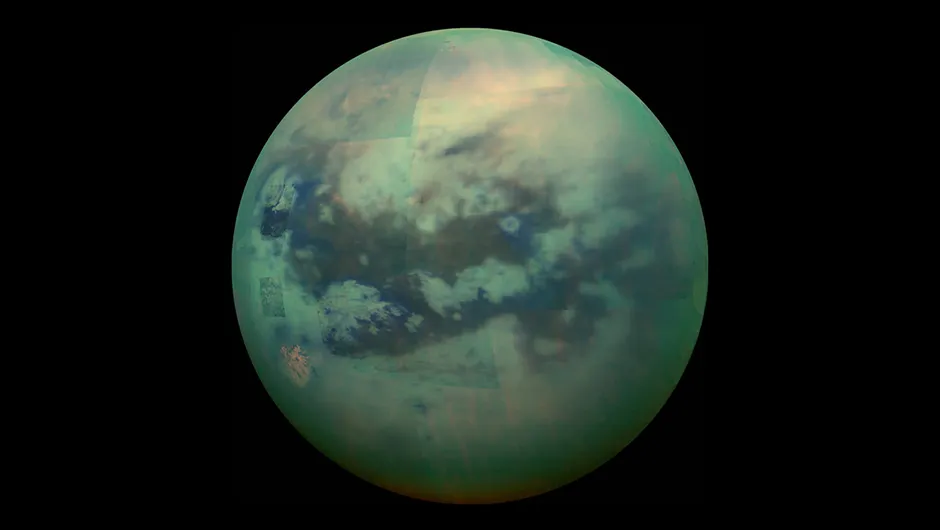 Titan, as seen by the Cassini spacecraft. Credit: NASA/JPL-Caltech/ASI
You may not want to teleport directly into Saturn’s rings, but what about something Saturn adjacent?
We can see why you’d pick its moon Titan, with its enormous lakes, but it’s a far cry from the lakes we have at home.
Firstly, Titan is very cold, –179ºC (–290ºF), meaning all the water is ice.
But that’s okay because its lakes are made up of liquid methane and ethane. However, while they’re not inherently toxic, they are so thin that you’d struggle to have a good swim.
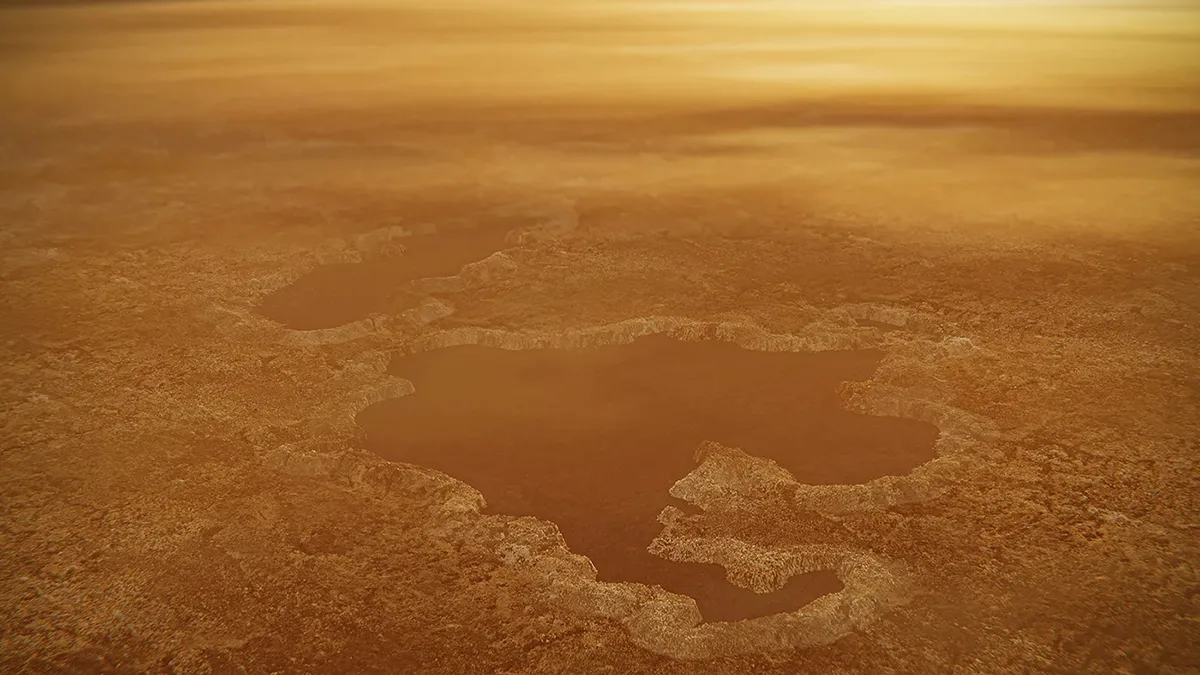 Artist’s concept of a lake at the north pole of Saturn’s moon Titan. Credit: NASA/JPL-Caltech
Did we mention the methane rain? Titan’s thick cloudy atmosphere forms into a smog of chemicals, which, admittedly, falls pleasingly slowly – six times slower than rain on Earth.
Of course, with all that methane you might worry about combustion, but things don’t burn without oxygen.
We forgot to mention, like everywhere on this list, there’s nothing you can breathe.
However, if you do bring some oxygen with you to Titan, you’d probably end up setting fire to everything around you.
Pluto
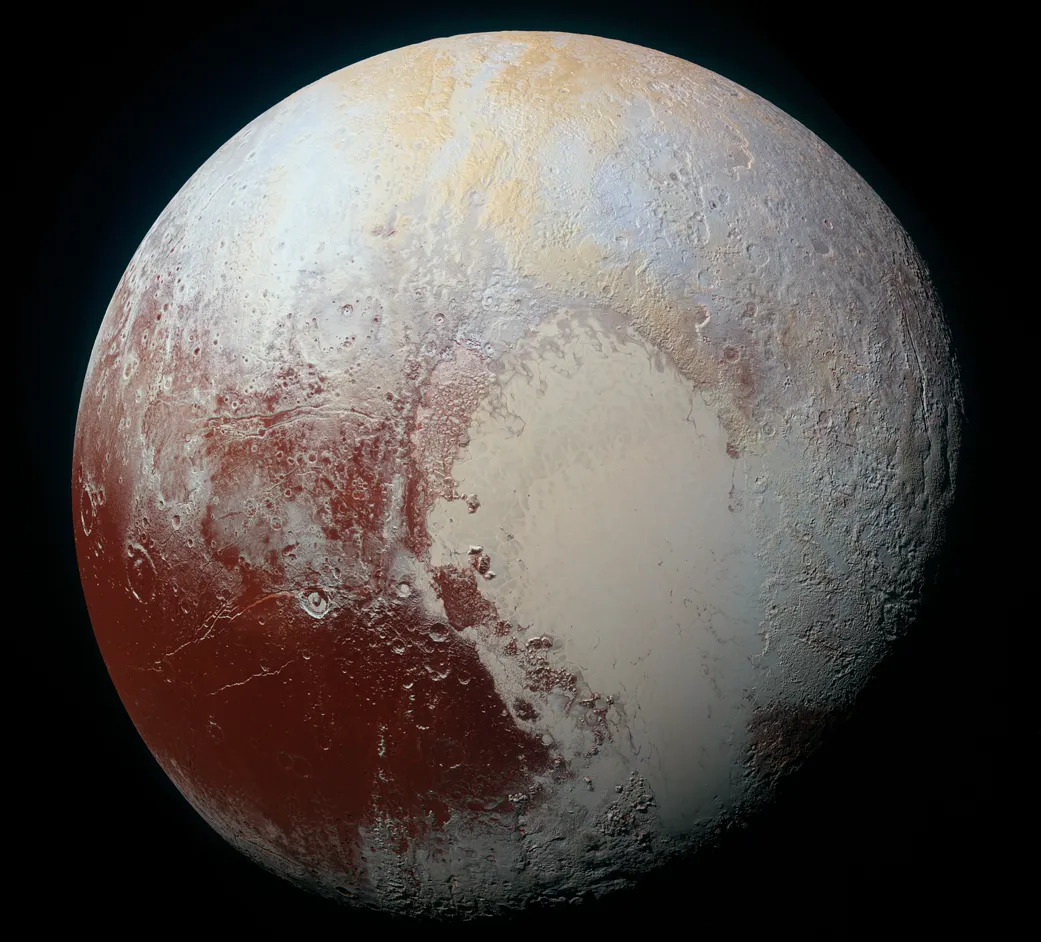 A real image of Pluto captured by NASA’s New Horizons spacecraft. Credit: NASA/JPL – NASA/Johns Hopkins University Applied Physics Laboratory/Southwest Research Institute – https://solarsystem.nasa.gov/resources/855/color-pluto/
Pluto was reclassified as a dwarf planet in 2006 and you’re still upset about it. You want to pay your respects, so it’s on your list as a top teleportation destination.
What should give you pause for thought, however, is the body-shattering temperatures.
It’ll take more than a big winter coat to survive the –232ºC (–385ºF) cold on the surface. Antarctica, the coldest place on Earth, is –92ºC (–130ºF).
As your body, mostly made of water, freezes, the water turns to ice and expands, forming spiky crystals that will shatter your cell membranes. So, remember to wrap up warm.
Neptune
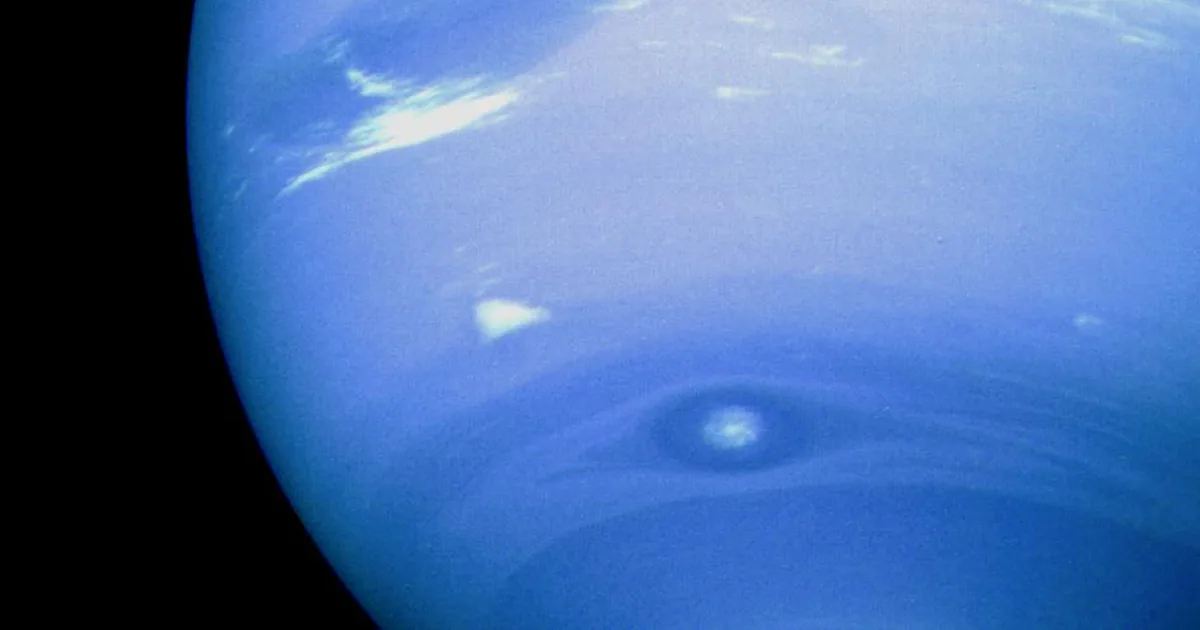 Photograph of Neptune reconstructed from two images taken by Voyager 2. Credit: NASA/JPL-Caltech
The largest ice giant and the densest giant planet in the Solar System, Neptune probably doesn’t feel like a natural spot to visit.
But you want to break a now 33-year-old world windsurfing record of 80.1 km/h (50 mph), which makes this big blue ball in the outer Solar System ideal.
We aren’t sure if Guinness World Records would accept a world record attempt that wasn’t set on Earth, but wind speeds on Neptune hit around 2,000 km/h (1,200 mph).
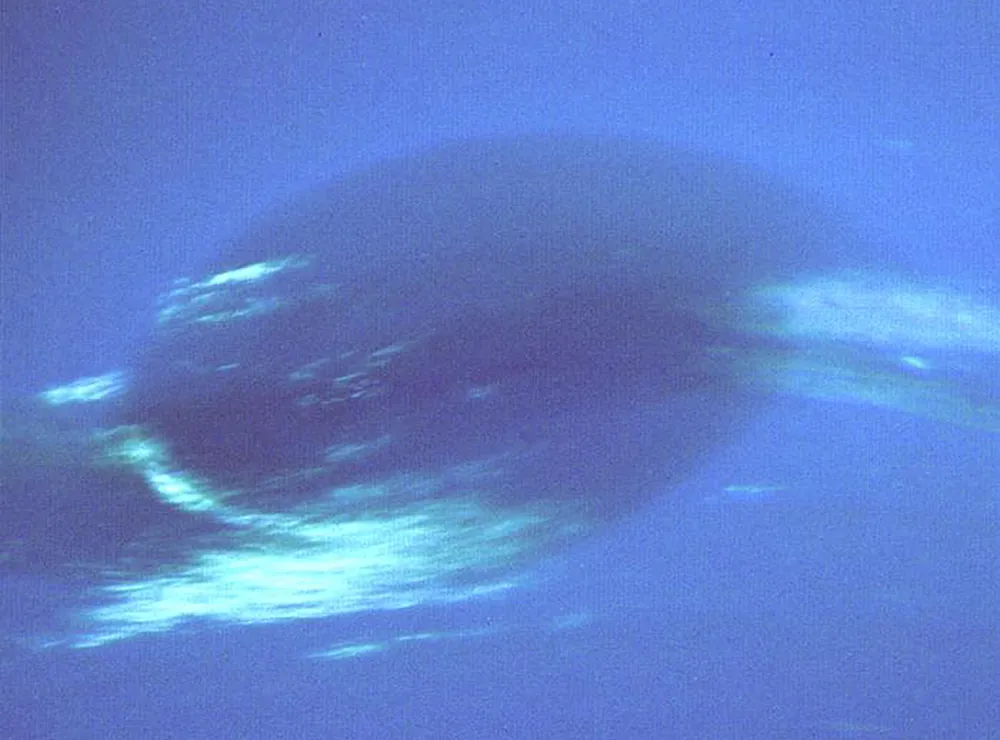 Neptune’s Great Dark Spot as seen by the Voyager 2 spacecraft. Credit: NASA/JPL
Surprisingly, you might survive this; humans have survived nearly half that wind speed with no injuries at all. When it comes to speed, though, it’s the stopping that gets you.
But on Neptune, you may not get to start out at all.
As it has no surface, you’ll just sink into the planet. That is, if you hadn’t already been instantly crushed by an atmosphere with 100,000 times greater pressure than Earth’s.
Jupiter
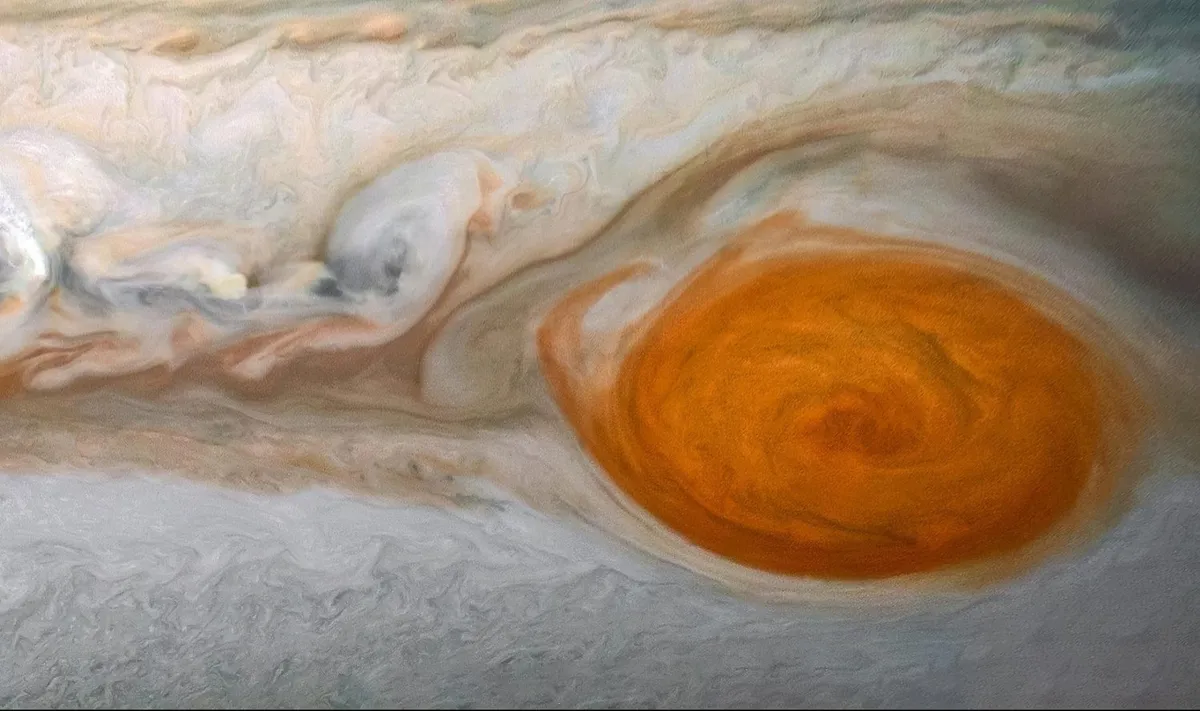 A view of Jupiter’s Great Red Spot captured by the Juno spacecraft and processed by citizen scientist Kevin M Gill. Image data: NASA/JPL-Caltech/SwRI/MSSS
With its Great Red Spot and distinctive bands, Jupiter is one of the most interesting-looking planets in the Solar System.
We can see why you’d want to go. There are good reasons not to, though.
For a start, it smells. Probably, quite badly.
Its atmospheric mix of hydrogen sulfide, hydrocarbons and ammonia is worse than a rotten egg sandwich from a gas station mostly frequented by incontinent stray cats.
But we suppose that’s not going to kill you.
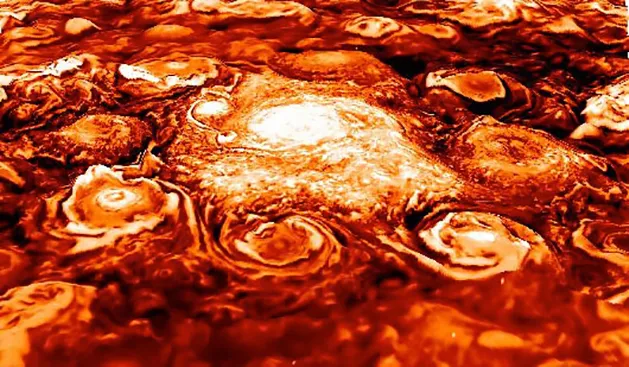 Infrared image of Jupiter’s south pole, as seen by NASA’s Juno spacecraft. Credit: NASA/JPL-Caltech/SwRI/ASI/INAF/JIRAM
What definitely will kill you is that Great Red Spot, a 16,300km- (10,000 mile)-wide, 8km- (5 mile-) high swirling storm of cyclones and anticyclones with wind speeds up to 430 km/h (260 mph) that’ll make you wish you’d stayed home for a relaxing night inside a tumble dryer.
And then there’s the radiation. Jupiter’s magnetosphere traps swathes of charged particles, accelerating them to high enough energy that the radiation sickness you’d get would kill you in a matter of days, if not sooner.
Moon Io
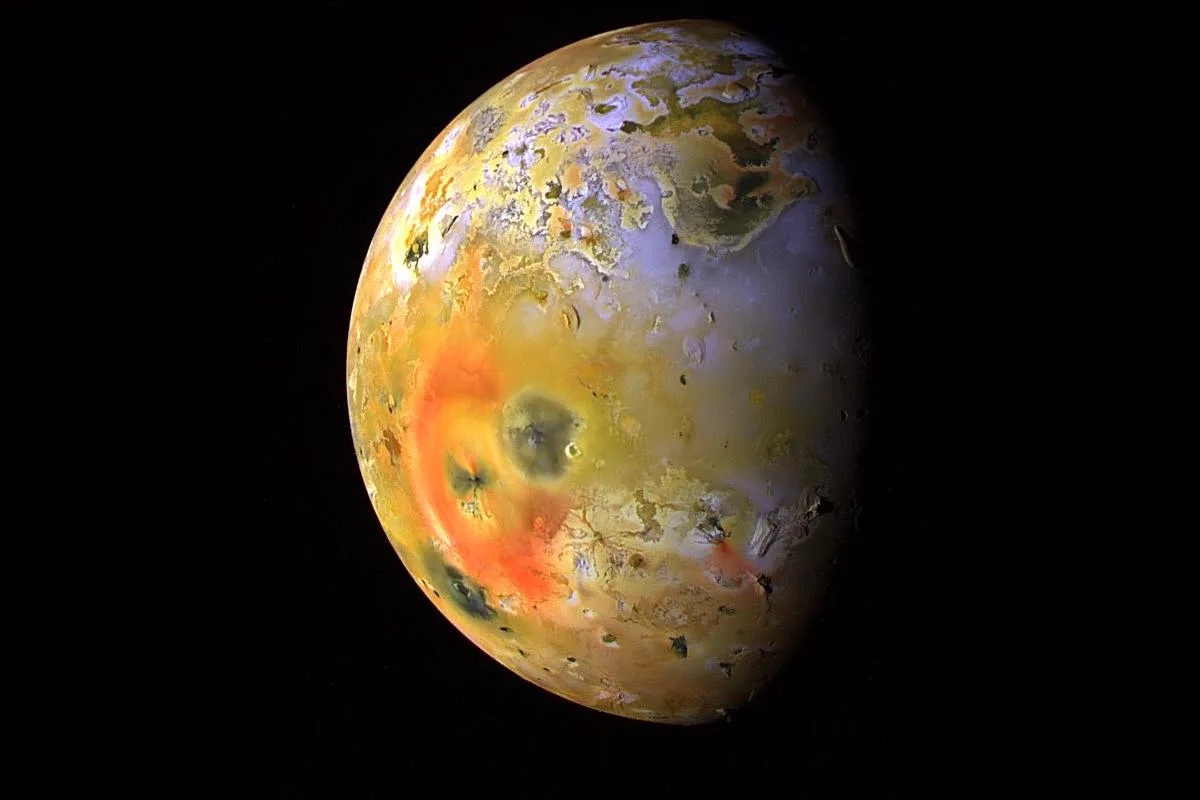 A view of Jupiter’s moon Io captured by the Galileo spacecraft. Credit: NASA/JPL/University of Arizona
While Jupiter might be a no-go, nestled just next to it, well 421,648km (262,000 miles) away, is Io – one of the gas giant’s four moons discovered by the Italian astronomer Galileo Galilei.
As it orbits Jupiter, the magnetosphere of the planet strips about 100kg (1 ton) of material from Io.
While scary in itself, this material then becomes ionized, turning into a donut-shaped cloud of deadly radiation (known as a plasma torus).
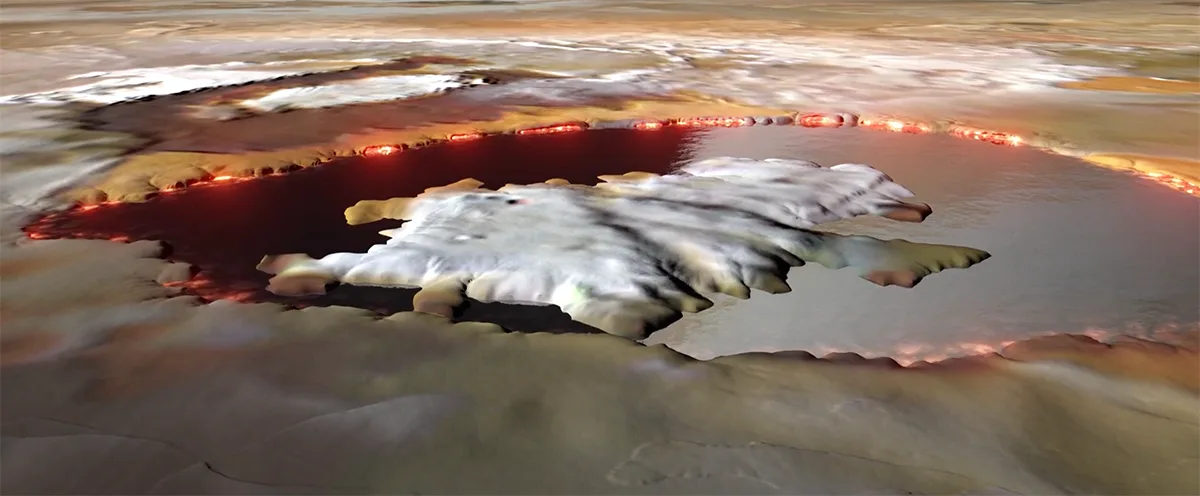 Artist’s concept of Loki Patera, a lava lake on Jupiter’s moon Io, made using data from the JunoCam imager aboard NASA’s Juno spacecraft. Credit: NASA/JPL-Caltech/SwRI/MSSS
We’ve not even got to the surface yet. It is the most volcanically active celestial body in the Solar System, littered with volcanoes, spewing lava dozens of miles into the sky.
The fiery liquid is constantly refreshing the landscape, turning craters into massive lava lakes that probably look cool, but will burn you to death.
It’s the sort of place Darth Vader would live; certainly one to be avoided.
The void
 Credit: Baac3nes / Getty Images
We’ve successfully put you off visiting almost everywhere, but, somewhat passive-aggressively, you’ve come up with a contrary solution: just visiting the void of space.
This way, you can watch everything float by in total safety.
Good thinking – we applaud the effort. But, no.
The baseline temperature in space is –275.45ºC (–460ºF), just a few degrees above absolute zero.
In the same way the ice crystals would destroy your cells on Pluto, that would happen here. Only faster.
If you were to stay a while, prolonged zero gravity would reduce your bone density and muscle mass, and its effect on the fluids in your body could lead to digestive issues, problems with your vision and blood pressure.
Even if you brought a space suit to get around some of those, you might just die of boredom. There’s not a lot to do in a vacuum.
What do you think are the worst places in the Solar System to visit? Let us know by emailing contactus@skyatnightmagazine.com