
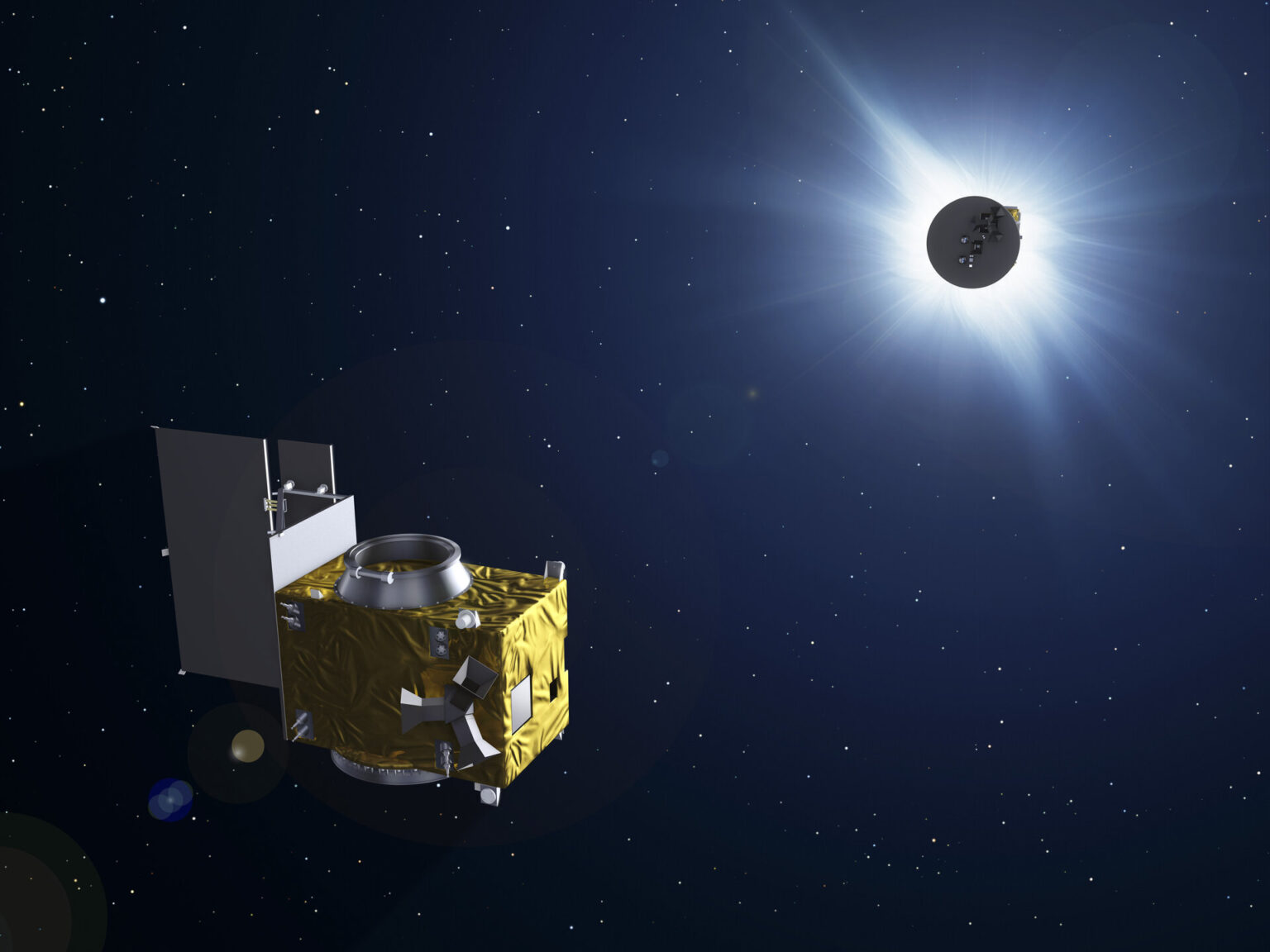
After more than a month of anxious silence, the European Space Agency (ESA) has successfully reestablished communication with the Coronagraph satellite, part of its Proba-3 mission. The satellite’s unexpected return to life comes as a major relief to engineers after a technical anomaly left it drifting in space since mid-February.
“Almost a Miracle,” ESA Says
ESA officials confirmed on 19 March that contact had been restored. The agency’s ground station in Villafranca, Spain, received a data packet from the spacecraft. This signal confirmed that the satellite remains stable and has entered “safe mode,” a self-protective state preserving essential systems.
“Getting a signal from the Coronagraph is terrific news and a huge relief,” said Damien Galano, Proba-3 Mission Manager. ESA Director General Josef Aschbacher added that “something like a miracle happened,” as the satellite’s solar panels gradually began receiving sunlight again after weeks of darkness. This minimal charge allowed the team to re-establish contact and begin recovery operations.
What Happened to Proba-3
Communication with the Coronagraph was lost on 14th February. Then, the spacecraft experienced an “attitude anomaly” — a failure in maintaining orientation. As its solar panels drifted away from the Sun, power levels dropped sharply, forcing the satellite into survival mode. Without communication or energy, the mission faced potential failure.
The renewed signal indicates that the panels are now correctly aligned toward the Sun, once again generating enough power to recharge the batteries. Engineers are performing diagnostics to assess any lasting damage, but early readings suggest the satellite’s core electronics remain operational.
Why It Matters
Proba-3 is ESA’s most ambitious formation-flying mission, consisting of two satellites, the Occulter and the Coronagraph, that orbit just 150 meters apart. The Occulter blocks the Sun’s bright disk to allow the Coronagraph to image the solar corona, the Sun’s outer atmosphere.
This technique creates a permanent, controllable artificial eclipse. It enables continuous observations of coronal structures and solar activity, far beyond what is possible during brief natural eclipses. These data are vital for understanding space weather. This includes solar flares and coronal mass ejections that can disrupt satellites and power grids.
Mission Overview
Proba-3 launched in December 2024 from India. The mission is designed as a two-year demonstration of precision formation flying and next-generation solar observation. The satellites maintain relative positions with an extraordinary 1-millimetre accuracy.
If the Coronagraph fully recovers, scientists hope to resume solar imaging within weeks. This will help to continue capturing hours of high-resolution data each orbit. The mission remains a key step toward future multi-satellite observatories capable of working as coherent systems in space.
Published by Space Enthusiast
An amateur rocket enthusiast with a keen interest in all space-related activity. Looking forward to the day when the UK starts launching rockets into space and I’m able to watch launches (from a safe distance of course).